The winner of the 2024 Stuart Hall Essay Prize is Hashem Abushama, for the essay “a map without guarantees: Stuart Hall and Palestinian geographies”.
The winning essay was the unanimous selection of the judging panel made up of Catherine Hall, Jo Littler and Kennetta Hammond Perry. The judges said: “We found it to be a powerful, politically important and theoretically nuanced piece of work written in lyrical prose. As a ‘theoretical diary’ that combines memoir, ethnography photography and critical analysis, it took us directly to particular places, evoking the author’s personal experience growing up in a Palestinian refugee camp, carefully historicising the layers of colonial and settler colonialisms of this space, and theorising their relationships to different modes of capitalism. We appreciated the utilisation of Stuart Hall’s work alongside that of Doreen Massey and the mobilisation of Hall’s emphasis on the contingency of the conjuncture to indicate the political complexities of this ‘map without guarantees.’ It is a deeply moving piece that elicits an urgent reckoning with ongoing realities of violence of dispossession, but with an eye toward imagining more just futures.”
Reflecting on his experience writing the essay, Hashem Abushama stated: “Stuart Hall insisted that the task of critical theory is to produce a complex knowledge of the world, one that does not console but challenges and transforms. To Hall, knowledge production meant both the commitment to produce rigorous analysis and to refuse to turn dispassionate eyes to the political problems of our moment. Knowledge is about transformation, reparations, freedom, return. Hall made me see Palestine through a different lens: as a place of immense suffering and turmoil, but also of multi-layered and complex iterations of freedom and return. I learned with him that one simply cannot think and write critically about Palestine without centring freedom in its widest sense. It is to see Palestine as a map without guarantees, where settler colonialism is abolished and rehearsals of return cease to be rehearsals.”
The winner of the £2,000 prize was selected from a shortlist of four. The other shortlistees were:
Dee Cattle, “Stuart Hall, the Concept of Ideology and Thatcherism: Theorising with Political Teeth”
Katy Ensch, “Mitigating the Climate Crisis Within Our Current Conjuncture: Crucial Lessons from Stuart Hall”
Rory Weal, “Digging for Coal in the Garden of England: What Stuart Hall and the Kent Miners’ Strike can Teach us about the Place of Class 40 years on”
The judges commented on “Stuart Hall, the Concept of Ideology and Thatcherism” by Dee Cattle that “it was a well-structured essay with clear lines of argumentation related to the political utility of Stuart Hall’s conception of ideology past and present. We appreciated its critical engagement with theory and politics, its ability to contextualise Hall’s contribution to the study of ideology, and its succinct and lucid prose”.
“Mitigating the Climate Crisis Within Our Current Conjuncture” by Katy Ensch is, the judges said, “a timely essay by which engages Stuart Hall’s ideas about capitalism, neoliberalism and the relationship between media and politics to think through how we might grapple with the urgency of climate change. We appreciated its range, scope and pertinence as well as its emphasis on celebrity, spectacle and common sense in its use of Stuart Hall’s work to consider the politics of the climate conjuncture.”
About “Digging for Coal in the Garden of England” by Rory Weal, the judges said: “We appreciated the emphasis on a return to the question of class, its focus on place and specificity. We welcomed its use of original oral histories from Kent to think, with Stuart Hall’s work, about the complexities of class in relation to gender and community, an important dimension of the miners’ strike, and the connections it drew to contemporary politics in Kent and beyond.”
A panel of trustees of the Stuart Hall Foundation was also involved in the judging process, and drew up the shortlist from which the winner was selected. Of the essays that were not shortlisted, the trustees said: “We were encouraged by the range of subjects covered by the submissions in this inaugural year of the Essay Prize, appropriately reflecting the breadth of Stuart Hall’s interests and influence. Entries included thought-provoking pieces on photography, film and journalism, and recent developments in social media and AI. Several authors wove personal experience into their themes, not least around race and identity. It was also heartening to see writers engaging with Hall’s ideas across a variety of academic disciplines.”
The winning essay is available to read on the Stuart Hall Foundation website here.
About the winner

Hashem Abushama is a Departmental Lecturer and Career Development Fellow at St John’s College and the School of Geography and the Environment (SoGE) at the University of Oxford. He is a human geographer with interests in urban studies, cultural studies, critical development studies, and postcolonial geographies. He holds a DPhil in Human Geography from the School of Geography and the Environment and an MSc in Refugee and Forced Migration Studies from the Department of International Development at the University of Oxford, and a BA in Peace and Global Studies from Earlham College in the United States. His PhD dissertation won the runner up for the Leigh Douglas Memorial Award for the Best Dissertation in British Middle East Studies. His forthcoming monograph looks at settler colonialism, capitalism, dispossession, and arts in contemporary Palestine. His writings have appeared in Refuge: Canada’s Journal on Refugees, the Jerusalem Quarterly, Jadaliyya, and Palestine Square.
About the judges

Left to right: Catherine Hall, Jo Littler, Kennetta Hammond Perry
Catherine Hall is Emerita Professor of History and Chair of the Centre of the Study of the Legacies of British Slavery at UCL. Her books include Civilising Subjects (2002) Macaulay and Son (2012), with others, Legacies of British Slave-ownership (2014) and Lucky Valley: Edward Long and the history of racial capitalism (2024).
Jo Littler is Professor of Culture, Media and Social Analysis at Goldsmiths, University of London. Her books include Left Feminisms (2023); with The Care Collective, The Care Manifesto (2020); Against Meritocracy (2018); Radical Consumption (2008);and, with Roshi Naidoo, The Politics of Heritage (2005).
Kennetta Hammond Perry is an associate professor in history at Northwestern University. Her research examines Black diasporic communities and political formations shaped by and within the imperial borderings of Britain. Her publications include London Is The Place For Me: Black Britons, Citizenship and the Politics of Race (2016).
The Stuart Hall Essay Prize is a new project of the Stuart Hall Foundation, funded by a private donation. Read more about the project here.
Related
8th April 2026 / Article
Choosing a Nation: Identity, Belonging, and Representation in International Sport
By: Harriet Hillier
26th June 2025
Stuart Hall Essay Prize reopens to submissions
The second Stuart Hall Essay Prize is reopening to submissions. The new submission window is open from now until Monday 3 November. Open to...
26th March 2024 / Article
a map without guarantees: Stuart Hall and Palestinian geographies
By: Hashem Abushama
26th March 2024 / Article
a map without guarantees: Stuart Hall and Palestinian geographies
By: Hashem Abushama
I write a theoretical diary, informed by Stuart Hall’s writings.
26th March 2024 / Article
a map without guarantees: Stuart Hall and Palestinian geographies
By: Hashem Abushama
The Stuart Hall Essay Prize
The Stuart Hall Essay Prize was launched in August 2023, inviting new and unpublished writing that connected with Stuart Hall’s ideas and impacted broad public discourse. The prize was intended for a selected writer whose essay engaged with and offered originality and value to a field of debate with which Hall engaged throughout his life, and contributed to a radical critique of contemporary society.
At the 7th Annual Stuart Hall Public Conversation in March 2024, the inaugural Stuart Hall Essay Prize was awarded to Hashem Abushama for the essay “a map without guarantees: Stuart Hall and Palestinian geographies”. The judging panel, composed of Catherine Hall, Jo Littler and Kennetta Hammond Perry, described the essay as “a powerful, politically important and theoretically nuanced piece of work written in lyrical prose… that elicits an urgent reckoning with ongoing realities of violence of dispossession, but with an eye toward imagining more just futures.”
Hashem Abushama’s prize-winning essay is published in full below. The author would like to thank Haya Zaatry for her indispensable help with this essay, particularly for her design of the countermaps.
a map without guarantees: Stuart Hall and Palestinian geographies
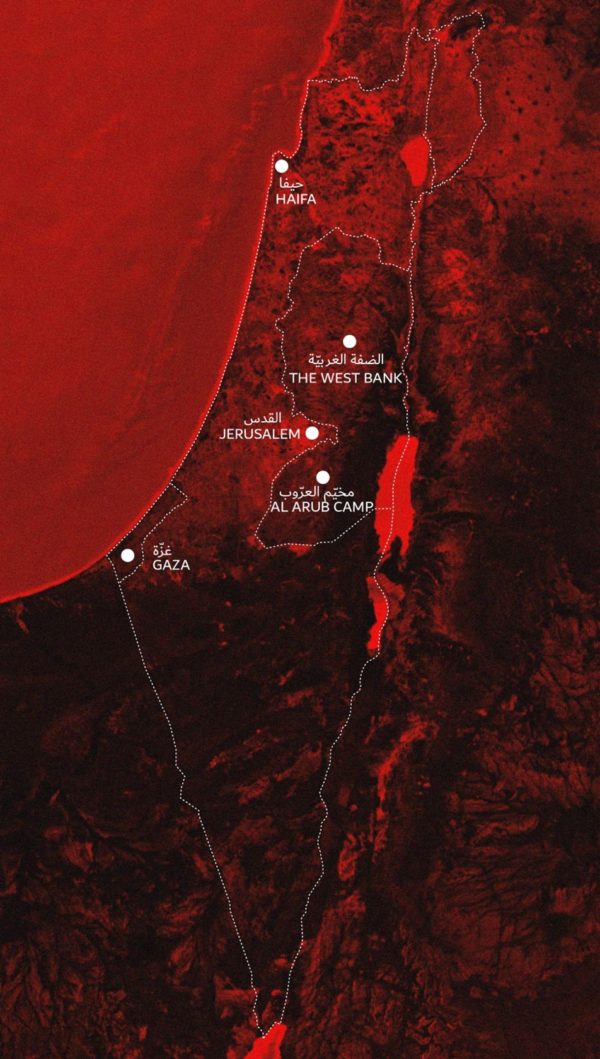
I could not locate the entrance of al ‘Arub refugee camp, where I grew up. The settlement was to my right. Driving on the main carriageway, shared between the Israeli settlers and Palestinians, I expected to get to the camp’s entrance without any turns. This was the map I had known. To my surprise, the carriageway took an elevation as if one was suddenly driving towards the sky. It then cut into the hill to the south of the camp. There was a new right turn marked by a red sign in Arabic and Hebrew, clearly declaring this territory as Palestinian and warning Israeli settlers against entering it. After a roundabout, I got to the camp’s entrance where an Israeli checkpoint was in place. My house is the first in the camp, so near the checkpoint that I eavesdrop to the soldiers’ conversations and music.
This is the 60-Route, a 146-mile running from al Nasira (Nazareth) in northern historic Palestine (today’s Israel) all the way to Beer Saba’ (what Israel calls Beersheba) to the south. The road stretches from the north to the south because of historic/continuous dispossession, restricting the Palestinians’ right to movement. Changing the fabric of life around al ‘Arub is part of a wider Israeli project that aims to better connect Tel Aviv and Jerusalem to Jerusalem’s surrounding settlements and to the settlements in southern West Bank. The project unfolds in a particular historical conjuncture defined by intensified privatization of the Israeli economy since 1985 (see Hanieh 2003; 2013), the introduction of the self-ruling Palestinian Authority in 1993 (see Rabie 2021), and the fragmentation of Palestinian geography and polity (Salamanca et al 2012).
Despite the increasing reliance on capital to exact the control, management, and elimination of the Palestinian population, colonial relations remain the most constitutive. While in this conjuncture the dispossession of the Palestinians may take forms that directly exploit or contradict the capitalist relations, the unfolding of such relations happens against the backdrop of what Glen Coulthard (2014, 15) calls the “inherited background field” of colonial relations. This already begs the question of how we understand the frictions and mediations between the different levels of a social formation: between a privatising market and a settler colonial road, a Zionist ideology and a settler colonial state, a consumerist subjectivity and an arts organization.
I came of age at a time when taking loans, purchasing private cars, and aspiring to move to ‘the city’ (i.e., Ramallah) were becoming a norm in the West Bank (see Harker 2020). This is capital making a larger claim on defining the horizon of possibilities for the colonized Palestinian subjects. This is capital unfolding alongside patterned axes of difference: what capital makes available to you is eclipsed by structured patterns informed by gender, race, class, and nationality. If capital is increasingly playing a primary role in Palestine and across the world, how do we make sense of its relations to settler colonialism and its mediation through those axes of difference? This is the question that brought me to Stuart Hall and his writings.
Settler colonialism is a complex set of relations, practices, and processes that get condensed into durable yet historically contingent institutions, eliminatory spaces, and ideologies. It seeks to implant a settler way of life in place of the indigenous. As Wolfe (2006, 387) argues, settler colonies are “premised on displacing indigenes from (or replacing them on) the land.” They do so through positive (e.g., recognition and assimilation) and negative (e.g., genocide and disenfranchisement) mechanisms. Writing on settler colonialism, Coulthard (2014) shows how, in its economic reductionism and developmentalism, orthodox Marxism fails to consider the constitutive and continuous role of dispossession, particularly in settler colonial contexts. This contradicts Marx’s idea of ‘primitive accumulation,’ which relegates violence to a bygone historical moment (see Levien 2015). Given the continuous use of brute violence by settler colonial states to dispossess the indigenous, including Israel’s latest genocide in Gaza and the United States’ attempt to dispossess indigenous communities in Standing Rock (see Estes 2019), there arises the political and conceptual necessity to understand dispossession as contemporarily constitutive.
Starting with space gives us a generative entry point into the ‘concrete historical work’ that settler colonialism achieves in each spatio-historical conjuncture: “as a set of economic, political, and ideological practices, of a distinctive kind, concretely articulated with other practices in a social formation” (Hall 2021, 236). Doreen Massey (2000, 225), citing a regular lift to work with Stuart Hall, proposes we understand space as produced by interrelations. Space is not fixed. “You are not just travelling across space; you are altering it a little, moving it on, producing it. The relations that constitute it are being reproduced in an always slightly altered form” (Massey 2000, 226).
The settler road is concrete, a material and spatial manifestation made possible through practices (stealing the land from the indigenous, building the road, and surveilling it with military watch towers), institutions (the military and supreme courts, municipality, and corporates), and processes (e.g., capitalism and colonialism). The settler state and the corporates get to decide how and where the road passes through. But that does not mean they are the only ones producing that space; such a view, Massey (1994, 40) suggests, ‘deadens space.’ I, a subject of military occupation and an afterlife of refugees displaced in 1948, produce the road as a space by passing on and living alongside it.
If space is made up of multiple intersecting relations, then there is a multiplicity in this production which unfolds within an open system and on an unequal terrain. The result is neither total incorporation of the native Palestinians into settler colonial spaces, nor a total reclaiming of space. It is a “continuous and necessarily uneven and unequal struggle” (Hall 2021, 354). This is a map without guarantees[1], one that sees processes and things as constituted by relations; relations as historically contingent and particular; and relations as prone to rupture and transformation. This is a map without guarantees, where settler colonialism may, one day, cease to exist.
In this essay, I write a theoretical diary, informed by Stuart Hall’s writings, that traverses the refugee camp, the village, and the city. It is part of a wider project that animates Stuart Hall’s thought by examining its remits and limits when thinking about settler colonialism across historic Palestine. In particular, I use Stuart Hall’s insistence on ‘conjunctural analysis’ to demonstrate how 1) there exists multiple Palestinian geographies; 2) how such geographies stand in relations of domination and subordination vis-à-vis one another and the Israeli state; and 3) how such geographies remain prone to rupture and transformation. I use countermaps designed for the essay by Palestinian architect and musician Haya Zaatry as well as photographs I have taken of the different geographies. I use ’48 territories to refer to Palestinian territories that had been occupied in 1948, ’67 territories to refer to the lands occupied in 1967, and ‘historic Palestine’ to refer to the entire land, engulfing both the ’48 and ’67 territories. This is not only consistent with how Palestinian communities, scholars, and activists name these territories, but also integral to any attempt to understand the continuous yet differentiated logics of dispossession across historic Palestine.
1. The camp
“In recounting the story of someone born out of place, displaced from the dominant currents of history, nothing can be taken for granted. Not least the telling of a life.” (Stuart Hall 2017, 95)
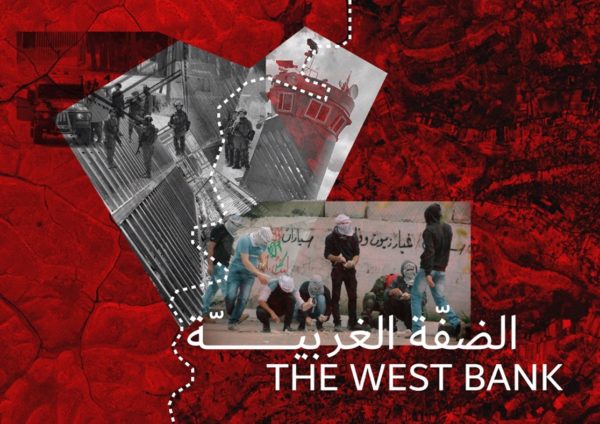
Nothing can be taken for granted. Is not the space of the refugee camp in and of itself a spatialization of a political demand? It is a space of waiting for an eventual return. And in that space of waiting lies the everyday politics—what Hall termed the “social transactions of everyday colonial life” (Hall 2017, 93). Nothing can be taken for granted when the street you live on is named after a village you have always imagined but never visited. When the entrance to the camp is controlled by checkpoints meticulously designed as life valves. When the Gush Etzion settlements lie at the hilltop, vividly lit up and ferociously surrounded by barbed wires, surveillance cameras, and watch towers. Palestinian novelist, Hussein Barghouthi (2022), once described the settlement as “if hanging from space, perhaps because of the lighting too, without touching the ground, or history, yet.”[2] This is the ‘colonial sector’ as Fanon (2004, 4), writing on colonial Algeria, once dubbed it: “it is a sector of lights and paved roads, where the trash cans constantly overflow with strange and wonderful garbage, undreamed-of leftovers.”
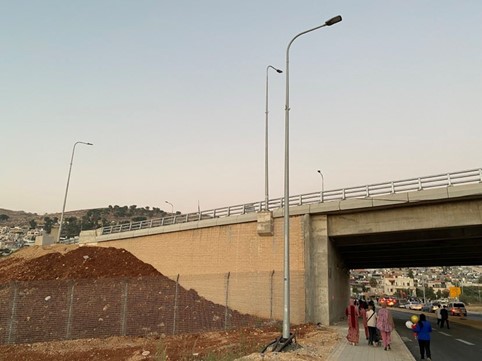
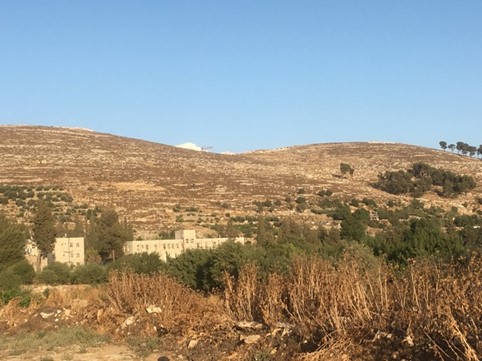
Al ‘Arub is a refugee camp in northern Hebron in the West Bank. It houses ten thousand Palestinian refugees mostly displaced from villages nearing Gaza and Hebron after the establishment of Israel in 1948. The camp is surrounded by settlements—Gush Etzion to the north, Karmei Tzur to the south, and another, recent settler outpost to the north. To its north and northwest, the camp is fully engulfed by the 60-Route (see Figure 3), a highway built by Israel and shared—though with differentiated access—between Palestinians and the Israeli settlers. The most recent settler outpost was imposed atop a historic hospital (see Figure 4) built under Jordanian rule in the 1950s. In 2015, settlers moved into the building, kicking out the Palestinian family guarding it. They have since turned it into a wedding hall that was officially conjoined with the Gush Etzion Municipality in 2016. Stealing this building meant the gradual seizure of the land surrounding it. The road, cutting nearby the hospital before ascending towards the southern hill, continues this erasure; its completion was contingent on the seizure of Palestinian lands. Roads, as Salamanca (2020) argues, are part of a wider project of dispossession that serves the long-term domination of the settlers.
The colonial relations serve as the inherited background field within which capitalist, patriarchal, and racist relations converge to create, sustain, and perpetuate a settler way of life. But these relations as well as their convergence are historically contingent. This is the ‘historical premise’ that Hall (2021, 217) always insisted on: the forms of historical relations and their convergence with one another cannot be schematized a priori, for they are historically and geographically specific. “And, that this, in turn, requires attention to class-race (and other) articulations forged through situated practices in the multiple arenas of daily life” (Hart 2002, 31). So, what is the historical context in which dispossession takes place around a refugee camp in the West Bank in the current moment?
The current historical conjuncture in the West Bank is defined by a particular articulation (i.e., linking) between colonial and capitalist modes of accumulation, crosscut by gender, race, and class. In 1985, the Israeli state issued the Economic Stabilization Plan (ESP), which effectively neoliberalized the Israeli economy. The plan meant more intensified privatization of publicly-owned lands and companies, and further plugging of the Israeli economy into global circuits of capital (see Sa’di-Ibraheem 2021; Karkabi 2018). In 1993, the Oslo Accords were signed between the Palestinian Liberation Organization and the Israeli state, officially establishing the Palestinian Authority as a self-ruling government in the West Bank and the Gaza Strip. The Accords were followed with the Protocol on Economic Relations (also called the Paris Protocol) in 1994, which integrated the Palestinian economy into Israel’s through a ‘customs union.’ Not only are the entry and exit ports controlled by the settler state, but also the inflow of international aid and the entire land of the West Bank (even when it is juridically categorized as areas A, B, and C with different levels of Israeli control). Both the Accords and the Protocol were supposed to be temporary until the final negotiations. However, they remain in effect until today.
Through those agreements, the Palestinian economy is locked in a relation of dependency. Adam Hanieh (2003, 18) argues that the Oslo Accords have aimed to outsource the costs of the military occupation to international aid and cantonize Palestinian geography. Writing on housing and the reconfiguration of Palestinian space in the post-Oslo conjuncture, Rabie’ (2021) argues that the accords became a way of managing and sustaining the inequality between the Israeli and Palestinian economies. The neoliberalization of the Israeli economy and the Oslo Accords set in motion a new coupling of capital and colonial relations, whereby the former comes to play a more direct role in dispossession. That coupling is mediated through multiple levels of determination: it triggers changes in the political, cultural, economic, and social spheres.
This brief mapping of the set of economic, political, and social relations that define the post-Oslo conjuncture already points to economic systems that stand within relations of domination and subordination. Writing on South Africa, Hall (2021, 229) proposes that the inequalities between different economies imply the existence of multiple forms of political representation. In the post-Oslo conjuncture, there exists a hierarchy of representation that reaches the entire map of historic Palestine. Palestinians living within the ’48 territories (such as Haifa) are positioned as citizens of the Israeli state. In contrast, Palestinians living within the ’67 territories are subjects of martial and administrative law. Israeli civil law too, as Rabie’ (2021) argues, is weaponized to entrench colonial hierarchies and domination. While the Palestinian Authority was meant to operate across the West Bank and the Gaza Strip, a political split occurred between Fatah (a secular, nationalist party) and Hamas (an Islamist party) after the 2006 Palestinian Legislative Council elections. Though internationally monitored, the elections’ results were rejected by the European Union, Israel, and the United States. While Hamas came to control the Gaza Strip, the Palestinian Authority (ruled by Fatah) came to control the West Bank.
The international delegitimization of Palestinian electoral politics meant more entrenched neoliberalization of the Palestinian economy. Neoliberalism aims to lower the barriers of trade and smoothen out the pathways for capital circulation while entrenching political, economic, and social inequalities. It is a general global phenomenon, but it actually exists as a historically determined phenomenon. Writing on post-Apartheid moment in South Africa, Hart (2002, 33) notes how the African National Congress led by Thabo Mbeki tried to balance the advancing of neoliberal agenda with liberation symbols and ideas. The Palestinian Authority embodies a similar conundrum. It mobilises a history of armed resistance to advance a neoliberal agenda that further entrenches colonial hierarchies. Such agenda have nurtured a Palestinian capitalist class, a Palestinian capitalism that exploits, rather than resists, the contradictions of the colonial reality. The Palestinian Authority led by Mahmoud Abbas, the head of the Palestinian Authority since 2005, has witnessed a noticeable harmonization between the Authority’s structures and the Israeli settler colonial state. In effect, this has meant close security coordination with the settler state, economic cooperation that selectively benefits a Palestinian bourgeoisie while impoverishing the rest, and intensified suppression of dissent.
Fanon (2004, 24) notes that compromise is the nationalist bourgeoisie’s attempt to reassure themselves and the colonists not to jeopardize everything. As Glen Coulthard (2014) notes, settler colonies revert to a ‘colonial politics of recognition,’ which aims to incorporate, and therefore annul, indigenous demands for self-determination through legal circuits that only serve the long-term dominance of the settlers. The result of this compromise in the West Bank has meant a hollowing of Palestinian institutional politics, a professionalization of grassroots politics through NGOization (see Hamammi 1995), and a proliferation of consumerist and indebted subjects enduring a military occupation while being tied by loans. This is the impossible promise of Oslo: to consume and dream of a better life within the structural constraints of a settler colonialism insistent on eliminating you from the land.
The camp in the West Bank is a constant reminder that dispossession remains active and constitutive across Palestine. That the settlement has eaten up the fabric around the refugee camp is an eloquent reminder that dispossession did not stop in 1948. But that does not mean dispossession has unfolded since then unabatedly, in the same shape and manner. The neoliberalization of the Israeli economy, followed by the Oslo Accords, demonstrates how capital and dispossession “adapt themselves to the contemporary imperatives of colonial domination” (Bhandar 2018, 14), ushering in new mechanisms of control, management, and erasure. In the post-Oslo conjuncture, dispossession continues but through new mechanisms, delivering a ‘transformed settler colonialism.’[3] Given their contingency, such mechanisms may be transformed, subverted, resisted, worked upon, or overthrown.
2. The village
“It’s difficult, too, to work through the question of how these pasts inhabit the historical present. Via many disjunctures—filaments which are broken, mediated, subterranean, unconscious—the dislocated presence of this history militates against our understanding of our own historical moment” (Hall 2017, 71).
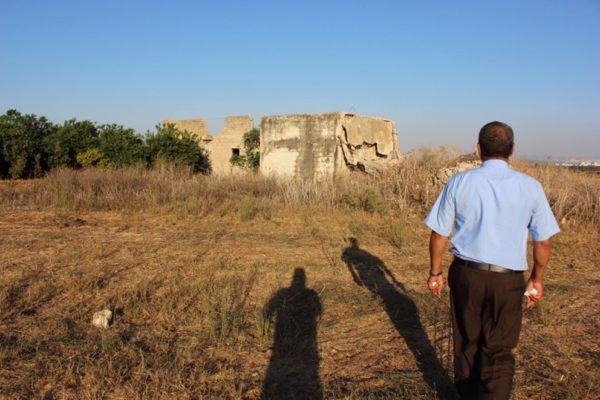
The Israeli state was established through an event of dispossession that turned more than 750,000 Palestinians into refugees. At that time, the newly established state organized committees, institutions, and processes to turn such an event into a sustainable juridical, political, cultural, and economic formation (see Robinson 2013). It also relied on Zionist institutions and agencies established prior to 1948, including the Histadrut (the General Organization of Workers in Israel; see Zureik 1979). Between 1948 and 1953 in particular, the state experimented with multiple ad hoc processes to institutionalize the theft of Palestinian land and property. The efforts culminated in the establishment of the Custodian of Absentee Property, a governmental agency responsible for handling stolen buildings and lands. That period also witnessed the establishment of Amidar National Housing Company in 1949 and the Development Authority in 1951.
Using Stuart Hall’s (2021, 232) register, the bringing together of practices of dispossession into sustainable juridical institutions constitutes an act of “connotative condensation.” Settler colonialism is constituted by processes and practices that become linked in ways particular to each historical conjuncture. In the first two decades following the establishment of the settler state, it played a major role in organizing the shape and form of these processes and practices as well as the linkings (articulations) between them to maintain a system of domination that favours the long-term development of the settler.
In 2018, my family and I enacted a rehearsal of return. Three generations (my grandmother, my father, and I) went through an Israeli checkpoint near Bethlehem. The fragmentation of Palestinian geographies means restrictions on the right to movement for Palestinians, so that the 60-Route, for example, is lived through different maps: one for settlers, and another for Palestinians. We arrived to al Safiriyya, which was once a Palestinian village ten kilometres to the east of Yafa (Jaffa). My grandparents owned a bakery here. And that bakery was demolished in 1937 by the British colonial forces as a punitive measure against the family’s participation in the Palestinian Great Revolt of 1936-39. When looking through Palestinian newspapers predating 1948, I found a call from the people of al Safiriyya in al Difa’ Newspaper, denouncing the demolition of Abdulmosen Abushama’s (my grandfather) house and bakery. If memory is “a means by which history is lived” (Hall 2017, 78), it is also a means by which space is reimagined and relived. This was my grandmother’s first visit back to al Safiriyya since 1948.
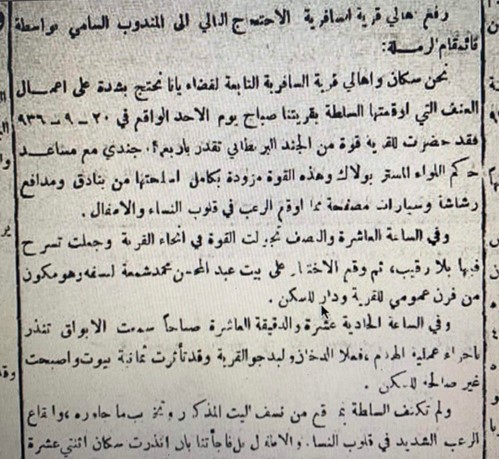
Many Palestinians I know attempted such a return: a necessary rehearsal that breaks the heart and reorients return towards the future. Return, then, becomes a constant process and practice of questioning the interlocking relations that structure dispossession as well as of weaving together the moments, acts, and movements of resistance against it.
The dispossession that had occurred in al Saifiryya, alongside another 450 Palestinian villages and the cities, serves as the event of condensation. The theft of property, and its articulation to economic and political institutions, was meant to create the settler subject as property-owning and the native Palestinian as propertyless. When discussing juridical forms and property under slavery, Hall (2021, 235) suggested that it was not just attitudes of racial superiority that precipitated slavery. Slavery, too, “produced those forms of juridical racism which distinguish the epoch of plantation slavery.” Again, this is an analysis that starts with ‘concrete historical work’ of a particular structure, asking: “what are the specific conditions which make [a particular] form of distinction socially pertinent, historically active?” (236)
It is the Zionist ideology, vouched in terra nullius logics of conquest that selectively repurpose secular and religious ideas to serve the particular social group of European settlers, that activates a constitutive distinction between the settler and the native. The state is a site of cohesion, the result of tendential articulations (particular, favoured linking) between ideology, subjectivity, and property. The state played the primary role in the erasure of al Safiriyya. Is not the erasure of al Safiriyya a primitive accumulation, an accumulation by dispossession, where the State and ideology (not only the economy, as Harvey (2004) might put it) play a primary role? As afterlives of that violence, the residents in al ‘Arub refugee camp experience violence differently in the post-Oslo historical conjuncture: violence mediated through the Israeli army as an agent of the state, the settler as an agent of Israeli civil law, and the Palestinian Authority as a native agency aimed at nurturing bourgeois interests while suppressing anti-colonial and social dissent. Settler colonialism is contingent on these historically determined practices and processes. And it is vulnerable to the rehearsals of return.
3. The city

On a cold day in January 2020, we drove around the city of Haifa.[4] We first went to Wadi Salib, which stands in the eastern part of the city with old homes—some neglected, others renovated—that belonged to Palestinian refugees before 1948. In al Burj neighbourhood stood the houses of Abdellatif Kanafani and Abed Elrahman El Haj (mayor of Haifa, 1870-1946). The house of the Kanafanis (Figure 7)—appropriated by the Israeli state in 1948, sold to the state-owned housing company Amidar in 1953 and then to four real estate companies in recent years (Sa’di-Ibraheem 2021, 698)—has been renovated and turned into law offices. The old and partially destroyed shops below the houses had a large poster in Hebrew by Ilan Pivko architects, showing the vision for their renovation. The old fronts would be polished and renovated, and atop of them, large ‘modern’ residential places would be built. These are all part of market-led, municipality-facilitated efforts to reshape what remains of Haifa.
Wadi Salib is a site of layered dispossession. The Israeli state forcibly drove out the Palestinian residents of the neighbourhood in 1948. While all the remaining Palestinians in Haifa were relocated to Wadi Nisnas neighbourhood and placed under strict military rule, arriving Arab Jews were placed in the Palestinian vacant homes. The Arab Jews were racialised as natural proprietors of these places as they were presumed to come from similar ‘mellah’[5] living conditions in Morocco (Weiss 2011). The racial hierarchy of the newly-established Israeli state was already being woven and mediated through space. The unbearable living conditions resulted in an Arab Jewish rebellion in 1959, leading to the evacuation of the neighbourhood (Shohat 2017, 72).
Contemporary attempts by the Haifa municipality and Israeli and international capital to refashion the neighbourhood as authentic real estate not only rely on but also perpetuate this layering of dispossession: firstly of the Palestinians, and secondly of the Arab Jews. The tendential articulation solidified in 1948, which favoured the white European settler as the archetypical proprietor of stolen Palestinian property, was accompanied by a sedimentation of other articulations, including the dispossession of the Palestinians and the racialization and precarization of the Arab Jew. The gradual, neoliberal refashioning of space within the ’48 territories, including Haifa, since 1985, occurs within the parameters of this inherited background field of colonial relations.
Indeed, as Milner (2020) shows in her discussion of the Arab Jewish Giv’at-Amal neighbourhood, built atop the depopulated Palestinian village of Jamassin in 1948, private capital feeds on this layering of dispossession by completely denying Palestinian claims to the land as well as contesting the precarious Arab Jewish settler’s title to it. Though included in the settler society as Jews whose religious lineage entitles them to a ‘right of return’ to stolen Palestinian lands (as per the 1950 Law of Return), Arab Jews are racialized as lesser settlers whose entitlement to the land is questioned. It is no surprise, then, that in 1986 the land of Jamassin-Giv’at Amal—along with the right to evict its Arab Jewish residents—was sold to several private entrepreneurs. Some of the Arab Jewish settlers, Milner tells us, weaponize their settler subjectivity and their participation in the dispossession of the Palestinians in order to substantiate their claim to the land. Capital, and its coupling with the colonial relations, constitute historical relations that are crosscut by race.
If, following Massey (2000) and Ajl et al (2015), we view the city as a condensed vantage point into articulated practices and processes (i.e., not a thing that precedes the process), the city becomes one socio-spatial form amongst many other possible and imagined ones. Furthermore, the city is a constellation of power relations determined by the particular historical conjuncture under examination. In the post-Oslo conjuncture, Palestinians living in Haifa face a new coupling of capital and colonial dispossession, crosscut by race, gender, and class, whereby capital takes a more primary role while feeding on the raw contradictions unleashed by the colonial relations. Although Palestinians within the ’48 territories are included as citizen subjects of the state, that inclusion is structured as an exclusion that remains reliant on a layering of dispossession that denies the Palestinian right to self-determination across the map.
Conclusion
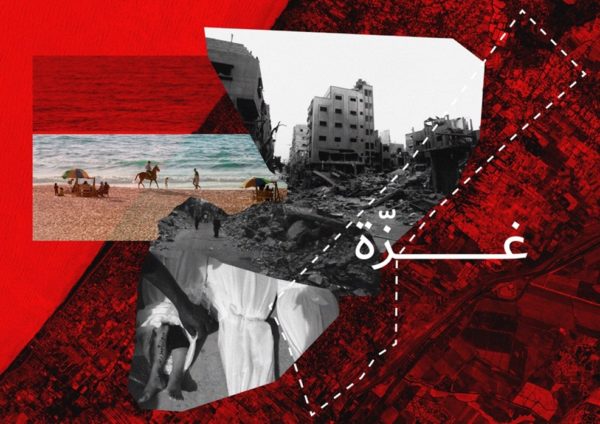
I write at a time of turmoil and intensified, genocidal violence. Thus far, Israel has killed more than fifteen thousand Palestinians in the Gaza Strip. Israeli airstrikes have targeted hospitals and schools, erasing entire neighbourhoods. Entire Palestinian families have been wiped out of the civil registry. Israeli officials have waved the idea of the permanent displacement of Gazans to the Sinai desert. While Western media outlets and political establishments rush to obscure this as rational self-defence, taking a historicist and geographic approach to Gaza shows how Israel’s targeting of the Strip is a brutal manifestation of the settler colonial intent to eliminate the native Palestinians. This is the same intent that takes the shape of settlers and military watch towers in the West Bank and that targets what remains of Palestinian urbanity in Haifa through urban renewal projects. In Gaza, this intent takes the shape of a brutal siege that has been imposed since 2007, followed by a series of wars that aim at de-developing the Strip (see Roy 1995). When viewed from al ‘Arub refugee camp, al Safiriyya, Jamassin, and Haifa, it becomes clear that the Gaza Strip faces another layering of dispossession. Gaza lies at the bottom of a hierarchy of life and violence that Israel imposes across the map of historic Palestine.
Settler colonialism is a whole constituted by historically determined parts—parts that are, in turn, constituted by a historically determined whole (see Hart 2018, 375-376). And so is capitalism. The local, such as al ‘Arub camp, is not a mere unilateral manifestation reflective of an all-encompassing global process. It is a nodal point of articulation—specific, differentiated, contingent. This is Hall’s (1986) Marxism without guarantees: there is no guaranteed correspondence or noncorrespondence between the different levels of a social formation; structures do not pre-date relations; and the global process of capitalist accumulation and that of Israeli settler colonialism take differentiated iterations that rely on the relations constituting each spatio-historical conjuncture.
As such processes unfold across the map of Palestine, they take particular shapes and forms, resulting in various historically determined settler colonial paradigms: the military occupation in the West Bank, the besiegement, de-development, and targeting of human life in the Gaza Strip, the administrative law in Jerusalem, and the inclusion through exclusion in the ’48 territories. This is a map without guarantees: there is neither a guarantee that settler colonialism’s intent to eliminate the Palestinians will succeed, nor a guarantee that Palestinians will take up a particular form of resistance. This is a map without guarantees: it is a map that takes very seriously the structural constraints shaping the fragmented Palestinian geographies but also one that animates the pressures that Palestinian practices and modes of resistance exert on such historical forces. This is a map without guarantees, where settler colonialism may, one day, cease to exist. A map without guarantees, where rehearsals of return will, one day, cease to be rehearsals.
About the author
Hashem Abushama is a Departmental Lecturer and Career Development Fellow at St John’s College and the School of Geography and the Environment (SoGE) at the University of Oxford. He is a human geographer with interests in urban studies, cultural studies, critical development studies, and postcolonial geographies. He holds a DPhil in Human Geography from the School of Geography and the Environment and an MSc in Refugee and Forced Migration Studies from the Department of International Development at the University of Oxford, and a BA in Peace and Global Studies from Earlham College in the United States. His PhD dissertation won the runner up for the Leigh Douglas Memorial Award for the Best Dissertation in British Middle East Studies. His forthcoming monograph looks at settler colonialism, capitalism, dispossession, and arts in contemporary Palestine. His writings have appeared in Refuge: Canada’s Journal on Refugees, the Jerusalem Quarterly, Jadaliyya, and Palestine Square.
Footnotes
[1] I am here paraphrasing Stuart Hall’s (1986) powerful essay ‘The Problem of Ideology—Marxism without guarantees,’ where he criticizes orthodox Marxism’s tendency to presume a necessary correspondence between the different levels of social formations. He argues that presuming a functionalist understanding whereby, for example, those occupying a working-class subjectivity are presumed to be revolutionary by virtue of that subjectivity leads to a determinism that deadens politics. There are no guarantees that such a subjectivity will be revolutionary for that depends on the actual, concrete struggles.
[2] Translated from Arabic by the author.
[3] Here, I am extending Stuart Hall’s concept of ‘transformed racisms’ (see Hall 2021). I explore this in greater length in an article titled ‘Articulations: a relational comparison of settler colonial dispossession and cultural practices in Haifa and Ramallah’ submitted to the Annals of the American Association of Geographers Journal.
[4] That day, I was taken on a tour around Haifa by Palestinian geographer Yara Sa’di-Ibraheem and her partner, Hisham, whom I would like to thank for their knowledge and time.
[5] Mellah is an Arabic term that refers to Jewish neighbourhoods in Morocco.
Bibliography
Ajl, Max, Hillary Angelo, Neil Brenner, Neil Brenner, John Friedmann, Matthew Gandy, Brendan Gleeson, et al. 2015. Implosions /Explosions: Towards a Study of Planetary Urbanization. Berlin: JOVIS Verlag GmbH. https://doi.org/10.1515/9783868598933
Barghouthi, Hussein. 2022. Among the Almond Trees: A Palestinian Memoir. Translated by Ibrahim Muhawi With an Introduction by Ibrahim Muhawi. The Arab List. Seagull Books. https://press.uchicago.edu/ucp/books/book/distributed/A/bo124470392.html.
Bhandar, Brenna. 2018. Colonial Lives of Property: Law, Land, and Racial Regimes of Ownership. Global and Insurgent Legalities. Durham [North Carolina: Durham North Carolina : Duke University Press.
Coulthard, Glen Sean. 2014. Red Skin, White Masks: Rejecting the Colonial Politics of Recognition. Indigenous Americas. Minneapolis: University of Minnesota Press.
‘Difa’ Newspaper 1937’. n.d. Accessed 6 November 2023. https://www.nli.org.il/ar/newspapers/difaa/1936/09/23/01/.
Estes, Nick. 2019. Our History Is the Future: Standing Rock versus the Dakota Access Pipeline, and the Long Tradition of Indigenous Resistance. London ; Verso.
Fanon, Frantz. 2004. The Wretched of the Earth: Frantz Fanon ; Translated from the French by Richard Philcox ; with Commentary by Jean-Paul Sartre and Homi K. Bhabha. New York: Grove Press.
Hall, Stuart. 1986. ‘The Problem of Ideology-Marxism without Guarantees’. The Journal of Communication Inquiry 10 (2): 28–44. https://doi.org/10.1177/019685998601000203.
———. 2017. Familiar Stranger: A Life between Two Islands. London: Allen Lane.
———. 2021a. Selected Writings on Race and Difference. Durham: Duke University Press.
———. 2021b. ‘Race, Articulation and Societies Structured in Dominance [1980]’. In Selected Writings on Race and Difference, edited by Paul Gilroy and Ruth Wilson Gilmore, 0. Duke University Press. https://doi.org/10.1215/9781478021223-014.
Hammami, Rema. 1995. ‘NGOs: The Professionalisation of Politics’. Race & Class 37 (2): 51–63. https://doi.org/10.1177/030639689503700200.
Hanieh, Adam. 2003. ‘From State-Led Growth to Globalization: The Evolution of Israeli Capitalism’. Journal of Palestine Studies 32 (4): 5–21. https://doi.org/10.1525/jps.2003.32.4.5.
———. 2013. Lineages of Revolt: Issues of Contemporary Capitalism in the Middle East. Chicago, Illinois: Haymarket Books.
Harker, Christopher. 2020. Spacing Debt: Obligations, Violence, and Endurance in Ramallah, Palestine [Electronic Resource]. Durham: Duke University Press. https://ezproxy-prd.bodleian.ox.ac.uk/login?url=http://dx.doi.org/10.1215/9781478012474.
Hart, Gillian. 2018. ‘Relational Comparison Revisited: Marxist Postcolonial Geographies in Practice’. Progress in Human Geography 42 (3): 371–94. https://doi.org/10.1177/0309132516681388.
Hart, Gillian Patricia. 2002. Disabling Globalization: Places of Power in Post-Apartheid South Africa. Berkeley: University of California Press. http://bvbr.bib-bvb.de:8991/F?func=service&doc_library=BVB01&local_base=BVB01&doc_number=009887163&line_number=0001&func_code=DB_RECORDS&service_type=MEDIA.
Harvey, David. 2004. ‘The “New” Imperialism: Accumulation by Dispossession’. Socialist Register 40.
Karkabi, Nadeem. 2018. ‘How and Why Haifa Has Become the “Palestinian Cultural Capital” in Israel’. City & Community 17 (4): pp1168-1188. https://doi.org/10.1111/cico.12341.
Levien, Michael. 2015. ‘From Primitive Accumulation to Regimes of Dispossession: Six Theses on India’s Land Question’. Economic and Political Weekly 50 (22): 146–57.
Massey, Doreen. 2000. ‘Travelling Thoughts’. In Without Guarantees: In Honour of Stuart Hall, edited by Stuart Hall, Paul Gilroy, Lawrence Grossberg, and Angela McRobbie, 225–32. London: Verso.
Massey, Doreen B. 2005. For Space. London: SAGE.
Milner, Elya Lucy. 2020. ‘Devaluation, Erasure and Replacement: Urban Frontiers and the Reproduction of Settler Colonial Urbanism in Tel Aviv’. Environment and Planning. D, Society & Space 38 (2): 267–86. https://doi.org/10.1177/0263775819866834.
Rabie, Kareem. 2021. Palestine Is Throwing a Party and the Whole World Is Invited: Capital and State Building in the West Bank [Electronic Resource]. E-Duke Books Scholarly Collection. Durham: Duke University Press. https://ezproxy-prd.bodleian.ox.ac.uk/login?url=http://dx.doi.org/10.1215/9781478021407.
Robinson, Shira. 2013. Citizen Strangers: Palestinians and the Birth of Israel’s Liberal Settler State. Stanford Studies in Middle Eastern and Islamic Societies and Cultures. Stanford, California: Stanford University Press.
Roy, Sara M. 1995. The Gaza Strip: The Political Economy of de-Development. Washington, D.C: Institute for Palestine studies.
Sa’di-Ibraheem, Yara. 2021. ‘Privatizing the Production of Settler Colonial Landscapes: “Authenticity” and Imaginative Geography in Wadi Al-Salib, Haifa’. Environment and Planning. C, Politics and Space 39 (4): 686–704. https://doi.org/10.1177/2399654420946757.
SALAMANCA, OMAR JABARY. 2016. ‘Assembling the Fabric of Life: When Settler Colonialism Becomes Development’. Journal of Palestine Studies 45 (4): 64–80. https://doi.org/10.1525/jps.2016.45.4.64.
Salamanca, Omar Jabary, Mezna Qato, Kareem Rabie, and Sobhi Samour. 2012. ‘Past Is Present: Settler Colonialism in Palestine’. Settler Colonial Studies 2 (1): 1–8. https://doi.org/10.1080/2201473X.2012.10648823.
Shohat, Ella. 2017. On the Arab-Jew, Palestine, and Other Displacements: Selected Writings. London: Pluto Press.
Weiss, Yfaat. 2011. A Confiscated Memory: Wadi Salib and Haifa’s Lost Heritage. New York: Columbia University Press.
Wolfe, Patrick. 2006. ‘Settler Colonialism and the Elimination of the Native’. Journal of Genocide Research 8 (4): 387–409. https://doi.org/10.1080/14623520601056240.
Zureik, Elia. 1979. The Palestinians in Israel: A Study in Internal Colonialism. International Library of Sociology. London: Routledge & Kegan Paul.
8th April 2026
The 2nd Stuart Hall Essay Prize awarded to Harriet Hillier
The winner of the 2nd Stuart Hall Essay Prize is Harriet Hillier, for the essay “Choosing a Nation: Identity, Belonging, and Representation in...
Stay connected
Sign up to our newsletter for the latest news, events and opportunities:
Share this