10th September 2026 / Image
SHF Peer Network Spring Workshop with Fred Moten (photos)
By: Tayyab Amin
Ahead of the 9th Annual Stuart Hall Public Conversation in May 2026, our network of creative and intellectual practitioners gathered at Conway Hall for the SHF Peer Network Spring Workshop. Joined by cultural theorist, poet and teacher of performance studies, Fred Moten, together they spent the day discussing each others’ practices, exchanging ideas and building connections.
Hosted by the Stuart Hall Foundation and facilitated by SHF Associate Ruth Ramsden-Karelse, the workshop began with introductions from attendees: members of the SHF Peer Network and the CoDE ECR (Centre on the Dynamics of Ethnicity Early Career Researcher) Network. Fred Moten and Ruth Ramsden-Karelse led open discussions, breakout sessions and readings around Policing the Crisis (Hall et al), The Crisis of the Negro Intellectual (Spillers) and more, prompted by a line of enquiry suggested by Moten:
“The aesthetics of common ground/policing the crisis (of the negro intellectual). On the one hand, let’s consider the problem of art and the artist in this particular moment in the history of our obligation to beauty; on the other hand, at this particular moment in the history of our commitment to truth, let’s consider the problem of the intellectual in an ongoing intensification and transformation of policing that turns out to be coterminous with a moment many of us have considered to be one of triumph. It might be especially to consider Stuart Hall’s work in relation to that of one of his great contemporaries, Hortense Spillers. What’s the relation between the refusal of personality and the refusal of the empiricist attitude?”
Workshop participants were also invited to attend the 9th Annual Stuart Hall Public Conversation with Fred Moten the next day. Written reflections on the Spring Workshop and Public Conversation were commissioned from Peer Network members Erinma Ochu, Researcher in Residence with Watershed and Professor in Immersive Media at UWE Bristol, and Konstantin Helm, researcher, lecturer, and PhD candidate at the Department for English and American Studies at Humboldt-Universität zu Berlin.
Supported by the Esmée Fairbairn Foundation, the Hollick Family Foundation, the Paul Hamlyn Foundation, the Power of Pop Fund, Conway Hall and CoDE.
Thank you to the SHF Trustees and Associates whose contributions made this event possible: Ruth Ramsden-Karelse, Angela McRobbie, Giorgia Doná, Nick Beech and Roshini Kempadoo.
Related
9th November 2025 / Video
Reading the Crisis: 'For Edward Said' with Brenna Bhandar and Hashem Abushama
4th June 2025
Reading the Crisis: Brenna Bhandar & Hashem Abushama
The Reading the Crisis series asks: what kinds of tools and strategies are needed to confront this conjuncture? This online...
17th December 2025 / Images
Reflections: Bleue Liverpool on an unclassified syncretism
By: Bleue Liverpool
17th December 2025 / Images
Reflections: Bleue Liverpool on an unclassified syncretism
By: Bleue Liverpool
On Friday 23rd May, 2025 University of Sussex Stuart Hall Fellow Bleue Liverpool presented new work at the Brighton Festival as part of her...
17th December 2025 / Image
Reflections: Bleue Liverpool on an unclassified syncretism
By: Bleue Liverpool
On Friday 23rd May, 2025 University of Sussex Stuart Hall Fellow Bleue Liverpool presented new work at the Brighton Festival as part of her Fellowship. Bleue collaborated with musician and sound artist Ibukun Sunday to create ‘an unclassified syncretism’, an audio-visual intervention within the Meeting House Chapel at the University of Sussex. Through this event, the duo sought to composite metaphysical abstractions of Paul Gilroy with research into migration narratives and landscapes of south-east English Channel coastline port culture. The event was part of the Festival of Ideas, a collaboration between the Faculty of Media, Arts and Humanities at the University of Sussex and Brighton Festival.
Bleue Liverpool shares reflections on her experience of the collaboration below, alongside production photographs of the audio-visual work plus a new text building upon the themes of project.
– So what do we know ?
– You mean, what are we willing to tell ?
Well, we know that the practice of syncretism in the 18th century Afro-Caribbean, enabled the subjugated to insurgently gather, speak, & remember – right under the gaze of the colonial eye. We’re aware that our ancestors, ambitious as they were, on the night of the 14th of August 1791, came together in ritual that embedded West African Vodou resistance – a legacy of the Fon Kingdom – into appropriated Christian systems and iconography. Allegedly the appropriation of the Catholic Church’s appliances deeply disturbed colonial administrators, whom were utilizing the system to “civilize”, “assimilate”, “commodify” our ancestors’ dignity. Subsequently, this ritual and a carefully calculated eclipse brought on a rebellion – sugar everywhere – a rupture, in the politics, that made a case of Identity.
– But Ibukun, you’re from that port Lagos, in Nigeria… South North Atlantic?
– Yes
– Me too, from a port, in the North North Atlantic…
– Yes
– A Pan-African conversation when we gather, no? when we commune?
– Yep… it’s old & ongoing
– What is?
– The conversation
The ports of Calais, Dover, Newhaven Port and Dieppe have had a great deal of increased activity in the 21st century. They are coming, the Others, moving from east to west, using container lorries in any attempt to flee civil rights atrocities, seeking employment, a better life than history. The border-industrial complex is having a field day, acquiring oxygen detectors, attempting to catch whomever before land. Asylum claims are easily accumulated, strategically neglected, and ultimately unclassified – leaving the politics to place the Others in Hotels. They stay in these hotels sometimes for years, a room for a family, unable to seek employment, without access to fundamental natural law actions e.g. cooking for oneself. These hotels, conduits, elongated liminal spaces forge new identities, the nature oscillates in spite of fixity.
– a form of syncretism?
– Yep
In a cafe around Waterloo, down a spiral staircase to a basement that could easily recreate London’s Great Fire of 1666, he comes to my table slowly but densely. “The word “race” was utilized in the same way that in our contemporary the word “culture” is used. That the project of cultural studies is a more or less attractive candidate for institutionalization. The national character ascribed to the concept of modes of production is a fundamental question, ethnohistorical specificity of dominant approaches of cultural politics. That what was initially felt to be a curse – the curse of homelessness or the curse of enforced exile gets repossessed. It becomes affirmed and is reconstructed as the basis of a privileged standpoint.”[1] I ask him if slavery was integral to the economic fruition of western civilization, how is the western world economically dependent on asylum seekers despite nationalism?
– Our inflections transfigure West to East, North to South.
– Yea… Of course.
– We need to find axis points.
– hmm
– Where do we gather to speak?
– They have Churches.
– Yes Ibukun, they have Churches.
As an Intermedia artist, collaboration has become an integral improvisational utility in circumventing a collective memory. By facilitating Pan-African conversations that take on unorthodox and unconventional mediums – such as sound and video artistic experimentation – new sonic-visual methodology is spontaneously generated that perhaps gives insight on not only acts of resistance but on cultural preservation. What was most appreciated on my side was that the Stuart Hall Foundation gave Ibukun and I the opportunity to come together finally for what will be a ongoing collaboration. In addition, the opportunity to wander, with naïveté, around the coast of South-East Sussex with nothing more than a handi-cam, generously provided by the media department of the University of Sussex, was pivotal. The camera gave me permission to wander, and that in itself from the position of my specific identity: revolutionary.
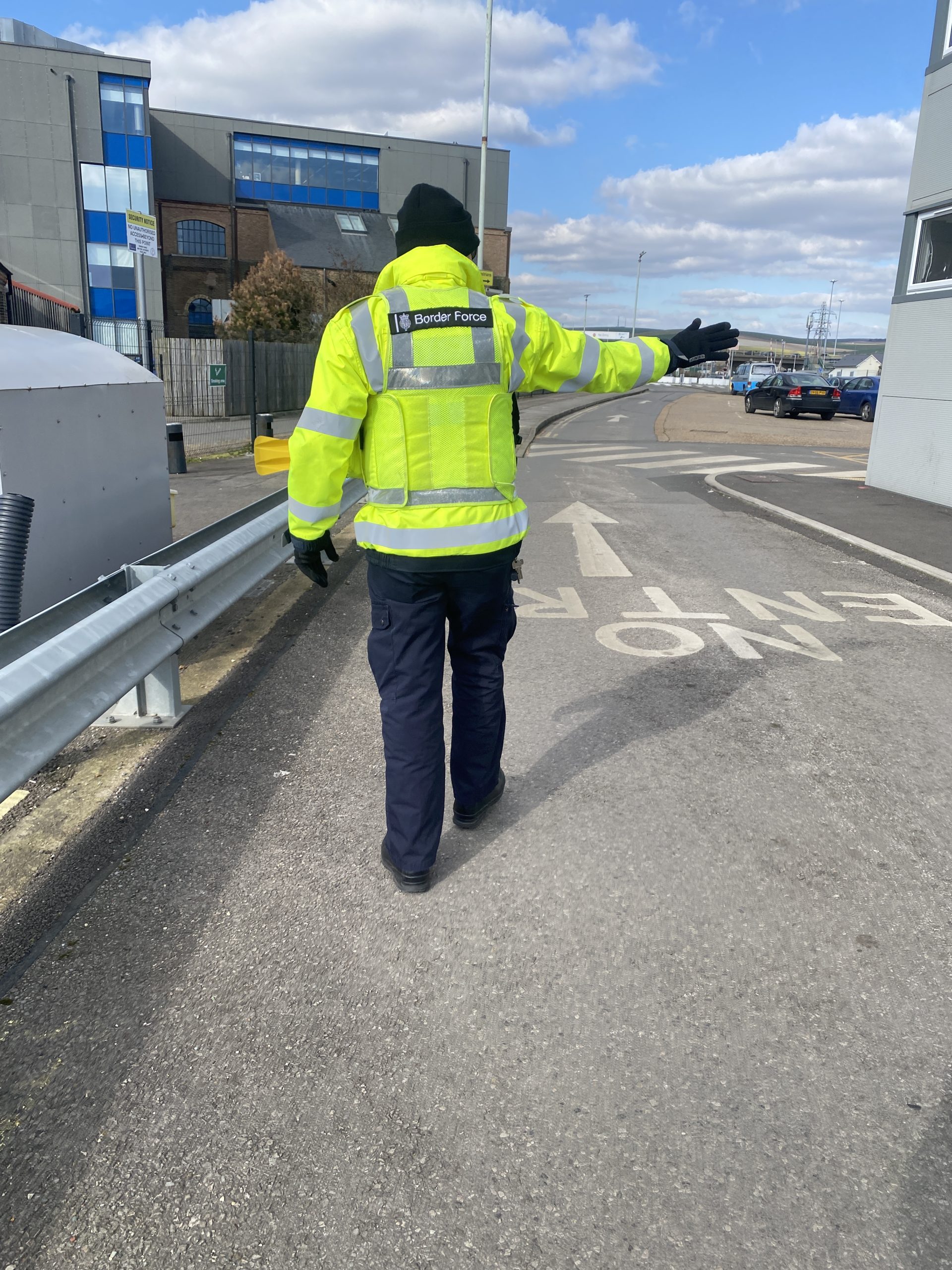
– Bleue Liverpool, November 2025
[1] Paul Gilroy, The Black Atlantic, The Black Atlantic: Modernity and Double Consciousness (Harvard University Press 1993)
View a video excerpt of ‘an unclassified syncretism’ below.
Share this