Legacies of British Slave Ownership with Catherine Hall and Ruth Ramsden-Karelse
Catherine Hall and Ruth Ramsden-Karelse discuss the Legacies of British Slave Ownership. They explore the importance of new histories, reparations, working to decolonise education and shifting collective memories to imagine new futures.
The most recent wave of Black Lives Matter protests rejuvenated popular debates over the removal of statues of British slave owners from public spaces. The fall of the Edward Colston statue in Bristol and calls to remove statues of Winston Churchill, Lord Nelson and Cecil Rhodes has forced the British public to reconsider questions of history and colonial legacies.
Read more about our #ReconstructionWork project here.
Speakers:
Catherine Hall is Emerita Professor of History and Chair of the Centre of the Study of British Slave-ownership at UCL. She has written extensively on the history of Britain and its empire including Civilising Subjects (2002) Macaulay and Son (2012) and, with others, Legacies of British Slave-ownership (2014). From 2009-2016 she was principal investigator on the LBS project www.ucl.ac.uk/lbs. She is currently writing a book on Edward Long, Jamaica and racial capitalism. She is a trustee of the Stuart Hall Foundation.
Ruth Ramsden-Karelse is founder and co-convener of the Oxford Queer Studies Network and a DPhil candidate in the English Faculty at the University of Oxford. The inaugural Stuart Hall Doctoral Studentship, in association with Merton College, the Oxford Research Centre in the Humanities and the Stuart Hall Foundation, supports her research on the world-making capacity of collaborative works by self-described gays and girls from communities formerly classified “Coloured” in Cape Town, South Africa, from 1950 to the present, with a specific focus on the Kewpie Photographic Collection. Ruth’s writing has appeared in GLQ: A Journal of Lesbian and Gay Studies.
Originally published by Race & Class, 2018 Institute of Race Relations, Vol. 60(1): 3–21 10.1177/0306396818769791 journals.sagepub.com/home/rac
Abstract
This article asks whether history writing can be reparatory. Opening with a discussion of the bi-centenary of the abolition of the slave trade in 2007 and the national conversation that was created at that time, it goes on to reflect on contestations over memory and the significance of the emergence of reparations as a key term with which to think about the wrongs of the past and the possibilities of repair. It uses a discussion of the author’s individual and collaborative historical work to argue for the importance of a different understanding of Britain’s involvement in the slavery business and our responsibilities, as beneficiaries, of the gross inequalities associated with slavery and colonialism.
Keywords: collective memory, disavowal, historical wrongs, Legacies of British Slave-ownership project, Macaulay, ‘race’, reparation, slavery
What is reparatory history?
What does it mean to do it in Britain?
This essay reflects on some of the ways in which the histories of ‘race’ and slavery have figured in the recent past in Britain. It argues that debates on reparation need to include questions about the historical narratives on ‘race’ and empire that have been and are being produced. It utilises a discussion of some of my own work as a historian over the past twenty years to think about what history that was reparative might look like.
Creating a national conversation
The bi-centenary of the abolition of the slave trade in 2007 provoked what could be described as a ‘national conversation’ in the United Kingdom.[1] This had happened before: at the end of the eighteenth century, pro-slavers and abolitionists engaged in fierce debate and polemic culminating in the abolition of the trade in 1807. The hope that once the trade had been dismantled slavery would disappear was soon shown to be an illusion, and this led to the activism of the 1820s, once again challenged by the pro-slavers. The major revolt of 1831 in Jamaica combined with popular pressure across the country brought about the Act of 1833 abolishing slavery in the British Caribbean, Mauritius and the Cape. During 2007, once again, the question of British responsibility for the enslavement of Africans became a subject of mainstream political and cultural debate. The context for this re-awakening was the major changes which had taken place in British society since the late 1940s, the scale of the African-Caribbean presence, the turbulent politics of race particularly in the wake of the killing of Stephen Lawrence (1993) and the Macpherson Report (1999) recognising the significance of institutional racism in the police, and the pressing questions from second and third generation young people as to whether it was possible to be black and British. In 2007 the bi-centenary provided an opportunity to re-open questions about the slave trade and slavery. Anti-racists had a number of different political agendas but were perhaps united in their hopes for new political and educational initiatives that would tackle persistent racism and repair historic wrongs.
Blair’s New Labour government looked to the future and advocated the idea of a modern multicultural Britain. The limits of their commitment were all too apparent, however, in the response to the Parekh Report of 2000, The Future of Multi-ethnic Britain, which discussed ‘the many varieties of racism and exclusion that disfigure modern Britain and that have been woven into the fabric of British history for many centuries’.[2] The report provoked a furore in the rightwing press. Jack Straw, the then Home Secretary who had supported the establishment of the Commission on the Future of Multi-Ethnic Britain by the Runnymede Trust, backtracked, effectively abandoning any efforts to follow up on the report’s more radical recommendations.[3] The following year, at the World Conference against Racism held in Durban, the British government did not support Caribbean nations’ claims for reparation for slavery and the Conference Declaration was limited to acknowledging the historical and contemporary practices of the slave trade and slavery as morally outrageous.[4] That same year, Randall Robinson, an African-American lawyer, author and activist, published The Debt: what America owes to Blacks. This significant intervention in the US debate on reparation argued that responsibility for the terrible effects of slavery across generations, the destruction of a hereditary identity, lay with the US government and people. Restitution could and should be made.[5] Questions about racisms, reparations and historical wrongs were increasingly present in public debate across the Atlantic world.
So when it came to 2007 the government felt the need to respond. ‘It is an opportunity for the United Kingdom to express our deep sorrow and regret’, as prime minister Tony Blair put it, ‘for our nation’s role in the slave trade and for the unbearable suffering, individually and collectively, it caused.’ He was very careful, however, as many pointed out, not to apologise; for an apology might have indicated historic responsibility and had material consequences.[6] 2007 gave all Britons an opportunity, he argued, to reflect on ‘the spirit of freedom, justice and equality that characterised the efforts of the early abolitionists, the same spirit that drives our determination to fight injustice and inequality today’. We could ‘rejoice at the different and better times we live in today’.[7] The government’s chosen focus was abolition, not slavery, echoing the narrative that had been established from the early nineteenth century.[8] This was part of an updated version of the Whig story of progress, of Britain’s capacity to lead the world on issues of liberty and freedom. ‘There is a golden thread which runs through British history,’ said Gordon Brown, ‘that runs from that long-ago day in Runnymede in 1215 when arbitrary power was fully challenged with the Magna Carta, on to the first bill of rights in 1689 where Britain became the first country where parliament asserted power over the king,’ to the abolition of the slave trade and on to democratic reform.[9] This was the narrative that informed the liberal humanitarian interventions of the Labour government, some of which had such disastrous effects.
While the official response to 2007 was to celebrate Britain’s record, others asked, how can we celebrate this? Establishment figures such as cultural commentator Melvyn Bragg and former Tory leader William Hague, albeit from different political perspectives, were united in their admiration for William Wilberforce, the saintly and iconic figurehead of the abolitionists whose evangelical Christianity was central to his struggle against both slavery in the Caribbean and vice at home. A rather different perspective informed the critique of what some called the Wilberfest.[10] ‘Our object’, as Wilberforce had put it, ‘was by ameliorating regulations, and by stopping the influx of uninstructed savages, to advance slowly towards the period when these unhappy things might exchange their degraded state of slavery for that of free and industrious peasantry.’[11] This language of ‘uninstructed savages’ and ‘unhappy things’ is redolent of the ways in which much abolitionist discourse assumed white superiority, a discourse that has had powerful echoes into the present. At the same time, Wilberforce’s vision of ‘free and industrial peasants’ marked the gap between conservative abolitionists such as himself, who believed in class, gender and racial hierarchies, and those radicals, Robert Wedderburn and Elizabeth Heyrick, for example, who rejected his pastoral vision of everyone in their proper place and sought not only the ending of slavery but also a transformation of society and the creation of an egalitarian world.
The ‘national conversation’ was greatly facilitated by the Heritage Lottery Fund’s decision to commit a substantial sum, between 15 and 20 million pounds, to bi-centenary projects. The money made possible both large-scale projects such as the establishment of the New Centre for the Understanding of slavery in association with the Liverpool Museums and many small-scale initiatives, some of which have now been archived in an effort to conserve what was an extraordinary set of activities. ‘Remembering 1807’ (http://antislavery.ac.uk/remember- ing1807) reflects the ways in which hundreds of heritage groups and local organisations around the UK marked the anniversary. Museums, galleries, archives, community groups, churches, theatres and schools organised exhibitions, debates, music, dance, theatre, storytelling, poetry, film, carnivals and festivals. The BBC commissioned radio and TV programmes. Universities organised conferences, seminars and exhibitions.[12] Artists produced new materials, such as Lubaina Himid’s ‘Swallow Hard: the Lancaster dinner service’. Himid collected plates, jugs, tureens and dishes from local shops in Lancaster and Whitehaven, significant ports for slaving vessels. She decorated them with images of traders, ships, sailors, buildings, servants, the enslaved, maps and goods, exploring the connections between the North West and the development and abolition of the slave trade. The dinner service was initially exhibited on the splendid mahogany dining table in the Judge’s Lodging in Lancaster, reminders both of the flourish- ing mahogany trade from Jamaica and Honduras and its importance to the development of eighteenth-century consumer society, and of the centrality of the law to class power in that period.
Contested memories
The ‘national conversation’ about the slave trade and slavery in 2007 marked a contestation over memory – what was to be remembered and how? It was Maurice Halbwachs in the period after the first world war who initiated much of the work on collective memory, drawing on his own experience and illuminating the ways in which memory is constructed, mediated and shaped in the social world. Individual and collective memory are always related; experiences and private recollections are tested by and shaped in encounters with collective memory. It is collective memory that constitutes social values, shapes convention, law and language. If we are haunted by past memories that are not shared by others, it can be deeply lonely and indeed alienating. ‘I have shown’, he argued, ‘that memory is a collective function … If recollections reappear, this is because at each moment society possesses the necessary means to reproduce them.’[13] In 2007 the question that was being asked was what should be remembered? Was Wilberforce really the carrier of the story of abolition? Can trauma pass through generations affecting the descendants of the enslaved? If so, how? How can the different legacies be given weight and significance in the minds and cultures of people today? There will always be different perspectives and voices but which narratives would/should achieve cultural and political hegemony? Would it continue to be white abolitionists or those black abolitionists, men such as Ottobah Cugoano, kidnapped at 13 in West Africa, sold into slavery and eventually freed in England, who believed that redress would never be adequate, and drew attention to ‘the incommensurability between pain and compensation’.[14] And what about the women? What about the practices of the trade and slavery itself, the hundreds and thousands of African men and women who had been transported across the Middle Passage, and sold to planters and merchants across the British Caribbean? What impact did all of this have on the lives of those in the UK? What kind of responsibility did Britons, generations later, have for those wrongs committed by their forbears? There was no common view, but many voices were raised, unsettling what had seemed to be settled narratives.[15] In that sense 2007 was a reparative moment, marking new discoveries and provoking new questions.[16]
Reparations
There is a long history of claims for reparations for the wrongs associated with slavery. As early as the 1780s there were petitions from those who had previously been enslaved. Hundreds of Quakers both freed enslaved men and women and paid them compensation. Some abolitionists argued in the nineteenth century that freedom should include compensation, some challenged the payment of compensation to slave-owners at the time of emancipation in the British Caribbean, Mauritius and the Cape.[17] Arguments were made for compensation in the US after the civil war and Marcus Garvey sought payment to descendants as part of the back to Africa movement. Congressman John Conyers, who represents Detroit, has marked every session for the last twenty-five years by introducing a bill calling for the congressional study of slavery and its lingering effects and recommending remedies.
‘The subterranean stream of Western history’, Hannah Arendt wrote in the immediate postwar years, ‘has finally come to the surface and usurped the dignity of our position. This is the reality in which we live. And this is why all efforts to escape from the grimness of the present into nostalgia for a still intact past, or into the anticipated oblivion of the future, are vain.’[18] Such a recognition of the weight of the past, ‘that subterranean stream’, marked a very different attitude from earlier periods. For Marx the past had weighed like a nightmare on the brain of the living: but it was to be transcended. It was not until the 1990s that the need to come to terms with the past and the insistence that the legacies of the past lived on in the present became more urgent. Notions of reparation and a demand for reparative justice became a global phenomenon. The Holocaust was the most powerful symbol of the impossibility of ignoring the misdeeds of the past, and of thinking about that past as catastrophic, for it was still a living memory. Holocaust survivors, slave labourers in Nazi camps, Australian aborigines, Native Americans in Canada, Maori in New Zealand, the Truth and Reconciliation in South Africa were making claims on governments. Such claims implied a break with the idea of history as progress, that the future would always be better than the past, an idea heavily influenced by both Enlightenment stadial theory and Marxism. Now the emphasis is on reconstituting the past, in ways that enable thinking about responsibility in the present. Some have argued that this preoccupation with the past is a result of the decline of a more future-oriented and utopian politics. The combination of the horrors of Stalinism and of fascism, together with the end of the Soviet Union, the resurgence of nationalism, the unfinished work of decolonisation, the ‘failures’ of postcolonial states and the apparent triumph of global capitalism, have destroyed beliefs in the possibility of a transformative politics, the loss of a sense of common destiny, and a retreat into a growing concern with particular groups and claims, with victims and their rights.[19] It may be that the crisis of neoliberalism and the growing critique of capitalism and the market that characterises one aspect of our contemporary world, albeit alongside the successes of authoritarian populism, will mark the onset of a very different political moment. Could re-thinking the past, taking responsibilities for its residues and legacies, be one way of challenging rightwing politics and imagining a different future?
In the aftermath of the first world war, the word reparations was associated with the punishing payments demanded by the victors from the defeated. Sometime after the second world war, the word was transformed from its original connotations with war reparations. Karl Jaspers’ The Question of German Guilt argued for the need for the German people as a whole to atone: the Nuremberg trials and the hanging of individual Nazis were in no sense an adequate response to what had happened. Reconstruction and restoration would require recognition of the full meaning of what had happened and its implications for the majority population.[20] A shift took place from the language of perpetrators to the notion of beneficiaries, facilitating efforts to claim reparations for wrongs done in the past, for gross violations of human rights and their effects into the present. As Mahmood Mamdani put it in relation to the Truth and Reconciliation Commission:
Where the focus is on perpetrators, victims are necessarily defined as the minority of political activists; for the victimhood of the majority to be recognized, the focus has to shift from perpetrators to beneficiaries. The difference is this: whereas the focus on perpetrators fuels the demand for justice as criminal justice, that on beneficiaries shifts the focus to a notion of justice as social justice.[21]
Responsibilities are then understood as belonging to nations and peoples, to ‘by- standers’, those who acquiesced or benefitted, as well as those who pressed the button. In a similar vein, Michael Rothberg, exploring what the legacies of slavery mean today in terms of justice and historical responsibility, has proposed the term ‘implicated subjects’. He argues that there is a need to develop a new cate- gory describing the implication of people in events that are temporally or spatially distant and in which they have not played a direct role either as perpetrators or victims.[22] Those of us living in the rich societies of the West have all, albeit profoundly unequally, enjoyed the fruits of racial capitalism, we are all survivors of slavery, not just those who can directly trace their lineages.
John Torpey makes a helpful distinction between ‘reparations’ (plural) in the more literal meaning of rectifying past injustices (whether or not you are directly responsible for committing the wrongs), and ‘reparation’ (the singular noun), which covers the wider terrain of reparation politics. Transitional justice, with its many permutations of truth, justice, and reconstruction; the tropes of forgive- ness, apologies, and regret; efforts at reconciliation, memory, and communal memorialisation, all these can play a part in attempts to take responsibility for as well as hope to put wrongs right.[23] While the word reparations generally means compensation of some kind, reparation has come to mean repair. People make reparation, states and corporations pay reparations. Reparation politics can include transitional justice, the legal mechanisms such as criminal trials and truth commis- sions which would mostly be concerned with perpetrators. ‘Transitional justice’, writes David Scott, ‘is the name of a post-Cold War development in liberal justice that, through the political technologies of successor trials and above all, historical truth commissions, aims to draw a line between the illiberal past and the liberalizing present.’[24] Then there is compensation and restitution of a material kind such as the German payments to Israel and the return of art works stolen by the Nazis. Reparation can include acknowledgement as in the case of the Japanese-American claims over internment, which involved token payments, apologies, as Blair refused in relation to slavery, some churches have made for sexual abuse, most recently Hollywood for misogyny/sexual harassment, or statements of regret. Efforts to reshape historical memory can also be made through history writing, school textbooks, exhibitions in museums, memorials, statues and commemorative plaques. Many of the activities associated with 2007 were indeed of this kind.
Claims from the Caribbean for reparation from the erstwhile empires were given new life by the publication of Hilary Beckles’s book Britain’s Black Debt in 2013, documenting the evidence of the destruction wreaked by slavery, the benefits that accrued to Britain, and the arguments for reparation. This was followed by the launch of the CARICOM ten-point programme in 2014, a claim from the regional states for reparatory justice from the European states ‘whose countries grew rich at the expense of those regions whose human wealth was stolen from them’. A full apology was demanded alongside debt cancellation, development programmes, resources to tackle ill health and illiteracy and psychological forms of rehabilitation for those who were ‘denied recognition as members of the human family by laws derived from the parliaments and pal- aces of Europe’.[25] The search was for a ‘path to reconciliation for victims of crimes against humanity and their descendants’ in the region. The CARICOM claim has been met with a deafening silence from European governments, has provoked criticism from Pan-Africanists for its failure to challenge the system of racial capitalism with its global reach, and from those in the wider diaspora for the exclusive focus on harms done in the Caribbean. Many black people are suspicious of the whole enterprise, many white people think that there is no reason to saddle them with responsibility for things they did not do. But might the reparations argument have the potential, as David Scott puts it, to
“redescribe the past’s relation to the present … to foreground the sense in which Caribbean debt is the other side of European theft – that the ‘persistent poverty’ of the Caribbean has been a constituting condition for ill-gotten European prosperity … The point is that this is not the story of a mere episode in a marginal history; it is the integrated story of the making of the modern world itself.”[26]
It is to be hoped that the new Centre for Reparations that has been established at the University of the West Indies will be able to build a detailed case that European governments will not be able to ignore. The priority is to seek reparations for the descendants of the enslaved and of those indigenous peoples who suffered genocide. But as Robin Kelley has written in relation to the US, ‘The reparations campaign, despite its potential contribution to eliminating racism and remaking the world, can never be an end in itself … without at least a rudimentary critique of the capitalist culture that consumes us, even reparations can have disastrous consequences.’[27]
Reparation and the UK
Reparatory work in the UK needs to be connected with these wider struggles but also to be rooted in the locality. Anti-racists have been challenging the systemic racism that has blighted the lives of generations, tackling inequality and discrimination for decades. Historians, writers, visual artists and critical race theorists have been exploring colonialism and its legacies, challenging the silences on ‘race’ and slavery. In her brilliant essay on the apparent absence of ‘race’ in the American literary canon, Playing in the Dark, Toni Morrison analysed a range of texts, from Willa Cather to Edgar Allen Poe and Mark Twain. ‘Her project’, she argued, ‘is an effort to avert the critical gaze from the racial object to the racial subject; from the described and imagined to the describers and imaginers; from the serving to the served.’ She examined
“the impact of notions of racial hierarchy, racial exclusion, and racial vulnerability and availability on nonblacks who held, resisted, explored, or altered those notions. The scholarship that looks into the mind, imagination, and behaviour of slaves is valuable. But equally valuable is a serious intellectual effort to see what racial ideology does to the mind, imagination, and behaviour of masters.”[28]
The recognition of white privilege, grasping the extent to which white identities have been built on the capacity to ‘other’ those who are defined as lesser is a crucial part of the work that is underway and needs to be sustained in Britain.
My own first effort to do something I have come to call ‘reparatory history’ began in the 1980s when questions about the politics of ‘race’ erupted angrily amongst feminists, with demands from black feminists that white women should think about themselves and the positions of privilege they/we occupied. I began to research the question of ‘race’, the ways its presence and significance had been denied and disavowed in British history, and what this meant for white populations, whether ‘at home’ or in the empire. Britain’s domestic history had been systematically demarcated from its imperial history as if the two had nothing to do with each other. My study became an investigation of the impact of colonial- ism on English identities in the period after the abolition of slavery, an exploration of the long historical links between England, particularly Birmingham, and Jamaica. What did it mean to be a coloniser: how central was that identity, that sense of power over others who were thought lesser, to notions of Englishness and Britishness? How were white identities constituted in relation to black? What were the distinctive characteristics of white masculinities and femininities? How was class articulated with this? What happened to thinking about ‘race’ in the wake of abolition? Once slavery, with its supposedly clear binary between white and black and assumption of black subjection, was abolished, other legitimations had to be found for the systematic forms of exploitation, expropriation, cruelty, terror, coercion, violence, abuse, destruction and hatred of ‘others’ that continued across different sites of empire. Othering could take many forms as has been clear from the treatment of the Irish, of Jews and of people of colour in the metropole.[29] As Cathy Bergin and Anita Rupprecht have argued, the demand for reparation put a particular purchase on history and the history of ‘race’. ‘It challenges the progressive onward march of freedom from below by demanding the recognition and repair of exploitation, expropriation and violence not just by building monuments or demanding financial payback.’
There is much work to be done: exploring the continuities between the racisms of the past and the present, investigating the history of the descendants of the enslaved, documenting resistance and exploring the constructions of ‘race’, including whiteness, across different sites of empire, investigating the role of states and corporations. We need histories of the enslaved and their survival, they argue, of the perpetrators and the beneficiaries, of those who refused the Manichean binaries of ‘race’. Reparatory history must be about more than identifying wrongdoers and seeking redress: it begins with the descendants, with trauma and loss, but the hope is that the work of mourning can be linked to hopes for reconciliation, the repair of relations damaged by historical injustice.[30]
The attachment to the idea of abolition as a mark of Britain’s love of liberty and freedom was linked to a deep, yet disavowed, attachment in English culture to Britain’s imperial power. In the wake of decolonisation and the loss of Empire,Paul Gilroy diagnosed ‘postimperial melancholia’, marked by
“an inability even to face, never mind actually mourn, the profound change in circumstances and moods that followed the end of the Empire … Once the his- tory of the Empire became a source of discomfort, shame, and perplexity, its complexities and ambiguities were readily set aside. Rather than work through those feelings, that unsettling history was diminished, denied, and then, if possible, actively forgotten.”
Such a denial has had profound moral and psychic costs, he suggested, not least shaping hostile responses to strangers and settlers, stirring up fears of ‘swamp- ing’ and invasion. ‘An anxious melancholic mood has become part of the cultural infrastructure’, he argued in 2004.[31] Gilroy’s analysis recalls Freud’s emphasis in Mourning and Melancholia that if a loved object cannot be relinquished and mourn- ing completed, melancholia will ensue, akin to a state of paralysis.[32] That melancholic mood has more recently been transposed into widescale resentment, an anger associated with the loss of an imagined time of purity, when England was white and her borders were secure.[33]
Disavowal and evasion
The concept of disavowal, first articulated by Freud and subsequently developed by a range of other psychoanalytic thinkers has become central to me in my efforts to understand the erasure of ‘race’ and empire in much British history writing. Freud asked, how do we remember, forget and reconfigure the past, and how is it that we can make a thing appear never to have happened? We can ‘know’, according to this account, something unconsciously even as we are consciously ‘innocent’ of the knowledge. Freud’s thinking was based upon the idea that mind is always conflicted, and that we actively rid ourselves (sometimes unbeknownst to ourselves) of certain mental contents. The body may speak another ‘unconscious’ story: thus Freud described a hysterical patient who seemed to know nothing of sexual desire, yet whose hands conveyed a different drama: the one unbuttoning her clothes, the other doing them up.[34] Others have investigated the ways we may misrecognise ourselves, avoid pain, bury our guilt, and disclaim our desires. Lacan’s famous reading of a story by Edgar Allen Poe, ‘The Purloined Letter’, zeroed in upon a hidden object, the epistle in question, hidden in plain view, on a mantelpiece where nobody (except the alert detective) could see it. Hence the casual leaving of a secret in an accessible location may turn out to be, by and large, a brilliant hiding place. As historians are well aware, archives may be technically ‘open’, but nobody bothers to look in them, or they/we look with ‘blind eyes’, asking some questions, forgetting others. Freud’s emphasis is on an unconscious process, the rejection of a reality that is potentially traumatic. Forgetting is understood as actively produced, not just a matter of failed remembering, rather it is willed, unconsciously. Disavowal is connected with a denial of external realities, a refusal to think what is unthinkable, a wish to put aside what cannot be integrated. And this is as relevant in our intimate and interpersonal relations as in relation to forgotten histories. Statements of denial are assertions that something did not happen, does not exist, is not true, or is not known about. It can be argued that individuals or collectives, indeed whole states and societies can be engaged in it.[35] Disavowal is the refusal to avow, the disclaiming of responsibility or knowledge of, repudiation or denial. It is often linked to the notion of a ‘blind eye’ or the refusal of something in plain sight, so carrying the implication of knowing and not knowing.
Hannah Arendt was no disciple of Freud, yet there are connections with her concept of thoughtlessness, characterised in part by the absence of internal dialogue. This was a crucial concept for her exploration of the imperial roots of totalitarianism and the Holocaust. She re-named Nazi rule ‘race imperialism’. The priority, she insisted was to examine the past ‘bearing consciously the burden that events have placed upon us – neither denying their existence nor submitting meekly to their weight as though everything that in fact happened could not have happened otherwise. Comprehension, in short, means the unpremeditated, attentive facing up to, and resisting of, reality – whatever it may be or might have been.’[36] She saw the repetition of empty and trivial truths as a key aspect of ‘modern times’.
‘In matters of race, silence and evasion have historically ruled literary dis- course’, Morrison wrote. ‘Evasion has fostered another, substitute language in which the issues are encoded, foreclosing open debate. The situation is aggravated by the tremor that breaks into discourse on race.’[37] A similar argument can be made about history writing, a topic that I have been investigating in recent times. One case study has focused on Macaulay’s History of England, the great popular history of the nineteenth century, read across the globe.[38] It was an epic story of progress from Elizabeth I to modern times, 1848. It covered the period of the conquest of Jamaica and the expansion of the slave trade and the development of colonial slavery. Macaulay’s father, Zachary, had a lifelong preoccupation with Africa and the Caribbean. An abolitionist, he had spent formative years as a bookkeeper in Jamaica and then time in Sierra Leone, and became Wilberforce’s right-hand man. Yet his son banished the slave trade and slavery to the uttermost margins of his volumes. The peoples and politics of the Atlantic were irrelevant to his vision of history as was the huge flow of wealth from Caribbean slavery and commerce. Despite the development of the Royal Africa Company under Charles II and James II there was no discussion of the slave trade or plantation slavery, the subjects that had occupied most of Zachary Macaulay’s waking hours. This was a startling silence. Sugar and slavery were becoming central to England’s wealth and power by the late seventeenth century. But slavery was a system that Macaulay preferred to forget. It was abolition that should be memorialised. This was a process that had begun in 1808, with the publication of Thomas Clarkson’s history, celebrating the actions of a group of humanitarian white men on both sides of the Atlantic: it was they who had effected abolition. The Wilberforce brothers’ hagiographic account of their father’s life confirmed this way of constructing England’s role: it was humanitarianism that was to be remembered, not the country’s investment in the slave trade and slavery.
In Macaulay’s mind there was nothing significant to be said about the Caribbean, those colonies had no History, with a capital H, History was a story of progress, the story England exemplified. The Caribbean was locked in what Dipesh Chakrabarty famously named ‘the waiting room of history’, possibly seeking entry at some future date.[39] The ‘great experiment’ of emancipation was increasingly problematic in the 1840s, the years Macaulay was writing, the freed men and women had found no real freedom and were frequently in conflict with their erstwhile owners, the Caribbean islands no longer dominated sugar production and were increasingly irrelevant to global economics and politics. There was no story of progress there. Macaulay’s history was of the making of the multi-ethnic nation named England, with its inclusion, as lesser siblings, of the Scots, and, much more problematically, the partial inclusion of the Irish, who could not be comfortably assimilated in his imagination. England provided a model in his analysis, a successful example of the route to modernity, laying out a path which others could follow. His underlying assumption, rooted in his ethnocentrism, was that it was the route. In that sense his History purported to be a universal history.
Macaulay never chose to write a biography of his father, far from it. He preferred to distance himself from all that his father had most valued, evangelicalism and the struggle against slavery. We cannot think, as he had once proclaimed, as our fathers do. His disavowal of the significance of the slave trade and slavery to his nation’s history could be read as the most potent rejection of his father’s legacy. Abolition had been effected: in its wake he had no time for ‘impracticable, uncompromising reformers’, who never did good and led ‘miserable lives’ and he hated ‘negrophiles’ as much as ‘nigger drivers’. He disliked the whole subject of slavery, did not want to talk, think, or write about it, refused to act as the Vice- President of the Edinburgh Antislavery Society. It was a relief when the subject was avoided, as at a dinner with Sumner, the Massachusetts anti-slavery leader: ‘We had no talk about slavery, to my great joy.’ Avoiding subjects, blocking off difficulties, making the world in his own image: these were some of his strategies for keeping trouble at bay.
He had been in the House of Commons in the difficult days when the terms of abolition were being negotiated. He had done his duty to his father. The supreme authority of the ‘parent state’ had been enacted with the abolition of slavery in 1833 by the imperial parliament, in the face of opposition from the colonial assemblies. England had done its duty and so had he. Now he could put it aside. But putting it aside meant deliberately avoiding and forgetting: disavowal. Macaulay was well aware of the extent to which the slave trade and slavery had sustained the economy and society. He was a member of the government that negotiated compensation to the slave-owners: he knew what the payment of 20 million pounds meant in terms of the government’s overall expenditure. But he preferred not to know, he could not face reality. The West Indies rarely crossed his mind, peopled as they were by ‘stupid ungrateful’ gangs of ‘negroes’. He paid lip service to the abolitionists, but Africa and the Caribbean, effectively excluded from his history, only featured in one paragraph.
Yet what a paragraph: the tremor in his text was marked by the forgotten but not to be dispelled spectre of the slave trade and slavery. Evoking the terrible earthquake in Port Royal, Jamaica, in 1692, he described ‘The fairest and wealthiest city which the English had yet built in the New World, renowned for its quays, for its warehouses, and for its stately streets, which were said to rival Cheapside.’ On that fateful day all ‘was turned into a mass of ruins’. Here the focus was on the city, built by Englishmen and brought into homely purview by being compared to Cheapside. The markets where the enslaved were sold as commodities, the wharves where the slavers docked, the Africans who peopled the island – none of these were in his line of vision. It was the impact on home that preoccupied him, the effect of the disaster on ‘the great mercantile houses of London and Bristol’. Thus Jamaica was domesticated and slavery disavowed. That earthquake signalled the eruption of repressed memories, for repression cannot always contain its troublesome baggage. Macaulay’s History marginalised slavery and empire in the nation’s story. The work of such an influential historian, read across generations, can tell us much about the construction of Anglophone visions of white civilisation. Unpicking that narrative, demonstrating how that marginalisation was effected, what and who were excluded, how the story is fundamentally changed once questions of gender, ‘race’ and class are opened up, exploitation and expropriation registered, is one way of attempting repair.
To focus on undoing the legacies of ‘great white men’ is one possible strategy. New understandings can never undo the devastation and loss that was suffered in the past and that lives on for descendants in the present. But thinking differently can perhaps awaken a sense of the responsibilities of ‘implicated subjects’ who have benefitted culturally, economically and politically from the hurts inflicted on others, in the hope that change can happen, racisms could be eradicated. Recognition matters. The reparation done for the Holocaust has made a difference – the absence of reparation for slavery means that the wound is still open for many people of African-Caribbean descent. Acknowledgement can mean that those implicated in oppression can align themselves with the oppressed and try to repair.
The Legacies of British Slave-ownership project (www.ucl.ac.uk/lbs) (LBS) which seeks to put slavery back into British history, on which I was a principal researcher from 2009 to 2015, has also focused on individuals, but this time on a significant group, the slave-owners.[40] The aim has been to shift the narrative of Britain’s relation to slavery from a focus on abolition to one on the benefits associated with the business of slavery and its importance to the making of modern Britain and in the process to contribute to undoing whitewashed histories. Little systematic attention had been paid to British slave-owners though there were invaluable case studies of particular families and Eric Williams had pointed the way in his attention to the absentee West Indian elite, living in Britain.[41] We decided to use them as a lens through which to explore the tentacles of the slav- ery business in the metropole. Pro-slavers resisted emancipation as long as they could. Once they knew the battle was lost they used their parliamentary power to get the best terms possible for themselves. They drove a hard bargain. The 20 mil- lion pounds (16 billion in today’s money) paid to them in compensation for the loss of ‘their’ human property was combined with a system of apprenticeship, binding the freed men and women to working unpaid for their former masters for fixed hours over four to six years. The compensation records were meticulously collected in the wake of emancipation, providing a census of slave-owners at that time, a unique source.[42] By documenting the 46,000 individual claims for compensation and detailing the legacies – commercial, financial, political, cultural and imperial of the absentees – those with addresses registered in Britain, the extent of Britons’ involvement in slave-ownership has been laid bare. Some of the wealthy slave-owners such as John Gladstone, William’s father, were well- known. But the 3,500+ who received compensation in the metropole were enormously varied, ranging from modest widows living on annuities that were funded by the labour of the enslaved to middle-range merchants, bankers and lawyers, and rich ‘West Indians’ based partially in Marylebone and enjoying a country residence. Twenty per cent of those who received compensation in Britain were women. The compensation records deal with individuals but they illuminate the structures of class and state power. It was the imperial parliament which legislated the ending of slavery, just as it had previously legislated the trade and the notion of an enslaved person as a commodity.
Tracking the legacies has meant looking at the West India lobby and its retention of significant political influence into the 1840s, protecting the interests of the planters. British railway and canal systems, merchant banks and insurance companies, urban developments in spa towns such as Leamington, all bear witness to wealth derived from slavery. British museums and galleries display the perquisites of slavery and empire, visitors to country houses can marvel at the riches associated with sugar. Enterprises in the new colonies of white settlement were partially built on the fruits of slave-ownership. Scrolling through the LBS documentation of slave-owners who contributed to philanthropic enterprises we dis- cover that they supported asylums and schools for the urban poor, hospitals and an Institute for the Blind, the Governesses Benevolent Society and the Lifeboat Institution, typical objects of middle- and upper-class charity. Modern Britain was better equipped to respond to ill-health, poverty and disability than were the lands and peoples it colonised.
Bringing slavery home means tracking all these material traces, following the money and the people, making visible the legacies of slave-ownership, excavating what has been suppressed and marginalised, re-inscribing the slavery business in modern British history in an effort to reshape what is understood as the truth of what has happened. The database provides the evidence of the webs of connections to slavery that continue into the present within the white British elite and key social and economic institutions. It confirms Eric Williams’ insistence on the contribution that slave wealth made to the development of capitalism. It is a resource opening up the entangled histories of Britain’s relation to the Caribbean and offering extensive refutations of that binary between black and white which the slave-owners tried to impose, the ‘race-making’ that was central to their power.[43] It challenges the systemic disavowal, the knowing and not knowing of the realities of slavery that has characterised British history writing and British society. Anecdotal evidence from educational institutions, the media and public debates suggests that LBS has made a difference. The national narrative has shifted: it is impossible now to think about abolition without compensation. Furthermore, the empirical work has given people who are making political claims the historical grounding from which to do so.
LBS’s current project is documenting the structure and scale of Britons’ owner- ship in the Caribbean between 1763–1833, this time establishing patterns of land holding and levels of production when possible, uncovering the political, economic and cultural legacies, and utilising the Slave Registers to record the numbers of men, women and children who worked on the estates.[44] Digitising these histories, in so far as we can, including locating estates on maps, means extensive additions to the database and new possibilities for family and local historians as well as academic researchers. Attempting to grasp the world of the planter historian of Jamaica, Edward Long, the subject of my current research, is greatly facilitated by this wider comparative context across the British Caribbean. I aim to situate him as a child growing up in a family whose plantations had been established in the 1650s, fill out the details of his twelve years on the island as a planter, grasp the significance of his authoritative work as a historian and his life amongst the West Indian elite as an influential pro-slaver in Marylebone and the home counties.
The hope is to understand more about how racial thinking works, what are its logics and its mechanics, how did slave-owners such as Long establish the practices that attempted to fix the binaries between black and white, master the world in which they lived? The ability to see and not see was fundamental to Long’s life, to disavow and deny realities. He relied on what Ann Stoler has called ‘imperial dispositions’ to legitimate his own behaviour, as a planter, a legislator in the House of Assembly, a writer and polemicist, and in the network of his family and kin. He learned to ignore, turn away, refuse to witness: these were the ‘well-tended conditions of disregard’ that enabled slave-owners to live with the contradictions of their practices.[45] Long could be a loving family man and a buyer and seller of human property, valuing others only as commodities and relying on violence and coercion to extract their labour. This culture and the divisions between black and white were not ‘natural’, they had to be created and learned. This was the work of ‘making race’.
So can we think of such work as reparative? Its primary intention is not to seek new resources for education and health in the Caribbean, nor is it focused on the long-term effects of the slave trade on Africa. It is not about the politics of sur- vival and existential struggle under the conditions of ‘bare life’ as Vincent Brown evokes in his discussion of studies of slavery.[46] It cannot offer the kinds of insights into the harshness of Jamaican plantation life that Diana Paton has been able to unearth in her study of slave courts or the complexities of the sex-gender system captured through a fragment in the life of a free woman of colour.[47] My chosen focus is on the UK and the need to develop a different understanding here of Britain’s involvement in the slavery business and our responsibilities, as beneficiaries of the gross inequalities associated with slavery and colonialism. This means thinking about understandings of ‘race’ and difference. How significant were the ideas about ‘race’ which developed in the Caribbean to English/British under- standings of difference? Debates over slavery and abolition brought this material ‘home’: pro-slavers and abolitionists tried to marshal their forces and their organisations, worked hard to influence policy and practice. Anti-slavery activism was vital, but it did not always undermine notions of white superiority.[48]
A decade after 2007 it is possible to make some assessment of what shifts have and have not taken place in the UK on the question of slavery and its legacies into the present. There have been some welcome changes in schools and universities, more scholarship produced, more materials made available, a sense that the story cannot any longer be told in quite the way it once was. Politically, ground has been lost. On his visit to Jamaica in 2015 the then prime minister David Cameron’s refusal to consider reparations together with his extraordinarily ill-judged promise of 25 million for a new prison on the island marked a low point. The harsh policies of the current Conservative government on immigration and deportation and of the police on stop and search leave little faith in platitudes about tolerance.[49] The appalling statistics on African-Caribbean levels of inequality, whether in edu- cation, employment, prisons or mental health speak volumes about the persistence of racism.
Colin Prescod has recently recognised the work that has been done by archivists and curators on Black cultural heritage, but makes a powerful argument for mov- ing beyond including the Black experience to allowing Black agency in the making of the record.[50] Black community groups have registered anger and frustration about the opportunities that have been lost, the disappointment of hopes raised in 2007 of changes that would be made, collaborations that would develop, more genuinely inclusive policies that would be implemented. It is just as urgent to insist that Black Lives Matter in the wake of Grenfell as it was in 2007, 1807 or 1833. Morrison’s call for a ‘serious intellectual effort to see what racial ideology does to the mind, imagination, and behaviour of masters’ seems no less important in the current climate of Islamophobia and xenophobia, the abandonment of refugees as ‘disposable people’. We need to understand that we are dealing with deeply embedded assumptions in the UK, what Stuart Hall described as ‘a reservoir of unconscious feelings’ about ‘race’.[51] There remains much reparatory work to be done: history writing can be one way in.
References
- This essay was originally a talk at the ‘Reparatory Histories’ conference in Brighton in April 2017 and then at the Bluecoats conference in Liverpool in October Thanks to all the par- ticipants at those conferences for their thoughts and then to Sally Alexander, Nick Draper, Cora Kaplan, Keith McClelland, Rachel Lang and Diana Paton.
- Runnymede Trust, The Future of Multi-ethnic Britain (London: Profile Books, 2000), p.
- The Guardian, 12 October 2000.
- For a critical account of the Durban conference see Hilary Beckles, Britain’s Black Debt: repara- tions for Caribbean slavery and native genocide (Kingston: University of West Indies Press, 2013).
- Randall Robinson, The Debt: what America owes to Blacks (New York: P. Dutton, 2000). There were echoes here of Orlando Patterson’s emphasis on the systematic alienation and social death associated with Atlantic slavery, Slavery and Social Death: a comparative study (Cambridge, MA, 1982).
- For a helpful discussion of the value of political apologies see Janna Thompson, ‘Is political apology a sorry affair?’, Social and Legal Studies 21, 2 (2012), pp. 215–25.
- Government Press Notice,
- John Oldfield, ‘Chords of Freedom’: commemoration, ritual and British transatlantic slavery (Manchester: Manchester University Press, 2007); ‘Repairing historical wrongs: public history and transatlantic slavery’, 21, no. 2 (2012), pp. 243–55.
- The Guardian, 27 February
- Toyin Agbetu intervened dramatically in the service at Westminster Abbey commemorating the bi-centenary which the Queen attended on 27 March 2007, saying that the service was an insult to those of African
- I. Wilberforce and S. Wilberforce, The Life of William Wilberforce (abridged version) (Seeley: Burnside & Seeley, 1843), p. 501.
- For one of the volumes that came out of new research in 2007 see Cora Kaplan and John Oldfield, eds, Imagining Transatlantic Slavery (London: Palgrave Macmillan, 2010).
- Maurice Halbwachs, On Collective Memory (Chicago: University of Chicago Press, 1992), 183, quoted in Erika Apfelbaum, ‘Halbwachs and the social properties of memory’, in Susannah Radstone and Bill Schwarz, eds, Memory. Histories, Theories, Debates (New York: Fordham University Press, 2010), pp. 77–92.
- Stephen Best and Saidiya Hartman, ‘Fugitive justice’, Representations 91, no. 1 (2005), pp. 1–12; Quobna Ottabah Cugoano, Thoughts and Sentiments on the Evil of Slavery (Harmondsworth: Penguin, 1999).
- For some of the reflections on 2007 see the special issue of Slavery and Abolition (30, 2 [2009]), ‘Remembering Slave Trade Abolitions; reflections on 2007 in international perspective’ (edited by Diana Paton and Jane Webster); Laurajane Smith et al., eds, Representing Enslavement and Abolition in Museums (London: Routledge, 2014).
- On the importance of discovery to possibilities of reparation see Karl Figlio, Remembering as Reparation: psychoanalysis and historical memory (London: Palgrave Macmillan, 2017).
- Nicholas Draper, The Price of Emancipation: slave-ownership, compensation and British society at the end of slavery (Cambridge: Cambridge University Press, 2010).
- Hannah Arendt, ‘Preface to the first edition’, in The Origins of Totalitarianism (New York: Harcourt, Brace, 1973 [1951]), p.
- See, for example, the discussions in John Torpey, Making Whole What Has Been Smashed: on reparation politics (Cambridge, MA: Harvard University Press, 2006); David Scott, Omens of Adversity: tragedy, time, memory, justice (Durham, NC: Duke University Press, 2014); Robert Meister, After Evil: a politics of human rights (New York: Columbia University Press, 2011).
- For an introduction to aspects of the complicated history of postwar responses in Germany see Geoff Eley, ‘Contemporary Germany and denial: is “Nazism” all there is to say?’, History Workshop Journal 84 (Autumn 2017), 44–66.
- Unpublished paper quoted in Priscilla B. Hayner, Unspeakable Truths: transitional justice and the challenge of truth commissions (New York, 2001), p.
- Michal Rothberg, Unpublished paper, ‘On being a descendant: implicated subjects and the legacy of slavery’, Utrecht, June 2013. See also his book, Multidirectional Memory: remembering the Holocaust in the age of decolonization (Stanford, CA: Stanford University Press, 2009) which brings together holocaust studies and postcolonial studies, aiming to change thinking about collective memory and group identities. See also Elazar Bakan, Guilt of Nations: restitution and negotiating historical injustices (Baltimore, MD: John Hopkins University Press, 2000).
- Torpey, Making Whole What Has Been Smashed. I have found Torpey’s discussion of reparations very helpful and have drawn on it in this
- Scott, Omens of Adversity, pp. 26–27.
- Beckles, Britain’s Black Debt; http://www.leighday.co.uk?News/March2014/Caricom- nations-unanimously-approve-10-point-plan.
- David Scott, ‘Debt, redress’, Small Axe 43 (2014), pp. 1–4.
- For an account of the scale of the politics of reparation movements see Robin Kelley, ‘A day of reckoning: dreams of reparations’, in Freedom Dreams (Boston: Beacon Press, 2002), 110–34.
- Toni Morrison, Playing in the Dark: whiteness and the literary imagination (Cambridge, MA: Harvard University Press, 1993 [1992]), pp. 90, 11–12.
- Catherine Hall, Civilising Subjects: metropole and colony in the English imagination 1830-1867 (Cambridge: Polity Press, 2002).
- 17. Cathy Bergin and Anita Rupprecht, ‘History, agency and the representation of “race” – an introduction’, Race & Class 57, 3 (2016), pp. 3–17.
- Paul Gilroy, After Empire: melancholia or convivial culture? (London: Routledge, 2004), 98.
- Sigmund Freud, ‘Mourning and melancholia’, The Standard Edition of the Complete Psychological Works of Sigmund Freud, 14 (London: Vintage Classics, 2001) pp. 239–60.
- Max Hastings, well-known military historian, editor-in-chief of the Daily Telegraph and one- time editor of the Evening Standard has recently commented on the disaster of producing a film such as Dunkirk in this conjuncture, the calamitous fantasies it encourages of Britain standing alone.
- I am quoting in this paragraph from a longer version of this argument: Catherine Hall and Daniel Pick, ‘Thinking about denial’, History Workshop Journal 84 (Autumn 2017), 1–23.
- Stan Cohen, States of Denial: knowing about atrocities and suffering (Cambridge: Polity Press, 2001).
- Arendt, ‘Preface to the first edition’, xviii.
- Morrison, Playing, p.9.
- For a longer account of Macaulay’s history writing see Catherine Hall, Macaulay and Son: archi- tects of imperial Britain (New Haven: Yale University Press, 2012). The citation in the following paragraphs are drawn from
- Dipesh Chakrabarty, Provincializing Europe: postcolonial thought and historical difference (Princeton: Princeton University Press, 2000).
- The project was funded by the ESRC, and supported by the Department of History at
- See, for example, S. G. Checkland, The Gladstones: A family biography 1764-1851 (Cambridge: Cambridge University Press, 1971); Eric Williams, Capitalism and Slavery (North Carolina: University of North Carolina Press, 1944).
- Draper, The Price of Emancipation.
- Catherine Hall, Nick Draper, Keith McClelland, Katie Donington and Rachel Lang, The Legacies of British Slave-ownership and the Formation of Victorian Britain (Cambridge: Cambridge University Press, 2014).
- This project has been funded by the ESRC and AHRC and supported by the History Department at The establishment of a Centre for the Study of British Slave-ownership at UCL is now supported by the Hutchins Center, Harvard University.
- Anne Laura Stoler, Along the Archival Grain: epistemic anxieties and colonial common sense (Princeton: Princeton University Press, 2009), p. 256.
- Vincent Brown, ‘Social death and political life in the study of slavery’, American Historical Review 114, no. 5 (December 2009), pp. 1231–49.
- Diana Paton, ‘Punishment, crime, and the bodies of slaves in eighteenth-century Jamaica’, Journal of Social History 34, 4 (Summer 2001), pp. 923–54; ‘Mary Williamson’s Letter, or seeing women in the archives of Atlantic slavery’, lecture to the Royal Historical Society, 9 February 2018. The work of doing reparatory history will always be collective and collabora- tive, drawing on the many and varied skills of historians across the world, located in specific national, transnational and global contexts.
- Hall, Civilising Subjects; Clare Midgley, Women against Slavery: the British campaigns 1780-1870 (London: Routledge, 1992).
- Any illusion that official understandings have changed could be dispelled by the Treasury tweet of 9 February about compensation that was ill-judged and See David Olusoga, ‘The Treasury’s tweet shows slavery is still misunderstood’, The Guardian, 13 February 2018.
- Colin Prescod, ‘Archives, race, class and rage’, Race & Class 58, no. 4 (2017), pp. 76–84.
- Stuart Hall interviewed by Les Back, Darkmatter.101.org/site/2010/11/28/stuart-hall- in-conversation-with-les-back.
In the second of the #ReconstructionWork series, ‘Parliamentary Politics and Grassroots Organising’, David Lammy and Amina Gichinga discussed how best to effect political change through grassroots activism and the parliamentary system, whilst taking into consideration the role of community, culture and theories of change.
Find out more about our #ReconstructionWork project here.
Speakers:
After being elected for the 7th time as the Member of Parliament for Tottenham in December 2019, David Lammy was appointed Shadow Secretary of State for Justice. He became the first black MP to hold the Justice post, either in government or opposition. This appointment concluded a busy year for David, who has fought for justice on behalf of the Windrush Generation, spearheaded the struggle to resist Brexit, campaigned for a humane immigration system, sought to protect vulnerable teenagers from surging knife-crime, re-applied pressure on the Government to compensate the victims of the Grenfell Tower Fire and continued to expose racial bias within the British criminal justice system. These are just some of the issues that David explores in his recently published book, Tribes, an exploration of both the benign and malign effects of our very human need to belong.
Amina Gichinga is a musician, a speaker and a community organiser. Amina became disillusioned with the elitist environment of parliament in her teens and turned to grassroots activism in Newham, where she’s always lived. Wanting to demonstrate a radical approach to how party politics could be done differently, she stood as Take Back the City’s GLA candidate for the City and East Constituency in the 2016 Mayoral & London Assembly elections. Since early 2018 she has worked as an organiser with London Renters Union, organising with local tenants in Newham & Leytonstone to harness their collective power. Amina combined her love of music with her dedication to social justice and founded Nawi Collective, an all-black women and non-binary femmes choir, in 2017.
Gary Younge and Lola Olufemi discuss ‘looking back to look forward’. In the first #ReconstructionWork conversation, writer and academic Gary Younge and black feminist writer, organiser and researcher Lola Olufemi explored how histories of black cultural and political activism can help us construct just and equal futures, working across different generations and geographies.
Learn more about our #ReconstructionWork project here.
Speakers:
Gary Younge is an award-winning journalist, author and professor of sociology at Manchester University. He has written five books, most recently Another Day in the Death of America, which was awarded the J. Anthony Lukas Book Prize from Columbia Journalism School and Nieman Foundation. Gary worked for The Guardian for 26 years where he was a columnist and the US correspondent for 12 years, returning to become the paper’s editor-at-large and leaving for Manchester University in April 2020. He is also the Alfred Knobler Fellow for Type Media and on the editorial board of The Nation in the US.
Lola Olufemi is a black feminist writer, organiser and researcher from London. She holds an undergraduate degree in English Literature from the University of Cambridge and an MA in Gender Studies from SOAS, University of London. Her work focuses on the uses of the feminist imagination and its relationship with futurity. She is co-author of A FLY Girl’s Guide to University (2019), author of Feminism Interrupted: Disrupting Power (2020), a member of ‘bare minimum’, an interdisciplinary anti-work arts collective and the recipient of the techne AHRC Doctoral Training Partnership between The Stuart Hall Foundation, CREAM and Westminster School of Arts.
The news that major institutions from the Bank of England, a number of universities and Oriel College Oxford, to companies such as Lloyds of London and Greene King have acknowledged their varied links to the slave trade, slavery and empire and announced their intentions to take down portraits and statues, provide money to redress inequalities and be more inclusive in their practices is most welcome. It has been a long time coming. Attempts to address Britain’s historic engagement with the slavery business and its life into the present have been going on for decades. Visual artists, film makers, writers, activists and historians have worked to unpick the national story of a liberty loving and humanitarian people who led the world in the abolition of slavery, and challenge the assumption that race and slavery are problems for the US, not here. The bi-centenary of the abolition of the slave trade in 2007 kick-started an unfinished and unresolved national conversation about the meanings and legacies of race and slavery. This time the serious protest movement in the wake of the brutal killing of George Floyd and the toppling of the slave trader Edward Colston’s statue in Bristol, under the banners of Black Lives Matter, ‘end racial injustices’ and ‘we can’t breathe’, has forced another reckoning. There are huge differences – not least the scale of the angry, passionate and energetic involvement now of young people – black, brown and white – and the role of social media in mobilising protest. In 2007 Blair refused to apologise for Britain’s slave trading past. This time the scale of the major demonstrations alongside public recognition of the disproportionate number of South Asian and black deaths due to Covid-19 have forced responses from institutions and companies that have had the information available as to their shameful histories for years but have chosen to ignore it.
The Legacies of British Slave-ownership database (www.ucl.ac.uk/lbs), was made public in 2012, and we have been adding material to it ever since. The recent press coverage of Lloyds, Greene King etc has drawn directly on the research conducted by the LBS team, funded by the Economic and Social Research Council and the Arts and Humanities Research Board and supported by UCL. Public money has produced public history. The initial research concerned the 20m paid in compensation to the slave-owners when their human property, enslaved men and women across the British Caribbean, Mauritius and the Cape, were emancipated in 1834. Slave-owners were paid a proportion of what was deemed to be the market value of these 300,000+ persons. People who had been bought and sold were now for the last time priced as commodities and the money went to the slaveholders. They invested their spoils in a whole range of economic, political and cultural activities – from building railways and developing merchant banks to buying art works some of which now grace our national collections, refurbishing country houses some of which the National Trust and English Heritage preserve, and investing their capital, both human and mobile, in the development of the new colonies of white settlement in Australia, New Zealand and Canada. Emancipated men and women, meanwhile, struggled with their varied conditions of limited freedom. Our subsequent research has focused on the Britons who owned property in land and people in the Caribbean from the mid-eighteenth century to 1833 – opening up the long histories of white families who lived off the exploitation of enslaved people over generations. Our aim has been to provide unequivocal evidence of the ways in which white Britons have benefitted from the slavery business and how practices of racial injustice are historically embedded in British society and culture, how the past lives on in the present.
We use the term the slavery business to encompass the range of economic activities associated with British slavery. There is confusion in many people’s minds between the slave trade – the capture of men, women and children, mainly in west Africa, their sale to European traders in exchange for guns, textiles etc, their terrible forced crossings of the Atlantic and sale in the New World – and slavery, the condition of being enslaved, working on plantations, in stock-breeding pens and as urban workers, in the Caribbean, producing the sugar which had become part of British life, treasured not least for that iconic English cup of tea. Both the slave trade and slavery were supported by a host of other activities which were crucial to the development of the British economy in the late C18 and early C19. Merchants provided the credit lines for both traders and plantation owners, the metal industries produced guns, fetters, bolts, nails, all manner of iron work necessary for the plantation economy, the famous firm of Boulton and Watt sent some of their earliest steam engines to Jamaica, the shipbuilding industry, the dockworkers, the sailors, the sugar refining industry, the grocers who sold to the consumers – and so it went on. And none of this stopped after emancipation, when British capital moved into cotton and fed the massive expansion of US slavery in the South, the extensive use of indentured labour on the tea plantations in India and for sugar in the Caribbean.
The history of Greene King gives one glimpse into some of these entanglements. Benjamin Greene was the son of a draper and apprenticed to the leading brewing firm of Whitbread in London. In 1801 he moved to the country town of Bury St Edmunds and established a partnership with William Buck, the father-in-law of the famous abolitionist Thomas Clarkson. A neighbour, Sir Patrick Blake, owned estates in St Kitts and when he died childless Greene became the manager of the estates. In due course he inherited the estates from Blake’s widow and he also took over the management of properties belonging to a Norfolk family. There were many West Indians, as they were called, absentee slave-owners living off their Caribbean estates, not to speak of the widows enjoying annuities funded by enslaved labour. Greene became an active pro-slaver, and in 1828 bought the Bury and Suffolk Herald to use as a platform for his ultra-Tory views. He steadfastly opposed parliamentary reform, attacked Thomas Clarkson and defended the West India interest. He was one of the c4,000 in Britain (20% of whom were women) who received compensation. His share was £4,000 for 1,396 enslaved men and women in St Kitts and Montserrat.
In 1829 he had sent his oldest son Benjamin Buck Greene to manage the estates and he gained a great reputation as a successful planter. By the time he returned in 1836 there were 18 properties and he had substantially increased the family fortunes. His father moved to London that same year and established a shipping and sugar importing firm in Mincing Lane. Benjamin Buck Greene married the daughter of a man with extensive trading and sugar interests in Mauritius and a new partnership, Blyth and Greene, became a leading London merchant house dealing in colonial merchandise and shipping. Benjamin Buck Greene gained recognition as a most respectable entrepeneur, public man and philanthropist, ‘a pattern of what an English merchant should be’. He was appointed a deputy governor of the Bank of England in 1850 and served as Governor from 1873-5. Meanwhile the brewery flourished under the management of his brother Edward Greene, later to partner with King, and the Caribbean estates continued to be profitable up to the 1840s.
A younger son of Benjamin Greene, Charles had been dispatched to St Kitts aged 16 to look after the estates but died 3 years later having fathered, it was believed, 13 illegitimate children. The novelist Graham Greene, his great-nephew, wrote powerful depictions of the closing years of empire in his fiction, peopled with disillusioned colonial officials and whisky sodden priests, one of the traces of a long history of connection between metropolitan and colonial worlds. In his autobiography, A Sort of Life, published in 1971 Greene does not mention slavery but records his encounters with ‘coloured Greenes’, one of the many legacies of British slave- ownership. His family’s activities as slave-owners and merchants, buttressed by inheritance, strategic marriages and partnerships, had secured their fortunes for generations. The ‘coloured Greenes’, alongside the descendants of the enslaved and the indentured on their plantations bear witness to the unequal legacies of racial capitalism as it was practiced across the empire.
In the next phase of our work we aim to aim to establish a new database documenting the enslaved of the British Caribbean in the last decades before emancipation, thus facilitating tracking connections between named men and women, the slaveholders and the estates and properties. between 1817-33. Who knows what connections into the present will emerge from this work and what demands it will be possible to make on the basis of new evidence?
SHF DPhil Scholar’s Caetano Santos talk ‘Haitian immigrant artists in Brazil: diasporic negotiations of belonging and citizenship, cosmopolitanism from below and the political aesthetics of migration’, presented at the Stuart Hall Foundation Scholars and Fellows event on 7th February 2020.This paper focuses on the current theme of offline response that is the result of research conducted on digital identity work and labour amongst queer and female British South Asian Instagrammers. In this context, online space is defined as internet-based social media platforms and offline space refers to the local diaspora community or family in which the participant is embedded.
This quote from Christine Hine speaks to the complex ways in which we navigate our way through these online and offline spaces:
‘ The internet has brought us together in myriad new ways, but still much of the interpretive work that goes on to embed it into people’s lives is not apparent on the Internet itself, as its users weave together highly individualized and complex patterns of meaning out of these publicly observable threads of interaction.’
(Ethnography for the Internet: Embedded, Embodied and Everyday)
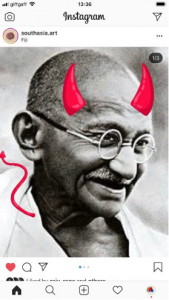
The image above is a screenshot taken from Instagram. It is a doctored image of Gandhi as the devil posted up to an account called SouthAsia Art. This image, along with others on this account are the result of an Indo-Fijian artist’s residency, where she has researched the plight of female South Asian indentured labourers in Fiji and Gandhi’s complicity with the British empire in deciding their fate. The offline conversations and activities that have resulted in this image go some way in highlighting these complex
patterns of meaning that Hine is talking about that aren’t obviously apparent on the internet alone. It would be interesting to gain an insight into the activity being done currently in Fiji around this forgotten history and the meetings and conversations that are taking place amongst the South Asian diaspora there. And it is the uncovering of a working-class female South Asian history, being done by female scholars from the diaspora that is at the heart of the activity behind this image. In this same vein, this research presents an opportunity for young British South Asians who exist outside of male, cis-gendered heteronormativity to reflect on and speak for themselves, about themselves and others who inhabit this online space. Just as the diaspora is recovering its histories, so too should it be allowed to articulate its present.
The decision to analyse participant responses was taken as opposed to analyses of digital content that users put up on their Instagram profiles as a different truth (and albeit one that is rarely researched) was found in participant’s reflections of this digital world. We know that we are beyond the point of the early days of tech utopia and simple empowerment online because the real-world systemic inequalities are perpetuated in the digital world. But what transformative elements of this world exist for its users? What are the limitations and barriers? How could participants explain, in their own words what this world represented to them? And in turn, what would these responses reveal about the wider South Asian diaspora in Britain today?
Thirty years after Stuart Hall’s discussion of ‘new ethnicities’, this paper is an attempt to try and think through the ways in which young female and queer British diaspora communities articulate themselves but also reflect on their digital selves and the issues that are confronted through their responses. Drawing on anonymised interviews conducted with 34 Instagrammers, this study attempts to make visible things that their digital content usually renders invisible.
Instagram is a photo and video sharing smartphone app launched in 2010 that enables an account holder to share content with followers who have chosen to subscribe to their account and vice versa. The particular sphere of Instagram the participants inhabit will be referred to as the South Asian Digital Diaspora space (the SADD space) throughout this paper. It is defined as a networked space that privileges articulations of gender, sexuality and culture through the lens of South Asian diaspora communities.
Many themes and issues were covered by participants in the interviews, but what stood out most were the anxieties and connections that lie behind the accounts within the SADD space. Here are some of the themes that really came to the fore and the ones that will be discussed in this paper:
- The private and public account
- Respectability politics
- Digital space invasion
- Racial neoliberalism
The private and public account
The private and public account theme was a prominent one amongst participants: this is where a user can choose to either make an Instagram account private so when someone clicks onto the account, they can’t see the content and have to put in a request to follow it. It is up to the account holder to grant them access to the content. A public account is open so anyone can view content when they click on the account. One participant talks about having a private account that ends up being infiltrated by what they term a ‘lurking profile’:
“So it’s typically a profile with not many posts at all, they follow more people than they are followed by and there’s often no profile picture and they just lurk and watch people’s stories. One of my friends alerted me coz people were making really homophobic comments about me in WhatsApp chats and I was like ‘oh damn’ I have to be careful. I blocked a lot of people after this and I thought it was a safe space because it was private but apparently it wasn’t. You don’t know whose watching, especially when you’re wanting to further your career and a lot of your art entails themes of queerness, there’s this sense of impending danger that you have lurking somewhere at the back of your mind. I think in one way, while Instagram is good in getting stuff out there, you also expose yourself which is difficult to navigate because you don’t know who’s watching.”
Another participant recently made her profile private after her comments on a photograph of a prominent Muslim Instagrammer sparked some outrage:
“There was an argument going on in somebody else’s comment section, as always! She [this famous instagrammer] wears her headscarf in quite a unique way so you can see a little bit of her hair. Then someone commented, a guy, who clearly didn’t know what he was on about saying ‘this is what fame does to you, you forget your morals, you forget your principles, you don’t wear the hijab correctly’ […] I said ‘that’s funny coming from you coz you’re a male and you don’t know the struggles of covering your hair’ […] he got angry at me and said ‘you don’t wear your hijab properly either’ and at that moment I realised for him to say that he’s seen my pictures on my Instagram […] it made me feel something, unsafe I think […] he’s looking at my photos and using that against me.”
Through these responses, we begin to understand how the public and private functions of the SADD space operate. Trying to articulate the intersections of your identity or defending another person’s can put you at risk. For the first participant, it was an ex-school friend who had created the ‘lurking profile’ – this friend had connections to the participant’s family and so there was risk of the offline world becoming an unsafe space for them. For the second participant, before this negative interaction, her profile had been public for a very long time meaning that the SADD space was where she felt safe. After this interaction, this space became unsafe.
To counter the public profile, private ones are made so there is a secret online life being lived alongside the offline life. This doubling of life isn’t new to those that have grown up in strict, conservative South Asian families, the difference is the detail that goes into this digital life and the constancy of it (you’re always carrying it around with you on your phone), which can create real anxiety for participants. The societal risks that exist within the offline and online South Asian community at large creates a barrier to self-representation for the participants, especially when it comes to issues around gender and sexuality.
Respectability politics
This barrier to self-representation, even when challenged, can remain a barrier, the result being the self-censoring of content. Participants are held up to the politics of respectability in the SAAD space. This participant says:
“I know there’s been cases where my mum’s been like ‘take that down now’ because I’m too exposed, and my mum is very liberal. She’s like ‘your projecting the wrong image out there’ and basically compared me to being a sex worker”
The images we would see on this participant’s profile isn’t how she truly wants to be seen, but how her family will allow her to be seen. What this remark makes visible are these private conversations between parents and offspring that happen behind closed doors and influence the images in the SADD space. Even though this participant describes her mum as very liberal, she tells her daughter that she is projecting the ‘wrong’ image by posting up pictures of herself in what she considers provocative clothing, equating the showing of flesh to sex work, which is very problematic for reasons we don’t have time for today . This participant’s notion of parental liberalism, or her mother’s liberalism, permits her to do things, like wear a short skirt and drink as long as it is done away from the community, that it remains invisible. And that no trace of it exists in the SADD space.
This idea of the ‘wrong image’ is echoed in this participant’s answer:
“I’m not going to say I censor it, but I can very easily choose certain issues that I know spark some kind of outrage within my parents’ communities – I would avoid those deliberately. I’m not gonna talk about my personal life so there’s nothing essentially on my profile that would make people think ‘oh my god, look what your daughter’s doing’. What am I doing? I’m just posting photos, so there’s not really anything wrong that I’m doing.”
This participant subconsciously conflates her personal life with doing something wrong – the personal: i.e: the emotional, the intimate is made to feel wrong in the SADD space, so is best kept invisible.
The SADD space is a space of self-representation that can end up being externally policed by those outside of it, especially when it comes down to articulations of sexuality, gender and lifestyle. One way of making the SADD space safe is to make it private, but even then, as demonstrated earlier, it can be infiltrated. So how can participants navigate these complex online/offline relations with some ease?
Digital space invasion
One participant said that the SADD space gave her the confidence to be more vocal about who is she within her local community:
“I think for the confidence levels and the confidence to be outspoken and political and to kind of take that change and put it back into the community as well. I’ve been able to, rather than living that entirely online, I have been able to take that back out and because I’ve shown that side of myself publicly on the internet, now it’s allowed me to show that person to the people I see in the community who’ve seen it on Instagram.”
There is an awareness that this approach comes with risk of confrontation or worse, but it demonstrates one way that these anxieties can be relieved. This approach comes down to how safe somebody already feels within their offline community.
The popularity of the SADD space goes beyond articulations of self to demonstrate the ways in which participants circumvent the traditional cultural industries, making them space invaders of industries that have historically rejected or compromised the work of British South Asian creatives, as Nirmal Puwar writes:
“As we witness a number of policy initiatives under the banner of ‘diversity’, the ‘guarded’ tolerance in the desire for difference carries in the unspoken small print of assimilation a ‘drive for sameness’. Through these processes the kind of questions that are asked as well as the voices that are amenable to being heard within the regular channels of the art world, academia, or other fields of work, can become seriously stunted.” (Space Invaders: Race, Gender and Bodies Out of Place, 2004)
This digital invasion of the cultural industries has forcibly opened up a space of difference without compromise and industry gatekeeping. One participant runs her business entirely through the SADD space and has relied on it heavily to gain recognition and get work, promoting herself specifically as a South Asian tattoo artist:
“I used my Instagram as my portfolio when I was looking for tattooing apprenticeships, and I was lucky enough to have found the apprenticeships I had because of Instagram. I used to be an apprentice at the studio I now own and they had offered me a job there because they saw and liked my work on Instagram.”
Participants have stated that they have gotten art and writing commissions, exhibitions, collaborations and job opportunities off the back of the SADD space and they also make a point of supporting each other through it:
“I’ve been able to connect with some really lovely people locally because of it and have been able to show up to events that were exclusively advertised on IG and learn about a lot of underrated hyperlocal culture that I felt needed visibility as well.”
Staying culturally true to yourself, connecting with others like you, not giving in to dominant whiteness and still financially succeeding by way of bypassing traditional gatekeepers is undeniably empowering for members of the SADD space.
Racial neoliberalism
However, it could be argued that this space, as a social media platform could be described as a cultural industry, whereby the processes of cultural production of British South
Asian identity are not without their problems. Under the racial neoliberal address, there is a call for a shift from the politics of representation to a politics of production (Anamik Saha, Race and the Cultural Industries, 2018), the constraints of which appear largely invisible within the SADD space. On a platform like Instagram, you can feel like you are in control of the processes of production behind your self-representation without having to question it further. This is a platform that has approached participants to sell products, that exists on an economy of likes and sponsorship deals and I think to not interrogate these processes of capitalist production further is to do a disservice to Stuart Hall’s conception of a politics of representation – we mustn’t forget the political. When we do, we begin to see the essentialising effects of the neoliberal processes of production, churning out what we believe to be our own truths, as one participant puts it:
“There’s this South Asian monolithic nation project happening out there which I think is something that I’m quite cautious about because I think that growing up in this country, a lot of South Asians, you’re growing up with loads of people from diasporas and to self – exoticise yourself sometimes because it does go to that at points, there is a real risk because with this collective consciousness which is coming about on Instagram, there is a convergence of more niche people into this bigger aesthetic in order to get recognition to be a part of that project.”
The convergence of South Asian religious and ethnic identities within the SADD space (usually Hindu/Punjabi and middle-class), removes the potential for a radical politics of representation, but this essentialism is not lost on some participants who inhabit the SADD space, which is promising.
Conversely, these processes of production are significant to users because the aforementioned religious and patriarchal barriers present much more of an oppression compared to that of capitalist neoliberal processes of production, which offer a type of safety and freedom to allow participants to be honest without major consequence. As recognised by some participants, these neoliberal forms of self-representation do not offer a long-term solution to systemic oppressions, but it also cannot be denied that the SADD space can be an affirming space for many of its users; this positive response from one participant is a reminder that ultimately we are all searching for ways to belong:
“It makes so much difference to know there are also other south Asians living alternative lifestyles, helping and supporting one another. Giving visibility to and sharing content from these accounts is important to me because I’m trying to be the person I needed when I was younger.”
In ‘Our Mongrel Selves’ (1992), Stuart Hall highlights how ‘strengthening of ‘local’ allegiances and identities’ might erode ‘‘centred’ nationalisms of the west European nation state’; this development could enable greater co-operation across national boundaries, but risks ‘re-valorisation of smaller, subordinate nationalisms’ based on these local allegiances.[1] Hall warns against temptations ‘to produce a purified ‘folk’ and to play the highly dangerous game of ‘ethnic cleansing’.[2] His fears are informed by genocide and forced migrations that, while he wrote, were accompanying the break-up of Yugoslavia; however, his caution might also apply more widely:
“Here, the real dislocated histories and hybridised ethnicities of Europe, which have been made and remade across the tortured and violent history of Europe’s march to modernity, are subsumed by some essentialist conception of national identity, by a surreptitious return to ‘tradition’ […] that recasts cultural identity as an unfolding essence, moving, apparently without change, from past to future.”[3]
The dilemma is how to cultivate the positive potential of folk cultures while resisting an essentialised, purist approach that could develop into fascism. One figure who grappled successfully with Hall’s problem is Bill Griffiths, a poet, Old English scholar, archivist, prisoners’ rights activist, classical pianist and sometime Hell’s Angel who stands out among the British avant-garde of the late 20th and early 21st centuries for his folkic methods, developing friendships with peripheral communities and letting their voices inform his writing. Even his earliest poems, written in the 1970s, incorporate idioms from prisoners, biker gangs and Roma. In 1990, Griffiths’ folk interests gained new focus when he moved from London to Seaham, a fishing and mining town in County Durham. He remained based there until he passed away in 2007.
Griffiths shares Hall’s appreciation of ‘real dislocated histories and hybridised ethnicities’ in any culture’s genealogy. This understanding of ‘folk’ is international, interracial and transcultural, remaining open to ongoing change. For Griffiths, ‘folk’ offers not a conservative force, but potential for radical resistance. This essay considers how these values impacted the folk-oriented research that Griffiths initiated in Seaham, including extensive work alongside long-term residents to celebrate North East dialect in the face of hegemonic, centralised Englishness. This all fed into his poetry, which periodically deployed dialect throughout his time in the region. The linguistic texture and poetic stakes show in the opening of the poem ‘On Vane Tempest Provisionally Shut, 23 October, in the Afternoon, 1992’:
While the bishop that tawks to the pollis that bray’d the miners woz marchin’,
wiv a thrang, weel-hair-comb’d mob, tiv address a petishun
til their Lord
whe lives mony a sunny mile frev here,
Satan, wiv a singular bat o’ his gristly neeve
tew’d Vane Tempest sarely, aal but drav it
clean belaw ti the sea. [4]
Vane Tempest was the last of three collieries around Seaham to shut. ‘Thrang’ means ‘busy’ or ‘crowded’; to ‘bray’ and ‘bat’ mean to ‘hit’ or ‘beat up’; to ‘tew’ is to ‘trouble’; while a ‘neeve’ is a fist.[5]
The poem demonstrates how dialect enables closely worked sound patterns. A series of subtle, often unstressed rhymes and pararhymes runs through the passage – ‘wiv’, ‘tiv’, ‘frev’, ‘wiv’, ‘neeve’, ‘drav’ – that disappear with the standard English ‘with’, ‘to’, ‘from’, ‘with’, ‘fist’, ‘drove’. Likewise, dialect pronunciation and vocabulary introduce puns that accentuate meaning. With ‘pollis’, pronunciation of ‘police’ approaches the word’s Greek root, πόλις (‘polis’) or ‘city’, aligning law enforcement with the poem’s city, either Durham (home of the local bishop, with ‘Lord’ suggesting God) or London (seat of the government whose policies led to the mine’s closure). Either way, the city represents power distanced from local concerns.
Griffiths’ engagement with North East dialect originates at his moment of arrival in Seaham. Shortly afterwards, Griffiths wrote to poet Eric Mottram: ‘I have only been here a week or so, but the difference to the tensions of the London Borough of Hillingdon is already striking, and I look forwards to making many good friends here (when I have learned the language).’[6] From most people, the parenthetical remark would seem a throwaway quip, but Griffiths meant it. He began researching local dialect, self-publishing books on the subject, as he had long done for his poetry; initially there was an anthology of
dialect texts, Durham and Around: A Dialect Reader (1993), and a lexicon, Durham & Around: Dialect Word List (1994).
It is worth noting that, for Griffiths, issues of language (dialect or otherwise) are intensely political. As early as 1974, he distributed to friends the mimeographed pamphlet Notes on Democracy, where he ruminates on the coercive power of language and outlines a programme for abolishing government itself:
Present govts seem scared to minimize change. Paradox: instability precipitates govt, but govt is limited by its own ambitions and creation from dealing with total reality. Events, populations, resources, are non-stable. So we have no continuous govts but a series of attempts. Each time a govt’s failure or corruption is exposed, and the concept of authority comes under scrutiny, we are told the only solution is an intensification of authority. Consider this in relation to English prison policy in the 1970s.[7]
Griffiths’ politics feel like anarchism, though he prefers the term ‘democracy’, holding that no British government has yet implemented democracy in its true sense. His principles extend to this text’s circulation, with a conversation or negotiation envisaged between writer and reader. He provides a wide margin on each page, as medieval scribes and early modern printers often did so that readers could add marginalia and initiate their own conversations with a text. The pamphlet concludes: ‘You are invited to use the space at the right of each page or any extra paper, to make your own comments and further points upon. You might like to return the annotated copy to Bill Griffiths, 107 Valley Drive, London NW9 9NT.’[8] Indeed, throughout his career, Griffiths leaves his texts open to continuing transformation; his editor, Alan Halsey, describes how ‘in some cases this involves revision in the commonly accepted sense, in others it is more a case of re-vision – the text reproduced verbatim but in a different page space and/or variant setting’.[9] What would this democratic, anarchistic poetics of constant renegotiation mean when actually enacted in a community, though? A few months after arriving in Seaham, Griffiths wrote A Pocket History of the Soul (1991). This essay describes how political hierarchies derive from a pernicious theology in which the human soul, with authority over the body, is in turn policed by God. Griffiths proposes that hierarchies of religion, nationhood, landlordship, colonialism and capital should all be dismantled, replaced by systems more accountable and responsive to the people they serve. This requires cultivation of skills and heightened participation in local culture by the residents:
Without participation there can be no meaningful ‘democracy’. […] Participation is thus something quite different from token consultation at a General Election, or token opportunity to put objections to some local scheme devised elsewhere by planners at county or country level. It is the opposite of social engineering since no grand theory is involved but only local conditions are taken into account.[10]
Griffiths actually came close to a position where he might have implemented his localism on a larger scale, and though he did not quite succeed, he nevertheless leveraged benefits for his neighbourhood. The inciting incident was an announcement of ‘grandiose plans for dockland redevelopment and new executive housing’, as his friend, historian Bill Lancaster, recollects:
This ‘wash and brush-up’ of Seaham was seen by Bill as the gentrification of his coastal village and a personal threat as the demolition of his home was part of the scheme. Although new to Seaham he organized and led the protests against the plan, which culminated in him standing as candidate for the council. Labour’s hold on Seaham was traditionally watertight and their candidates were usually elected unopposed. He came within a few votes of winning the seat, a shock to Labour who wisely revised the plan and left Bill’s area as it was.[11]
Griffiths saw even the Labour Party, traditional ally of North Eastern mining communities, as too distant from Seaham’s local concerns. Campaigns for regional devolution have long been active in the North East: in the 1970s, poets Colin Simms and Basil Bunting were on the committee of the Campaign for the North; a successor organisation, the Campaign for a Northern Assembly, was active but unsuccessful in 2004’s referendum on devolution for the North East; and recently, Newcastle-based scholar Alex Niven has persuasively argued for regional devolution across England.[12] None of this would satisfy Griffiths, for whom even the Durham County Council’s fiefdom is unwieldy and dehumanising. For him, the town is the level at which local democracy and culture should operate.
Griffiths’ election bid was in May 1995; the following November, Durham County Council published Turning the Tide, a report proposing removal of mining spoil from beaches between Seaham and nearby Easington. In a journal article the following year, Griffiths explained that the plan would accelerate coastal erosion, and questioned whether some spoil should be ‘tipped into Hawthorn Quarry […] making one site (the coast) pretty and another site (the abandoned, renascent quarry) ugly’.[13] He argued that the County Council’s participation in a ‘cult of the restoration of the past is necessarily delusory, unavoidably a fantasy’, betokening a ‘myth of a return to former Aryan glory’.[14] Evoking
white supremacist ideology, Griffiths parallels Hall’s wariness of seeing folk culture as ‘an unfolding essence, moving, apparently without change, from past to future’, as well as the link between this and ‘ethnic cleansing’. Griffiths, unlike the Council, shows willingness to celebrate the unexpected, notionally ‘impure’ materials that history may present.
These conflicts all manifest in the poem about Vane Tempest. The piece was published posthumously; in his computer files, Griffiths grouped it with dialect poems published in 1992–93, but it must postdate these, as it portrays later events.[15] After the description of the mine closure, the narrator receives mail:
[…] a letter cam hoy’d thru me door axin’ if we’d mebbe like
the toon-cooncil abolisht, like? Kas oor views might metter. An’ wad we like the toon-centre jis pulled doon too,
while thor at it.[16]
This refers to the gentrification scheme, and to a referendum that preceded Griffiths’ election bid, concerning the possible abolition of Easington District Council so that its functions could be centralised at County Council level.[17] Despite reservations about the District Council’s track record, Griffiths abhorred this attempt to appropriate power, as did many of his neighbours, to judge by referendum results which saw the District Council retained.
The poem continues; Satan reappears. An arch-Thatcherite, he urges Seaham’s miners to use their redundancy payments to buy shares in a newly privatised Hell – a post-
regeneration vision of Seaham where the Devil will ‘landskip ye aal in kak’.[18] This alludes to the County Council’s scheme to infill nearby Hawthorn Quarry with spoil from the beach – a near-literal landscaping of the area with excrement. Griffiths reflects:
An’ Aa stud in a stiumor. For whe knaws, i’ true, What’s plann’d?
It’s sittled
An’ leave us wi’ nowt
But dialeck for democracy.[19]
Buying shares in privatised industries, like the parliamentary phantom of democracy, bestows merely illusory control over the world – Seaham’s future is already ‘plann’d’ and ‘sittled’ between the Council and its corporate allies. ‘Dialeck’ remains the one area where some measure of personal choice can persist in defiance of such forces. Though it, too, is under siege by a hegemonic culture industry enforcing standard English, its potential remains far from trivial. It is in the aftermath of his political and environmental campaigns of 1995 and 1996 that Griffiths’ dialect activities truly took wing. While they may seem indirect actions compared to, say, running for office, in fact it was in dialect research that he was able to bring his political poetics most completely into practice.
Through the mid-1990s, Griffiths continued his dialect research in partnership with his friends Gordon Patrickson and Trevor Charlton.[20] By 1998, there was enough local interest to establish the Durham & Tyneside Dialect Group, a larger-scale project to catalogue the region’s distinctive vocabulary. This ran along collectivist lines, with Griffiths
taking the title ‘Co-ordinator’ rather than becoming leader per se.[21] In a 2006 interview, recorded during wider research into North Eastern dialects by B.B.C. Radio Newcastle, Griffiths is interviewed alongside the Group’s Secretary Tom Richardson and colleague Nichol Hopper. The conversation gives a valuable insight into their decentred methodology and organisational structure.
The interviewer asks about the trio’s experience of using or hearing local dialect terms. What’s noticeable about Griffiths’ contribution is his diffidence. He happily supplies findings from the group’s research, or etymology from his medieval studies, but lets his friends handle all the questions about personal use of dialect. It is refreshing that, despite his accomplishments, he does not impose himself as spokesman; instead, he behaves as a specialist within a collective whose other members may have expertise more pertinent to certain questions. Even when the interviewer requests an account of the Dialect Group’s methods, Griffiths asks ‘Shall I do that?’ and waits for agreement from the others before proceeding.[22] He then describes opening project to even wider participation by soliciting dialect words from the region’s wider population.
Griffiths: […] in 2001 we put out a questionnaire, quite a simple one, and that got a lot of responses, about 500 came in, and we built on that to build up a dictionary, which is published now. And that’s a mix of words from previous publications and all the words that were sent in. And, ah, people was very keen on it. We get words coming in every week, certainly, if not every day. There’s a lot to collect still. […] One I hadn’t heard before was ‘pagged’ for ‘tired out’.
Richardson: That one’s been in common use for as long as I remember, yeah. But you’ve just added it to the list, haven’t you?
Griffiths: That’s the first I heard it.
Richardson: Yeah, maybe you should get out more, Bill?[23]
Griffiths also built a website with a feature that allowed contributions to be submitted internationally. Dozens of co-authors were thereby welcomed into what eventually became A Dictionary of North East Dialect (2004; second edition 2005).
By collecting input from living speakers in this way, the Dialect Group documented speech that speech that is no mere ‘essence, moving, apparently without change’, but that constantly adjusts to its environment. For example, numerous ‘dialect terms seem to have survived by a process of doubling-up, whereby the unfamiliar term is linked into a self- explanatory compound’ – for example ‘guissy-pig’, where ‘guissy’ itself means ‘pig’.[24] Also, established dialect words have taken on new meanings:
canch (stony ridge) now used for ‘kerb’
charver (young person) now used for ‘club-goer’ duds (clothes) now used for ‘boxer shorts’
dut (bowler hat or cap) now used for ‘small woolly hat’ midden (rubbish tip) now used for ‘dustbin’
skeets (boots) now used for ‘football boots’ sneck (latch) now used for ‘catch on a yale lock’
and from earlier sources: settle (bench) used (1938) for ‘couch’.[25]
Both the Durham & Tyneside Dialect Group, and North East dialect itself, hence epitomise Griffiths’ anarchistic, democratic poetics. Like one of his ‘re-visioned’ poems, or the provisional text of A Note on Democracy, dialect words’ meanings can change when introduced to new contexts, and are subject to renegotiation through conversation. The Group exemplifies democratic participation of the kind imagined in A Pocket History of the Soul, where success depends on locally specific knowledge, and on willingness to concede
the floor when one’s own knowledge is less pertinent to particular circumstances than someone else’s (as does Griffiths in the B.B.C. interview). Most notably, just as Griffiths rejects the idea that the Durham coast ever had a supposedly ‘pure’ past, the Group celebrates (in Hall’s words) the ‘dislocated histories and hybridised ethnicities’ of their region. This manifests not only in the modern dialect’s constant flux, but in the fact that the dialect has never not been in flux. The Dictionary of North East Dialect is painstaking in cataloguing etymologies; not only are there abundant legacies of the Anglian and Norse languages (which Griffiths suspects of having creolised together to a degree during the early medieval period), but loan-words are borrowed from throughout nearby regions and nations, as well as from peripatetic communities like the Roma (the abovementioned ‘charver’ has Romani origins).[26] Griffiths also rejects the racist trope that ‘dialect signals ethnic descent.’[27] It is impossible to read the Dialect Group’s research and come away, as Hall puts it, ‘subsumed by some essentialist conception of national identity’ for the North East. A good dictionary may be the best antidote to fascism.
Griffiths’ cultural activism in Seaham, particularly around dialect research, remains a testament to the possibility of local resistance against the totalising influence of the nation – either the existing nation-state, or the ‘new nationalisms’ of locality. Likewise, in Griffiths’ poetry, dialect is how a marginalised community voices opposition to the individuals in power, highlighting the latter’s actual helplessness to grant freedom from the structures that bestow this power. In contrast, proposing one’s own structures, as Griffiths and his allies attempted through political, environmental activism, and via linguistic research, may well distribute power more equitably. The poem on Vane Tempest concludes:
Onyway,
Aa had me environmentalist badge alang wi’ me, and howk’d it oot, and confronted him wi’it,
an’ Satan bowked oot an awefu’ pump, and lowped inti the hole
the pit wiz yance,
an’ the sun cam spanglin’ oot, an’ someone somewhere
gov the bishop a thanks
as tho’ any wun man can de owt thru power
ti release ye.[28]
References
- Stuart Hall, Selected Political Writings: The Great Moving Right Show and Other Essays, ed. by Sally Davison et al. (London: Lawrence & Wishart, 2017), p.276.
- Hall, p.278.
- Hall, p.278.
- Bill Griffiths, Collected Poems Volume 3 (1992-96), ed. by Alan Halsey (Hastings: Reality Street, 2016), p.144.
- Griffiths, A Dictionary of North East Dialect (Second Edition) (Newcastle upon Tyne: Northumbria University Press, 2005), p.173, p.19, p.9, p.170–171, p.122.
- Griffiths, Letter to Eric Mottram, 9 June 1990; London, King’s College, MOTTRAM 5/100/1–36.
- Griffiths, A Note on Democracy (London: Pirate Press, 1974), n.p. Typographical errors corrected.
- Griffiths, A Note on Democracy, n.p. Griffiths’ italics.
- Alan Halsey, ‘Pirate Press: A Bibliographical Excursion’, in The Salt Companion to Bill Griffiths, ed. by Will Rowe (Cambridge: Salt, 2007), pp.55–71: p.55.
- Bill Griffiths, A Pocket History of the Soul, n.p.; section 40.
- Lancaster, ‘Bill Griffiths Northern Days’, Lancaster, Bill, ‘Bill Griffiths Northern Days’, Journal of British and Irish Poetry, 6.1 (March 2014), 13–26: 16.
- Colin Simms, ‘A Glimpse of the “Inly-Working North”: A Meeting of the Campaign for the North’, in Northern Review, 6, Spring 1998, 69–70; Alex Niven, New Model England: How to Build a Radical Culture beyond the Idea of England (London: Repeater Books, 2019).
- Griffiths, ‘Coastal Strategy in Co. Durham: Turning the Tide or Losing the Beaches?’, in Northern Review, 4, Winter 1996, 100–104: 103.
- Griffiths, ‘Coastal Strategy in Co. Durham’, p.103, p.101.
- Alan Halsey, notes to Griffiths, Collected Poems Volume 3, pp.512–513.
- Griffiths, Collected Poems Volume 3, p.145.
- Griffiths, A Century of Self-Service?: Aspects of Local Government in the North East with Special Reference to Seaham (Seaham: Amra Imprint, 1995), n.p. (section 1).
- Griffiths, Collected Poems Volume 3, p.146.
- Griffiths, Collected Poems Volume 3, p.147.
- Durham & Tyneside Dialect Group: 2005-03-22T12:00:00 (archived website): London, British Library.
- Durham & Tyneside Dialect Group.
- ‘‘Conversation in Seaham about Accent, Dialect and Attitudes to Language’, B.B.C. ‘Voices’ Recordings, 2005: London, British Library, 00:01:07.
- ‘Conversation in Seaham…’, 00:01:09.
- Griffiths, ‘Words with Edges’, Northern Review, 11, 2002, 41– 51: 49.
- Griffiths, ‘Words with Edges’, p.49. Griffiths’ underlining.
- Griffiths, A Dictionary of North East Dialect, p.xiii; p.30.
- Griffiths, ‘Words with Edges’, p.44.
- Griffiths, Collected Poems Volume 3, p.147. A ‘pump’ is a fart – Griffiths, A Dictionary of North East Dialect, p.136.
Diasporic Negotiations of Belonging and Citizenship, Cosmopolitanism from Below and the Political Aesthetics of Migration
By Caetano Maschio Santos
caetano.santos@merton.ox.ac.uk
Introduction
Echoing W.E.B. Dubois, Stuart Hall once said that the fundamental challenge of the 21st century would be “how to live with difference”. In this brief excursion through parts of my work with the Haitian diaspora in Brazil, I’ll try to showcase how music making provides us with valuable insights to reflect on how this specific black migration wave has spurred processes of negotiation and construction of cultural identities, and is struggling to be recognized as a legitimate part of Brazilian society. In the processes of creating its own spaces and pathways for political action, we find complex entanglements of Hall’s Fateful Triangle: race, ethnicity, and nation.
Haitian immigration to Brazil
Albeit still little known within the Global North, Haitian migration to Brazil has an important place within that which some name as the global “crisis” of migrants and refugees. In the Haitian case, a combination of the longue durée effects of colonialism and imperialism, restrictive immigration policies, internal political crisis (Jean-Bertrand Aristide’s ousting in 2004), international occupation through United Nations’ MINUSTAH mission from 2004 to 2017, and natural catastrophes (the Port-au-Prince 2010 earthquake) has come to affect time-honoured migration routes to the US, Canada and France that stretched back at least to the 1950s, now bent towards South America, specially to Brazil and Chile. Scholars researching Haitian migration to Brazil have linked it to the country’s significant economic growth in the first decade of the millennium, its military presence in Haiti leading MINUSTAH, to Haitians perception of or belief in a cultural affinity between Haiti and Brazil (centred on the sharing of African roots) and to restrictive immigration policies in the Global North (Audebert, 2017).
In the borderline between economic migration and climate refuge, Haitians arriving in Brazil have been granted a special humanitarian visa that affords them right to work and reside, and the possibility of bringing relatives through family reunification processes. Even though a significant percentage of migrants held higher education degrees, the staggering majority ended
up taking very precarious work, becoming cheap labour force, in activities such as civil construction and meat processing. Whilst many have worked their way out of this, one is reminded of Hall’s powerful suggestion on how race is the modality through which classed is lived – something true not only for Haitians but also for Afro-Brazilians even today, more than a century after the abolition of slavery, as income statistics continue to demonstrate the structured racial and gender inequalities in Brazilian society. Last but not least, scholars studying Haitian migration have shown how a racializing gaze has been determinant in forging the native/other divide in Brazil (Uebel, 2015), and a common experience to Haitian migrants has been the sudden confrontation with the fact of their own blackness, underscoring once more the continuing importance of the work of Frantz Fanon.
Music and Migration: Haitian artists in Brazil
As it seems to be the case with most diasporas, with Haitians also came along music, or, shall I say, an overwhelming diversity of Haitian and Caribbean musics: konpa, rap kreyòl, reggae, bachata, reggaeton, merengue, twoubadou, gospel music, etc. Haitian immigrant artists’ music making is a noteworthy grassroots cultural industry, despite still barely visible (and audible), and has gradually increased its output and sophistication, specially during the last 3 years. It is all the more surprising if we stop to consider the intense work routine that most of these artists/workers live on a daily basis, having to find the time to compose and record, the latter mostly carried out in the home studios that they have been setting up through patient savings and collective efforts. Within the remarkable diversity of this diasporic musical output, what I wish to stress here is Haitian artists’ significant engagement with Brazilian reality, a reflexive and dialogic engagement that denotes the work of truly organic intellectuals, in the Gramscian sense, through the commentary, critique and interpretation of their own lived reality in Brazil. It’s the kind of intellectual workings of what Stuart Hall called a diasporic consciousness – of those who have one foot in and one foot out, are both here and there, constantly living in translation and remaking themselves (Hall & Werbner, 2008). Particularly, I’d like to briefly comment on two specific cases to illustrate what I’ve just said.
The first one is the song “Lula livre”, by Surprise69.[1] Surprise69 is a musical group formed by Mariolove, Elnegroflow, and RealBlack, artistic names of three Haitians migrants living in São Paulo. According to them, Surprise69’s main aim is to help Haitian immigrants within and outside Brazil through art, encouraging them to pursue their dreams and vocations. In the final weeks of the 2018 presidential campaign, as right-wing candidate and now president Jair Bolsonaro approached victory, Surprise69 released in social media and Haitian WhatsApp groups a new song and video clip entitled “Lula livre” (Free Lula). Mixing freestyle hip hop verses and a sort of political campaign jingle chorus over a digitalized breakdance beat, the song was an overt manifestation of support for Workers Party (PT) candidate Fernando Haddad, and also a critique of Lula’s questionable imprisonment due to operation Car Wash. As a participant in some of the digital networks of the Haitian diaspora in Brazil, I was then witnessing Haitians’ apparent unease with Bolsonaro’s likely victory, and the compelling critiques they addressed him, facts connected to his openly xenophobic, racist and anti-minority posture. Surprise 69’s song, despite circulating mainly within the circles of the Haitian diaspora, nonetheless succeeded in converting a reading of the political moment into music that sought to enable political action, aligning itself with a powerful tradition of politically engaged music making in Haitian history known as mizik angaje (Averill, 1997), one of the most distinguished marks of cultural resistance against the Duvalier dictatorship. Since as migrants Haitians are dispossessed of the right to vote, Surprise69s’ musical agency can be viewed as manifesting a type of cultural and sonic citizenship, stemming from their own conjunctural reading and using the available means to craft belonging and make themselves heard as politically conscious subjects.
The second case I’d like to address here is overwhelmingly infused with particularities. It concerns the individual articulation of cultural identity through music by Alix Georges, a Haitian migrant living in Brazil’s southernmost state, Rio Grande do Sul. It concerns his strategic use of a popular regional song through lyric quotation in daily conversation and his translation of the song to French.[2] The song, “Canto Alegretense” by the family-based ensemble “Os Fagundes”, refers their native town of Alegrete, close to the border with Argentina and Uruguay, and can be seen to stand as a synecdoche to the state’s hegemonic narrative of cultural identity, one in which discourses surrounding the symbolic figure of the gaúcho (the horse rider and ranch peon of the countryside) have historically invisibilized the state’s black population and culture, and highlighted amongst other things the conflicting qualities of hospitality and defense against foreign invaders (Oliven, 1996). Alix’s development of a personal identification with what is known as “gaúcho regional music” (Lucas, 2000) since his first years living in the state has rendered him able to articulate his belonging in a social and cultural environment significantly marked by the hegemony of Eurocentric and white cultural standards.
The main impulse for his use of the song came from daily intercultural encounters, in which his blackness would be the focus of racializing and othering gazes, epitomized by the question of: “Where are you from?”. In these dialogues framed by what Judith Butler has called “normative schemes of intelligibility” (Butler, 2005), in the crossroads of axis of race, ethnicity and nation, Alix’s answer with the initial lines of the song (“Don’t ask me where Alegrete is, follow the path of your own heart”) resulted in a powerful and effective claim to his right to be and to belong, momentarily disrupting power relations and his own othering as a black migrant through a form of conversational sampling (Roth-Gordon, 2012). He even came up with a hybrid identity moniker to mark the uniqueness of his position: Haitiúcho, a combination of Haitian and gaúcho. The final product of this process, his translated version of the song, achieved considerable popularity within the state, and, as a consequence, got him to know the composers of the song and get their authorization to include it free of copyright charge in his CD. Significantly, he later was invited to Alegrete and awarded the official prize of “Black Star of Alegrete” by the city’s municipal chamber, as part of the celebrations of the Brazilian Black Consciousness day. This second example allows us to see how, through the able use of what is regarded as an authentic asset of regional cultural identity, Alix musically played with identity through difference, effectively countering the binary native/migrant divide. This might be seen as a consequence of his cosmopolitan outlook and engagement with local culture, a cosmopolitanism from below, of those who had little or no choice as to whether become cosmopolitans, as Hall once said (Werbner & Hall, 2008). Amongst other things, then, Alix’s musical agency speaks loudly to Stuart Hall’s comments on cultural identity within the Caribbean diaspora (Hall, 1992): the matter of “becoming” as well as “being”, the unstable points of suture made within practices of representation, within discourses of history and culture – made through a politics of positioning affected by unequal power relations.
Concluding remarks
Despite having had set aside many of the complexities of these examples, in way of conclusion I wish to stress that the black labor migrant wave that characterizes the demographics of Brazil in the last decade, of which Haitians are perhaps the most significant part, has brought to the fore issues of race and identity in a unique way, questioning the hegemonic understanding of racial relations in Brazilian society, still today marked by the ideal of racial democracy, the harmonious interracial model of the three races owed to the thinking of Brazilian anthropologist Gilberto Freyre in the 1930s – consequences that, I might say, I’m not really sure that Freyre would unhesitatingly accept. However, in real life one is confronted by the enactment of a racially marked regime of differentiated citizenship, structurally lived and enforced, both formally and informally, affecting the daily lives of Afro-Brazilians and black migrants such as Haitians. It is in such a context that the musical production of Haitian artists such as Surprise69 and Alix Georges attests to what ethnomusicologist Phillip Bohlman has named the political aesthetics of migration (Bohlman, 2011), and stands out as a significant engaged grassroots musical phenomenon. In a global context of escalating nationalism, authoritarian and conservative right-wing populism, Haitian migrants’ aesthetic agency is providing us with valuable lessons on how to learn to live with difference.
Footnotes
- The song can be viewed at < https://www.youtube.com/watch?v=QTsE7oJIIgo> [16/03/2020].
- Alix’s version can be viewed at < https://www.youtube.com/watch?v=hRHKvQJQ80I> [16/03/2020].
References
Averill, Gage. A day for the hunter, a day for the prey: popular music and power in Haiti. Chicago, The University of Chicago Press, 1997.
Audebert, Cedric. The recent geodynamics of Haitian migration in the Americas: refugees or economic migrants?. Revista Brasileira de Estudos de População. Belo Horizonte, vol. 34, n. 1, jan./abr. 2017, pp. (55-71). Available at: <http://www.scielo.br/pdf/rbepop/v34n1/0102-3098-rbepop-34-01-00055.pdf>. [04/11/2018]
Bohlman, Phillip. When migration ends, when music ceases. Music and arts in action, vol. 3, issue 3, 2011, pp. (148-165)
Butler, Judith. Giving an Account of Oneself. Ashland, Ohio: Fordham UP, 2005. University Press Scholarship Online.
Hall, Stuart. Cultural identity and the diaspora. In: WILLIAMS, Patrick; CHRISMAN, Laura. Colonial discourse and post-colonial theory: a reader. London, Harverster Wheatsheaf Ed., 1994, 222-237.
Hall, Stuart; WERBNER, Pnina. “Cosmopolitanism, Globalisation and Diaspora”. In: Werbner, Pnina. Anthropology and the New Cosmopolitanism: Rooted, Feminist and Vernacular Perspectives. Oxford: Berg, 2008.
Lucas, Maria Elizabeth. “Gaucho Musical Regionalism”. British Journal of Ethnomusicology 9.1 (2000): 41-60.
Oliven, Ruben George. Tradition Matters: Modern Gaúcho Identity in Brazil. New York: Columbia UP, 1996.
Roth-Gordon, Jennifer. “Linguistic Techniques of the Self: The Intertextual Language of Racial Empowerment in Politically Conscious Brazilian Hip Hop.” Language and Communication, 32.1 (2012): 36-47.
Uebel, Roberto Rodolfo Georg. Analysis of the sociospacial profile of international migration to Rio Grande do Sul in the beginning of the 21st century: networks, actors and scenarios of Haitian and Senegalese immigration. Master thesis, Federal University of Rio Grande do Sul (UFRGS), Geography Graduate Program, Brazil, 2015.
Our third Annual Public Conversation pursued the theme of Resistance through multiple lenses. The event, which took place on Saturday 8th February, welcomed special guests; multidisciplinary artist and designer Bahia Shehab, journalist and author Jack Shenker, investigative journalist Rebecca Omonira-Oyekanmi, sociologist Yusef Bakkali, and jazz pianist and composer Nikki Yeoh. The afternoon was chaired by Professor Ethel Brooks. Watch a selection from the day’s sessions: – Keynote from Jack Shenker 00:00:04 – Discussion panel with, Yusef Bakkali, Rebecca Omonira-Oyekanmi and Jack Shenker, chaired by Ethel Brooks 00:30:33 – Stuart Hall Foundation Chair Gilane Tawadros, introduces Nikki Yeoh 1:25:50 – Performance from Nikki Yeoh 1:26:43 www.stuarthallfoundation.orgAbstract
My recently completed PhD thesis addresses how sound and listening relate to knowledge production within the field of acoustic archaeology, or archaeoacoustics. In this presentation I will describe the epistemological challenge of the sonic for knowledge in my project, which mobilizes the echo as a feminist and decolonial material-semiotic figuration. I ask to what extent the sonic can – justifiably or not – be considered an “epistemological rupture”, and how the figure of echo might function within this.
It’s my great pleasure to come and speak at this Stuart Hall Foundation event today, having recently completed my PhD viva and following minor corrections, I will be soon closing this chapter of my life which began with the kind support of the SHF. I had the great honour of being the first SHF PhD scholar in 2015-16 at the department of Media & Communication studies at Goldsmiths College, supervised by Prof. Julian Henriques, a trustee of the SHF and family friend of Stuart Hall himself. These gatherings in previous years have always clashed with teaching obligations, so I really am happy to be here today and to meet other SHF scholars and fellows and learn about their research, which in its different ways continues Hall’s important legacy.
I wanted to use the talk today as opportunity to reflect on the work carried out as part of my PhD and tentatively ask in particular how it sits within a larger gesture of Hall’s work, which I will conceive of as measured moves towards what Hall often leaned on French Marxist structuralist philosopher Louis Althusser’s work to term “epistemological breaks” or “epistemological ruptures.” I find it useful to understand Hall’s intellectual biography as one poised on the inescapable tension between a hegemonic knowledge production paradigm and its possible alternatives. As John Akomfrah’s 2013 documentary film The Stuart Hall Project so evocatively depicted, Hall’s intellectual work was inextricable from his politics which were in turn inextricable from his lived experiences as a young Jamaican on a Rhodes scholar to Oxford University in the 1950s and subsequent decades of living as a Black academic and public intellectual in the UK. The complexity of questions of “home” “belonging” “Britishness” and race, the hybridity of postcolonial experiences – exemplifying W.E.B. Du Bois’s term of “double consciousness” in which a Black person in a white society sees themselves “through the eyes of others” and always feels one’s “two-ness” – has not only importance for understanding culture in twentieth and twenty-first century Britain, but also epistemological significances. In my thesis, I chose to use the terms “a hegemonic here” to describe the onto-epistemological paradigm inherited from an all-pervasive Eurocentric, white supremacist, cis – heteronormative- patriarchal, military-industrialist capitalist histories. Against, or rather – within and against – this “hegemonic here” of prevalent Western knowledge paradigms, I posed a “political-philosophical elsewhere” which I understand to be a common project of anti-racist, anti-imperialist, anti-fascist, feminist and anti-capitalistic thought and action for thinkers, writers and activists who also share these aims.
I’ll spend my talk today, then, attempting to explain how my project relates to this larger endeavour which aligns with how Hall conceived of the work of Cultural Studies encapsulated in part by the term “epistemological break”. As Hall describes in re-telling the history of the establishment of Cultural Studies in British academia in the Birmingham Centre for Cultural Studies in the 1970s, Althusser’s “epistemological rupture” was often used in an absolutist fashion in which the break is imagined as “clean” and distinct, rather than messy and complicated. Whatever ins and outs of Marxist and post-Marxist philosophy had happened in the academic Left in this period, Hall sought to foreground that Althusser’s general argument and approach to only understand terms and concepts in context, not in isolation from their context, as a way to comprehend “‘the problematic’—and in relation to the ‘constitutive unity of effective thoughts that make up the domain of an existing ideological field’ (Hall, 2006, p. 13), or in other formulations “the conjuncture” of a particular historical moment. Grounding investigations within a “conjuncture” was a hugely useful heuristic in my PhD investigation, thus, based within the emerging field of sound studies I’ve chosen to title my talk “a sonic conjuncture”.
To set the scene, I’d like to play an excerpt of an audio recording from my PhD fieldwork. It’s a field recording taken 3000m high up in the Central Peruvian Andes, at a 3000-year-old ceremonial temple complex and archaeological site called Chavín de Huántar. We hear three conch shell horns, known locally as pututu horns being played on the open plain. Four years of PhD research and 100,000 words I wrote in the end – there’s too much to cover in the remaining time but I’ll do my best to explain how my project attempted to probe into what a “sonic conjuncture” might mean, with regards to the project of an “epistemological break” – of the messy and complicated kind, of course.
The field of archaeoacoustics, or acoustic archaeology began with research usually cited as dating back to mid-1980s in France and became a sub-field of archaeology around 2003. Sound, listening and acoustics had long been neglected in archaeological studies of sites, but the field of archaeoacoustics sought to dislodge the dominance of the visual in archaeological knowledge production and opened up archaeology to a multi-sensory approach of which attending to how sound and listening may have played a role in human behaviours of the past was one of a few novel concerns. A small but growing field made up of a handful of researchers, my thesis involved interviews with the field’s main protagonists and participant-observer fieldwork with some key researchers. The clip I just played resulted from a trip supported by the generous participation of Dr Miriam Kolar, who has undertaken extensive archaeoacoustical research at the Andean site.
Whilst the researchers themselves, such as that evident in Dr Kolar’s extremely rigorous high calibre research, are focused on aiding archaeological understanding of a site through acoustic and psychoacoustic tests and investigations, the object of knowledge in my thesis was different to the people I interviewed. A central question in my thesis was: how do sound and listening configure within larger questions of epistemology and academic knowledge production? If Western modernity has been multiply named (and implicitly shamed) as ocular- or visuocentric, that is to say, dominated by vision, then what of sound?
Is sound and the sonic a challenge to traditional Eurocentric epistemologies? And if so, in what way?
What I’m calling for the purposes of the talk today – a sonic conjuncture – is not intended to replicate the overblown absolutist ideas of an epistemological break from the past and Eurocentric epistemological histories; none of us are “innocent” of being shaped by these dominant and deeply embedded ideas – as Patricia Hill Collins’ work in Black feminist epistemology has demonstrated the exclusion of Black women’s ideas and scholarship has perpetuated the further elevation of elite White male ideas, and disconcertingly White feminisms have all too often done little to dismantle this (Hill Collins, 2000). These structural oppressions make up the intellectual and conceptual and material “bricks” which are stuck firmly together to make institutional walls or barriers to ideas and persons who challenge this, as Sara Ahmed’s concisely chosen metaphor helps us articulate (Ahmed, 2017). Rather, as sound studies scholar Jonathan Sterne proposes, what the sonic does provide, however, is a different map to the territory (Sterne, 2003, p. 15). A sonic conjuncture, therefore, overlays onto a particular historical moment and convergence of people, things, ideas, institutions, but opens itself with curiosity to how matters of sound and listening might implicate our understanding of this moment.
As Kolar’s work, along with colleagues at the Stanford University project has helped to uncover, the site of Chavín de Huántar does have some impressive and overwhelming evidence for significant sonic behaviours taking place at the site over its 3000 year history. At least twenty intact and highly decorated conch shell horns, known locally as pututus, have been found at the site; these were transported over thousands of miles from the coast off modern-day Ecuador; engravings at the site depict anthropomorphic figures holding and blowing into these horns, suggesting beyond dispute their sonic (or music) use during ceremonies; in addition, Kolar’s detailed acoustical work has demonstrated that the complex network of built internal spaces within the mountain-top site aids the sonic transmission of the frequencies produced by the pututu horns. Sound and these horns, was by no means the only significant element of archaeological investigation of the site, but it is fair to say there is substantial evidence for it playing some substantial role in the cultures and peoples who built and used the site.
The site and its archaeology, are fascinating, undoubtedly. However, for my PhD investigation, focused on the epistemological questions provoked by sound and listening, the site of Chavín offered a particularly rich set of circumstances from which to theorize from. It was important to conceptualize knowledge production at and of Chavín thoroughly in my thesis, situating myself as a researcher, as well as situating the knowledges produced by researchers there historically from the battles between a European influenced establishment of Peruvian archaeology and its positivist epistemological models, and the Indigenous archaeology which countered some of its pervasive and false narratives about the cultural and intellectual sophistication of the Indigenous people historically in Peru. The epistemological ramifications of colonialism are multi-faceted. Yet, nevertheless, it was central to articulate that at the time Chavín was built and was active as a ceremonial temple complex by its builders, this was a pre-colonial time; before the inception of Western colonizers and merchants who enforced their cultural, political, social and economic models such as capitalism, white/European ethnocentric superiority and heteronormativity based on a dimorphic sexual difference (Lugones, 2007, 2010). Chavín existed in a conjuncture before this had become established, which is not to suggest that certain forms of what we might recognize as patriarchy did not exist, rather, it did not exist in the form which has become so prevalent since Western domination beginning from the various waves of colonialism since the 1500s and the concurrent onset of the modern period.
This outside of the “hegemonic here”, as I referred to it earlier, seems to begin to be – at least partially – conceivable in a place like Chavín. A provocative idea guides us: could it be considered a political-philosophical elsewhere, an outside (an epistemological break?) which offers an alternative mode of knowledge production, perhaps one which is not constrained by the same oppressive modes and models of modern Eurocentric patriarchal capitalist- extractivist histories? This is a question I probe and pose in my thesis. Not in order to assume any kind of clean rupture from the hegemonic here, as Hall was clear to emphasize, but rather to conceive of the potential of an alternative way of thinking and doing whilst all the time acknowledging the epistemological limitations within which this endeavour is necessary implicated and embedded within.
This is a recording made at Chavín of me clapping facing the staircases. This is a well- researched phenomenon at the pyramids of Chichén Itza in Yucatan, Mexico where this chirping sound is known to emanate from the staircases and has been theorized in archaeoacoustics to be symbolic of the Quetzal bird, a significant creature in Mayan mythology. A similar phenomenon can be observed at Chavín, although nobody as yet has undertaken any formal investigation as to whether this sonic phenomenon was of potential use or significance to Chavín’s builders.
In closing, I’ll turn to the figure of echo which was fundamental in my PhD research. I conceived of echo as a feminist and decolonial figuration which is both material and semiotic. This conceptualisation leaned heavily on feminist science scholar Donna Haraway’s famous conception of the cyborg (Haraway, 1991). A cyborgian echo, not so much in its high-tech incarnation, but rathermore in its characterisation as a material-semiotic figure, is a usefully flexible tool for understanding echo. It understands, that an echo in its contemporary definition has been formed by a scientific-acoustic model of sonic matter which is reflected to the hearer; this is its dominant material-semiotic meaning. Other commonly understood meanings can be found in the Ancient Greek myths of echo which are still well known, in which Echo is a nymph who for various reasons has been cursed to only repeat the words of others on mountaintops or other scenes of nature. My conceptualisation leans instead on Gayatri Spivak’s, who read Echo as a devious and defiant figure of différance (in a Derridean sense of deferral and difference) (Spivak, 1993). A shifting figure of the boundaries, which exudes hybridity and inbetweenness and never settles on a single fixed origin or identity. This material-semiotic figuration of echo, which I imbue with feminist and decolonial theoretical meaning in my thesis, addresses the sonic conjuncture of archaeoacoustics. This figure of echo might just offer, perhaps not “a” or “the” big epistemological break, but in the spirit of Hall’s work, help push towards the hybridity made of the multiple, minute and larger, epistemological breakages from the hegemonic epistemological modes of the modern and post-modern West that we still very much need to pursue. In Hall’s words on Cultural studies, “where old lines of thought are disrupted, older constellations displaced, and elements, old and new, are regrouped around a different set of premises and themes…[these] breaks are worth recording” (Hall, 1980, p. 57). A sonic conjuncture, in my project, was an attempt to understand how sound and listening help to figure and reconfigure knowledge paradigms of the present.
References
Ahmed, S. (2017). Living a feminist life. Duke University Press.
Hall, S. (1980). Cultural studies: Two paradigms. Media, Culture & Society, 2(1), 57–72. https://doi.org/10.1177/016344378000200106
Hall, S. (2006). Culture, media, language working papers in cultural studies, 1972-79. Routledge ; in association with the Centre for Contemporary Cultural Studies, University of Birmingham.
Haraway, D. J. (1991). A Cyborg Manifesto: Science, Technology, and Socialist-Feminism in the Late Twentieth Century. In Simians, Cyborgs, and Women The Reinvention of Nature (pp. 149–182). Routledge.
Hill Collins, P. (2000). Black feminist thought knowledge, consciousness, and the politics of empowerment. Routledge.
Lugones, M. (2007). Heterosexualism and the Colonial / Modern Gender System. Hypatia, 22(1), 186–209.
Lugones, M. (2010). Toward a Decolonial Feminism. Hypatia, 25(4), 742–759.
Spivak, G. C. (1993). Echo. New Literary History, 24(1), 17–43. https://doi.org/10.2307/469267 Sterne, J. (2003). The Audible Past: Cultural Origins of Sound Reproduction. Duke University Press.
Listen to the audio recording of The Second Annual Stuart Hall Public Conversation, held at Conway Hall on 2nd February 2019. The event gathered our growing community of artists, students, academics, cultural activists and engaged citizens to consider how to reimagine and reclaim public space in the context of our present social and political upheavals.
Pursuing this question through multiple lenses, the afternoon centred on two sets of conversations. The first, between artist Willie Doherty and curator Elvira Dyangani Ose, addressed the question of ‘how to share a place’ through Doherty’s longstanding engagement with the Ireland/Northern Ireland border. The second conversation featured a panel including Guardian columnist John Harris; sociologist Michael Rustin; and senior editor, Novara Media, Ash Sarkar. Titled ‘Meeting the Crisis: Trump, Brexit, and the Left’, it asked ‘what is to be done’. These two discussions were punctuated with interventions and perspectives from a new generation of artists, scholars and cultural activists.
Programme:
14.00: Welcome note Hammad Nasar, Stuart Hall Foundation Executive Director
14.10: Black Cultural Activism Map Presentation Farzana Khan
14.15: My time as a Stuart Hall Scholar Ruth Ramsden-Karelse
14.20: How to share a place Willie Doherty in conversation with Elvira Dyangani Ose
15.10: Joining the Stuart Hall Foundation’s work Rebecca Hall and Hammad Nasar
15.20: Tea & coffee break
15.50: Meeting the Crisis: Trump, Brexit, and the Left John Harris, Michael Rustin and Ash Sarkar, chaired by Claire Alexander
17.05: Closing remarks Gilane Tawadros, Stuart Hall Foundation Vice-Chair
17.10: Musical improvisation * Elaine Mitchener, Mark Sanders and Neil Charles * Acoustic performance—not recorded.
17.30: Event finishes
Image: Willie Doherty, At the Border IV (The Invisible Line), 1995. Image courtesy the artist and Kerlin Gallery.
“We are living through a period of profound political instability, in which old paradigms are crumbling, and new ones struggling to be born. At this moment of both possibility and danger, what does ‘resistance’ look like to those seeking it on the ground, and what exactly are the forces ranged against them?” – Jack Shenker.
The 3rd Stuart Hall Public Conversation pursued the theme of Resistance through multiple lenses, providing a chance for questions and discussion, and punctuated with interventions and perspectives from a new generation of artists, scholars and cultural activists.
The event was introduced by the Stuart Hall Foundation’s new Executive Director Ruth Borthwick, who welcomed multidisciplinary artist and designer Bahia Shehab to deliver the opening presentation.
Journalist and author Jack Shenker took to the stage for a keynote speech. Drawing on his deep reporting on grassroots movements in different parts of the world over recent years, Jack told the story of two young people several thousand miles apart – one in Manchester, England, another in Cairo, Egypt – to explore how the children of the financial crisis are fighting to widen their political imaginations, and often paying a heavy price in return.
Delivered at the Institute of Contemporary Arts, 5 June 2019
A panel discussion with David Morley, Angela McRobbie, Roshini Kempadoo and Clive Nwonka, chaired by Julian Henriques
Despite the fact that the title for the session stresses Stuart`s relevance to the `here and now`, just for a moment, I want to go back and say some things of a more general nature. In doing so, I want to focus not so much on what Stuart did or said but on how he did it—his `methodology` we might say—and on how we might learn from that.
However, in saying that, we also have to note how difficult it is to learn things from the past. There is an exemplary rendition of that difficulty in the publicity for Nick Beech`s forthcoming event on Policing the Crisis. In that publicity Nick quotes Stuart on how, if you want to use something like Gramsci’s comments on regional culture in Sardinia to inform your own analysis of some other situation, you have to ‘dis- inter’ them from their original context, very carefully, if you are hoping to transplant them elsewhere—as it’s rather more than a cut-and-paste job
But apart from all that, today has many resonances for me: 20 years ago, I took part in another launch event here at the ICA, for a book of essays by and about Stuart called Critical Dialogues in Cultural Studies. One of its reviewers remarked in a jocular (but telling) ‘aside’ that anyone writing a novel about the British intellectual left in the post-war period might well find themselves ‘spontaneously reinventing a figure exactly like Stuart Hall, so much had his personal narrative and the public history and 20th century Britain been intertwined—at once, deeply symbiotic and sharply at odds’. Looking back at the publication of that book in 1997—and at the influence which Stuart’s work continues to have today, both in academia and in public discussion of cultural politics—it is its sheer prescience that is most striking…
The question of his continuing influence also relates to his conception of how cultural power operates. He was particularly interested in how systems of hegemony work almost ‘invisibly’—through their capacity to set the limits of common sense—and thus set the horizons of thought—in a given period. They do this by establishing certain propositions to be so self-evidently true that they don`t have to be stated explicitly – so they literally ‘go without saying’. (1) The ideological twist here, of course, is that while common sense always presents itself as natural and ‘timeless’, its actual contents are radically changeable over time. To take one example, in the early 70s ‘monetarism’ was an obscure (and much derided) bit of specialist economic theory; a decade later it had become the taken for granted common sense of Thatcherism. Today it still provides the intellectual rationale for the assumed necessity to reduce the ‘national deficit’—a presumption which has condemned us all to the last 10 years of austerity politics
While I`d certainly regard Stuart’s influence on things as considerably more benign than that of monetarism, I want to propose a formal analogy, in so far as in both cases, the influence is so profound that it becomes almost invisible. His work has had a similarly transformative effect on the ‘common sense’ of the many academic
disciplines which have, in recent years, undergone a ‘cultural turn’ as a result of their engagement with the cultural studies that Stuart originated.
Nowadays, it ‘goes without saying’ that issues of culture and representation are as important as questions of economics; that we must pay attention not only to class, but also to questions of race, ethnicity, gender and sexuality; and that our very definition of the field of the ‘political’ must be extended to include its popular and vernacular forms. However, if all that now seems to be no more than common sense, that is precisely because work such as Stuart’s has made it so
Having said that, let me turn to the books. My most difficult task, as the editor of the two volumes whose publication we celebrate today, was that of finalising the selection, from the vast range of Stuart`s essays, of a plausibly ‘representative’ sample. My priority has been to situate them in the context of the conjunctural debates to which they were variously contributed. I`ve also been concerned to highlight the continuities that underlay them. If Stuart always wanted to push any argument forward, he was nonetheless opposed to any simple model of intellectual ‘progress’: and was also concerned, as he put it, to ‘honour’ his intellectual debts to the positions he was trying to transcend.
Let me just mention some of those continuities, which became increasingly apparent, the more I re-read essays written sometimes 30 or 40 years apart…
One was the continuing influence of his early training in literary methods of analysis and his insistence on the necessity of close attention to the text—an approach derived from literary scholars such as F R Leavis (2). Indeed, while he entirely rejected Leavis’ politics, he was still at pains to recognise his ‘moral seriousness’—a quality which informed Stuart`s own abiding concern with questions of aesthetic and cultural value. He had no time for the uncritical celebration of popular culture, but rather, aimed for the ‘de-canonisation of the established categories alongside the retention of the critical function’.
What also became clearer to me in the editing process was the extent to which concerns with race and ethnicity already informed his earliest work—so that even when he is ostensibly talking about class, he is usually doing so from a diasporic perspective. Conversely, it was his critique of conventional Marxism`s deterministic models of class, which provided what Kobena Mercer described as the ‘architechtonic grounding’ which enabled his later deconstruction of essentialist models of race and ethnicity. From what I have heard, it seems that the recently opened archive of Stuart`s files at the Cadbury Research Library in Birmingham will throw considerably more light on these inter-connections.
Another striking continuity I found was how Stuart`s analyses of the recomposition of the class structure in the ‘affluent societies’ of the 1950s, had already laid the conceptual groundwork for his later work on the emergent consumer cultures of the ‘new times’ of Post-Fordism and then of Neo-Liberalism
If, as you probably all know, Stuart said that he had found himself ‘dragged into Marxism backwards’ by the events of 1956, what also became clearer to me, the longer I was immersed in the essays, was how much, right from his time in Oxford,
Stuart had always been engaged with Marxism from outside its Eurocentric presumptions. As he notes, almost all the group to which he belonged were from the ex-colonies. We see there a glimpse, right at the beginning, of the hybrid origins of what came to be called ‘British’ Cultural Studies
It was that perspective which provided the intellectual basis from which he went on to produce his later critique of ethnocentric perspectives on globalisation: his Marxism was always ‘de-centred’ by his liminal perspective as a ‘marginal native’ or, as Bill Schwarz`s book-title has it, a ‘familiar stranger’ in the West.
Nonetheless, the central concerns of Marxism—how changes in the mode of production related to changes in socio-political formations; how to provide a historical perspective on present day events— were never far away. Right to the end, he remained deeply concerned with these questions—and especially the question of periodisation. But we also find him already posing them (if in a rather different vocabulary) as early as 1958, when he asks, in ‘A Sense of Classlessness’— ‘where does the old end, where does the new—the really new, not the superficially new—begin?’
Stuart would never, of course, have claimed to have a definitive answer to any such question—his was always a more modest search for provisional truths. However, it was a search conducted in the utmost seriousness, if accompanied by a wry chuckle at the most intellectually challenging moments. That chuckle was no incidental mannerism—David Scott is right to point us towards Fanon’s observation that the quality of a man is to be found not simply in his acts, but in the ethos of his intellectual style. In Stuart`s case, the conviviality of his particular style was manifested not simply in what he did himself but also in what he enabled so many others to do—and can still enable us to do, today.
But, to return to my beginning… today’s panel also has a resonance with other important events here—such as the conference which led to the first publication of Stuart`s ‘New Ethnicities’ paper in 1988 in the ICA’s ‘Black Film and British Cinema’. Evidently today, the relative optimism of that moment has been largely superseded, as poisonous forms of xenophobia, which we might have hoped to have left behind by now, have been re-legitimised by contemporary political discourse. But I will say no more of that for now, as I know that my fellow panellists also have plenty to say about all this…
Notes
- In the discussion of the changing modes and varieties of ‘authoritarian populism’ which took place in this session, Tony Jefferson made the important point that one of the things about common sense is that it is, itself, inevitably authoritarian—precisely insofar as it sets limits to what it is that might be deemed to be ‘sensible’.
- In her presentation of Stuart’s essay on ‘Deconstructing the Popular’ in this session, Angela McRobbie discussed the complex ways in which the media ‘ventriloquise’ popular sentiment. In doing so, she offered one very good example of where close textual analysis is necessary to reveal the complexity of the ideological processes in play. She referred to the resonant phrase which was used at one point in discussion of ‘welfare scroungers’—who were described in the popular press as wasting their time ‘sleeping off a life lived on benefits’. The rhetorical slight of hand in the phrase is astonishing: alcohol is never mentioned directly, but the clear implication is that such (feckless) people are only not working because they are too preoccupied with ‘sleeping off’ their hangovers. More than that, their whole life is somehow metaphorically reduced to being no more than one long, wasteful ‘hangover’. Overall, those seven little words offer in a seemingly colloquial fashion, a vicious characterisation of the ‘undeserving’ poor.
SWEET TOOTH is a cross-disciplinary music theatre piece devised by vocal and movement artist Elaine Mitchener. It uses text, improvisation and movement to stage a dramatic engagement with the brutal realities of slavery, as revealed by historical records of the British sugar industry and to illuminate its contemporary echoes. The work was commissioned by Bluecoat Liverpool in partnership with the Stuart Hall Foundation and the International Slavery Museum. It was premiered at the Bluecoat, Liverpool in November 2017 and at St. George’s Bloomsbury, London in February 2018.
Gilane Tawadros (GT): How did you come to conceive SWEET TOOTH as a performance work?
Elaine Mitchener (EM): Musical ideas spring from the strangest sources. The idea for SWEET TOOTH came from a shared addiction of Scottish Tablet with my late father. That crumbly sweet substance sparked many questions in my mind concerning the deadly cost to human life and livelihood of one race in order to feed the addiction and greed of another; and how far people will go to satisfy their desire to gain wealth and satiate an appetite.
The Sugar Trade and the enslavement of millions of Africans, represented the zenith of capitalism; in other words, the removal of its most costly item: paying people for their work. By dehumanising one race, another gained in prosperity and wealth and the vast funds received in turn were used to develop Western society at all levels – education, culture, medicine, science – which we profit from today.
How could I tackle this vast topic through music? Was music the right medium through which to examine this area of human history? Did I have a right to? I had no idea how all-consuming this exciting journey would be.
My practice works primarily in movement and voice. Over the last five years working collaboratively with the choreographer Dam Van Huynh, I have created a technique which is grounded in classical vocal training (my teacher Jacqueline Bremar is brilliant) but also enables me to employ the physicality of contemporary dance. My philosophy of encounter-enact-engage allows me to develop and devise works combining found texts, sound, movement, vocalization, improvisation, and collaboration to create intimate and experimental music theatre performance pieces. Pulling together a team of extraordinary musicians, Sylvia Hallett, Marks Sanders and Jason Yarde along with Dam Van Huynh and invaluable guidance and insight from historian Christer Petley, we undertook two years of research and development.
I started creating from a blank space. The only definite idea I had was that I knew I wanted people to experience the work live and that sound would be integral. Through reading research, discussion and learning, it became clear to me that the work required a strong aural basis and not just a physical one. Meditating on what it might have been for enslaved Africans to experience the unknown and the sound and smell of fear, the strength, self-determination and resolve of rebellion; the essential activity of song and dance as a constant reminder of one’s own humanity, history, tradition; these became the cornerstones of the work from which I was able to build a skeletal framework to hang ideas on.
The next stage was to ask the team to engage with the topic fully and to find their own personal ways into it. To embody the feelings for themselves; place themselves and their families into the situation and to express their reactions musically. What became clear (and what I had in mind) was that this work was not going to be a comfortable experience for us or the audience and it ought not be. I will have failed if people applaud loudly, whoop and cheer. So far the response has been silent reflection and thoughtful discussion afterwards, but I can’t prevent an audience from responding to the work in a more enthusiastic way.
GT: SWEET TOOTH is a very uncomfortable piece to experience and it is an experience rather than a spectacle. It draws you in to a sequence of episodes or movements but has no overarching, linear narrative as you would expect from a fictional novel or a historical account. Can you say some more about the piece’s relationship to historical research and how your approach to source material differs from that of a historian?
EM: It’s such an immense subject that it was very clear early on that I would need to work with an expert to check facts and to alert me to current research and resources that might prove useful to the development of my ideas around the work and how to present it. Working with Dr Christer Petley proved
invaluable and I believe we learnt a lot from each other. I wanted to avoid voyeurism, victim ‘porn’ or any kind of spectacle and the idea was to try and evoke an unnerving sense of tension, claustrophobia and entrapment. Of course, one can never know what that really felt like, but we have narratives and accounts, diaries which describe each step of the experience, albeit mainly from the oppressor’s point of view.
Not being a historian enabled me to focus on other aspects of the source material. Being a musician, I decided to draw the audience’s attention to sound as the narrative, the sound of people, their voices, their expression of rage, fear, defiance, joy, comfort. These would be reminders that, although reduced by their oppressors to being part of the huge machinery of slavery, enslaved Africans were people who dreamed, loved, hoped and resisted, and finally overcame.
The vast knowledge base of historians is enviable. They are able to digest what they’ve painstakingly researched and re-present it for public understanding. However, I find that this is all conducted in a clinical way, as though these events are being viewed under a microscope or at arm’s length. The purpose of SWEET TOOTH was to give a voice to those millions of people lost to slavery. Recalling their given names reminds us of their humanity. Referencing their work songs and rituals allows us to honour the culture which they developed and the legacy of which remains to this day. My job was to liberate the dry historical facts and somehow breathe life into them.
It was a challenge for me to view the historical material researched with an academic eye. I had to seek ways to absorb information, much of which was deeply upsetting, disturbing and difficult to accept. I had to digest it as historical fact and allow myself to find a creative and artistic response to it.
My decision to work abstractly with words was a conscious one in that I did not want them to obstruct the sound experience. Where words are used, they are used sparingly and are quickly fractured. Because SWEET TOOTH is also a visual work, I felt strongly that any ‘narrative’ could be felt and heard without the use of words.
GT: Can you say something about the episodic structure of SWEET TOOTH which has been conceived as a series of distinct chapters or movements?
EM: The decision to call these movements ‘chapters’ was a deliberate way of anchoring the work and the fact that it concerns a tragic episode, not only in the history of black people but in the history of humanity. This holocaust has repeated itself at different periods of human history. I employed a creative
semantic approach to liberate the source text material from books. Slavery in the British Caribbean was operated at a conveniently safe distance (not within the British Isles as in North America), and therefore I couldn’t draw upon personal familial accounts or records. In this way I was more like an historian because of the slight impersonal distance.
GT: You are also a jazz musician, working with other musicians and using improvisation and other techniques to create unique sounds and compositions. How has this influenced the way in which you approached and composed SWEET TOOTH?
EM: I consider myself as a musician who works across and draws on difference genres: experimental/free-jazz, avant-garde contemporary new music, gospel, Afro-Caribbean (Jamaican) music, free-improvisation and I think these influences can be heard in this work. I never thought about ‘composing’ the work. Having worked with composers and performed works by composers, I realised that my approach would need to be different to work effectively. I always wanted a sonic experience and with movement SWEET TOOTH is a work that is seen and felt. Early on I imagined it as a radio piece (so I’m pleased it was eventually broadcast on BBC Radio 3), but as the piece developed over two years it told me that it also had to be a visual / movement experience. Lighting also plays a musical part in this work and Alex Johnston has designed incredibly striking lighting moods which move the work forward.
The artists I have brought together for this project bring with them a wealth of experience and expertise along with an openness to trying new ideas. We are all well versed in the world of free-improvisation, however, for SWEET TOOTH I knew its musical world couldn’t be defined or restricted in this way. So we came together to workshop and research ideas and devise the piece along with Dam who was invaluable in helping us to access organic natural movement whilst playing.
Over time I was able to construct a method of structured improvisation upon which we were able to hang the skeletal form of the work. This method allows us the freedom to improvise whilst retaining the structural, musical form of the work. So although the concept is mine, how we arrive at realising it is very much a collective effort. My job was to work out what to retain or mull over an idea and to have the confidence to discard something because it’s not right for the work. It’s very important that each of us feels ownership of the work and finds our own narrative that can be communicated. It then becomes a powerfully direct statement of humanity to humanity.
GT: The events and experiences to which SWEET TOOTH refers took place in the historical past. What can this past teach us in the present?
EM: According to Michael Craton in his book Testing the Chains: Resistance to Slavery in the British West Indies, ‘Historians who believe history to be the story of man’s rise to civilisation tend to define civilisation to include the acceptance by all classes of their place with the socioeconomic system.’ Even from a liberal point of view its appearance is essentially that of accommodation and acceptance. These ideas have been challenged by writers and commentators such as CLR James and Herbert Aptheker, also the Jamaican writer and cultural theorist Sylvia Wynter and her theory of the human, which she discusses in her essay “Unsettling the Colonially of Being/Power/Truth/Freedom: Towards the Human, after Man, Its Overrepresentation – An Argument.” The Atlantic Slave Trade, the Middle Passage, which largely took place during the so-called Age of Enlightenment, marked a brutal and catastrophic period of human history. The past teaches us a lesson that we seem unable to understand and learn from: humanity’s capacity for inhumanity. Professor Catherine Hall said that it’s easy to think that those involved in the slave trade are different to us, that we are different to them. We are not. Only when we acknowledge this simple truth are we able to change and make changes.
Gilane Tawadros is Vice-Chair of the Stuart Hall Foundation.
SWEET TOOTH has been supported with public funding from Arts Council England. Commissioned by Bluecoat in partnership with the Stuart Hall Foundation, London and The International Slavery Museum with further support from PRSF Open Fund, Edge Hill University, John Hansard Gallery, Centre 151 and St George’s Bloomsbury.
To celebrate the launch of Ting-Ting Cheng’s On the Desert Island, the outcome of the first ever Stuart Hall Library Artist’s Residency, Ting-Ting was in conversation with Stephanie Moran, Iniva’s Library Manager.
Offering a unique way to explore Iniva’s remarkable collection, On the Desert Island takes its cue from Professor Stuart Hall speaking to Sue Lawley on BBC Radio 4’s Desert Island Discs in February 2000. On the long-running radio show, the presenter asks the guest to punctuate their conversation with eight records they would choose to take with them if they were cast away on a desert island. Ting-Ting Cheng draws on the recording of Professor Stuart Hall’s interview to create an audio map which imagines the Stuart Hall Library as islands with its bookshelves and contents as land mass to be negotiated.
Find our more about the Stuart Hall Library Residency here.The Stuart Hall Library Residency has been jointly funded by Iniva and the Stuart Hall Foundation.
During the big antiwar protests in early 2003, Ta-Nehisi Coates was a deliveryman for a deli in Park Slope, Brooklyn. He, too, was ‘sceptical’, he wrote a decade later in a blog post for the Atlantic, ‘but if the US was going to take out a mad tyrant, who was I to object?’ After all, as Coates remembered, ‘every “sensible” and “serious” person you knew – left or right – was for the war.’ ‘I am not a radical,’ Coates said. Even so he found it ‘searing’ to watch ‘reasonable people assemble sober arguments for a disaster’.
In retrospect, the most remarkable of these reasonable people were not the neoconservatives but the liberals – some of them now Coates’s colleagues and supporters – who recommended war and condoned torture while advancing America’s mission to bring democracy to the world’s benighted. In The Fight Is for Democracy (2003), George Packer argued that a ‘vibrant, hardheaded liberalism’ could use the American military to promote its values. The subtitle of The Good Fight (2006) by Peter Beinart, the then editor of the New Republic, insisted ‘Why Liberals – and Only Liberals – Can Win the War on Terror and Make America Great Again’. ‘It’s time to think of torture,’ Newsweek declared a few weeks after 9/11. ‘Focused brutality’, Time recommended. Vanity Fair praised Rumsfeld for his ‘oddly reassuring ruthlessness’. As the invasion of Iraq got underway, the Atlantic, described as ‘prestigious’ by Coates in his new book, walked its readers through the advantages of ‘torture-lite’ in a cover story. In the New York Times Magazine, Michael Ignatieff, biographer of Isaiah Berlin and professor of human rights, exhorted Americans to embrace their imperial destiny and offered his own suggestions for ‘permissible duress’. Even the New Yorker, fastidiously aloof from Beltway schemers during the Cold War, published a report by Jeffrey Goldberg, the Atlantic’s current editor, detailing links between al-Qaida and Iraq – links later revealed to be non-existent. Goldberg’s article was seized on by Bush and Cheney: the New Yorker had become, as an unusually bold writer in the Nation pointed out, ‘one more courtier straining to get the king’s ear’. But the Bush administration didn’t need eggheads to euphemise pre-emptive war, torture, rendition and indefinite offshore detention. Bush’s own demotic – ‘We’ll smoke them out,’ ‘wanted dead or alive’, ‘Pretty soon, we’ll have to start displaying scalps’ – repeatedly invoked wars of extirpation against what the Declaration of Independence had called ‘merciless Indian Savages’. ‘When this is all over,’ Cofer Black, Bush’s chief counterterrorist adviser, assured his boss, ‘the bad guys are going to have flies walking across their eyeballs.’ The mood was infectious among the personnel in charge of exterminating the brutes. The Atlantic’s Robert Kaplan cheerfully reported that ‘Welcome to Injun Country’ was the refrain among American soldiers worldwide. The primal blood-lusts of the war on terror survived Obama’s renaming of it. The Seal Team that in 2011 eventually scalped Osama bin Laden (code-named Geronimo) carried 14-inch hatchets made by a North Carolina knife-maker known for his blades in the 1992 film The Last of the Mohicans. Obama administration officials volunteered details of the wildly popular slaying to the makers of the 2012 film Zero Dark Thirty, which depicted (falsely) swarthy villains revealing bin Laden’s hideout under torture. ‘A racist society can’t but fight a racist war,’ James Baldwin wrote in 1967, ‘the assumptions acted on at home are also acted on abroad.’ During the war on terror the traffic between the US and various shithole countries wasn’t only in assumptions: there was also a wholesale exporting of equipment, technologies of torture and bad lieutenants. To take one instance, Richard Zuley, a specialist at Guantánamo, had become reassuringly ruthless while working for a Chicago police unit that for decades interrogated predominantly African-Americans at so-called black sites. It’s only now, with a white supremacist ensconced in the White House, that those same hardheaded liberals – who did so much to create a climate of opinion and a legal regime in which black and brown bodies could be seized, broken and destroyed outside all norms and laws of war – are coming to grips with ‘America’s Original Sin: Slavery and the Legacy of White Supremacy’ (an unlikely recent headline in Foreign Affairs). Back in the early 2000s the liberal universalists seemed unaware that their project might be fatally flawed, and that America’s own democracy had been secured by mass bondage, colonial dispossession and wars of aggression; they still hadn’t fully reckoned with the historical legacy of institutionalised racial cruelty, inequality and division – what Coates has come to describe. ‘In America,’ Coates writes, ‘it is traditional to destroy the black body – it is heritage.’ ‘To be black’ is to be perpetually ‘naked before the elements of the world, before all the guns, fists, knives, crack, rape and disease’. The liberal freedoms of propertied men were always defined against omnipresent threats: mutinous natives, rebellious slaves. The white man, Tocqueville wrote as he observed race relations in America, ‘is to the men of other races what man himself is to the animals’, in the sense that he ‘makes them serve his purposes, and when he cannot make them bend, he destroys them.’ A social order built on systemic violence made the black man, Tocqueville recognised, an ever present menace in his white master’s imagination. This proximity to a nemesis made a culture of fear central to American politics, entailing a continuous investment in the machinery of coercion, surveillance and control, along with pre-emptive brutality against internal and external enemies. Coates, who was born in 1975, came of age just as a new Jim Crow was emerging domestically to accompany Bush Sr’s new world order. ‘By God, we’ve kicked the Vietnam Syndrome once and for all!’ So Bush Sr said in a euphoric victory statement at the end of the Gulf War. The kicking of the Vietnam Syndrome and ‘Saddam Hussein’s ass’ signalled the removal of all restraints on American power imposed by dogged gooks and their traitorous allies on the American left. With America free to police the world, old legal and moral barriers were also dismantled at home. Just as Coates entered Howard University and began his harsh education in American history, the stage was set for a pitiless imposition of market discipline and evisceration of welfare-state protections. Such drastic socioeconomic re-engineering required a fresh public consensus, and a racialised view of crime and national security came in handy in separating the deserving from the undeserving. Under Reagan, the police had started to resemble the military with its special weapons and bellicose posturing. The prison-industrial complex burgeoned under Bill Clinton: an incarcerated population of 300,000 in 1970 expanded to 2.1 million in 2000 – the majority black and brown, and poor. Liberals did not simply inherit Republican schemes of harsh policing and extreme punishment. They took the initiative. Clinton, hailed as the ‘first black president’ by Toni Morrison, ended what he called ‘welfare as we know it’ and deregulated financial markets. Amid a national panic about ‘street terrorists’, he signed the most draconian crime bill in US history in 1994, following it up two years later with an anti-terrorism bill that laid the foundation for the Patriot Act of 2001. The intimate relationship between America’s internal and external wars, established by its original sin, has long been clear. The question was always how long mainstream intellectuals could continue to offer fig-leaf euphemisms for shock-and-awe racism, and suppress an entwined history of white supremacism and militarisation with fables about American exceptionalism, liberalism’s long battle with totalitarianism, and that sort of thing. Hurricane Katrina, coming after the non-discovery of WMDs in Iraq, undermined liberal faith in Bush’s heavily racialised war. American claims to global moral leadership since the 1960s had depended greatly on the apparent breakthrough of the civil rights movement, and the sidelining of the bigots who screamed: ‘segregation now, segregation tomorrow, segregation for ever’. In New Orleans, black bodies naked before the elements of the world – elements which included trigger-happy Blackwater mercenaries guarding the rich – made it clear that old-style racial separation had been replaced by sharply defined zones of prosperity and destitution: segregation for ever. But the apparent successes of social liberalism, culminating in Obama’s election, managed to obscure the new regimes of racial sequester for a while longer. Since the 1990s, the bonanzas of free trade and financial deregulation had helped breed greater tolerance for racial and sexual variety, primarily among the privileged – the CIA under Obama set up a recruiting office at the Miami Beach Gay Pride parade. Overt racism and homophobia had become taboo, even as imprisonment or premature death removed 1.5 million black men from public life. Diversification and multiculturalism among upwardly mobile, college-educated elites went together with mass incarceration at home and endless military interventions abroad.In many ways , Coates’s career manifests these collateral trends of progress and regress in American society. He grew up in Baltimore at the height of the crack epidemic. One of his own friends at Howard University in the 1990s was murdered by the police. Coates didn’t finish college and had been working and writing for small magazines when in 2008 he was commissioned by the Atlantic to write a blog during Obama’s campaign for president. Three books and many blog posts and tweets later, Coates is, in Packer’s words, ‘the most influential writer in America today’ – an elevation that no writer of colour could previously have achieved. Toni Morrison claims he has filled ‘the intellectual void that plagued me after James Baldwin died’. Philip Roth has been led to histories of American racism by Coates’s books. David Brooks credits him for advancing an ‘education for white people’ that evidently began after ‘Ferguson, Baltimore, Charleston and the other killings’. Even USA Today thinks that ‘to have such a voice, in such a moment, is a ray of light.’ Coates seems genuinely embarrassed by his swift celebrity: by the fact that, as he writes in his latest book, We Were Eight Years in Power, a collection of essays published in the Atlantic between 2008 and 2016, ‘I, who’d begun in failure, who held no degrees or credentials, had become such a person.’ He also visibly struggles with the question ‘Why do white people like what I write?’ This is a fraught issue for the very few writers from formerly colonised countries or historically disadvantaged minorities in the West who are embraced by ‘legacy’ periodicals, and then tasked with representing their people – or country, religion, race, and even continent (as in the New York Times’s praise for Salman Rushdie: ‘A continent finding its voice’). Relations between the anointed ‘representative’ writer and those who are denied this privilege by white gatekeepers are notoriously prickly. Coates, a self-made writer, is particularly vulnerable to the charge that he is popular among white liberals since he assuages their guilt about racism.
He doesn’t have a perch in academia, where most prominent African-American intellectuals have found a stable home. Nor is he affiliated to any political movement – he is sceptical of the possibilities of political change – and, unlike his bitter critic, Cornel West, he is an atheist. Identified solely with the Atlantic, a periodical better known for its oligarchic shindigs than its subversive content, Coates also seems distant from the tradition of black magazines like Reconstruction, Transition and Emerge, or left-wing journals like n+1, Dissent and Jacobin. He credits his large white fan club to Obama. Fascination with a black president, he thinks, ‘eventually expanded into curiosity about the community he had so consciously made his home and all the old, fitfully slumbering questions he’d awakened about American identity.’ This is true, but only in the way a banality is true. Most mainstream publications have indeed tried in recent years to accommodate more writers and journalists from racial and ethnic minorities. But the relevant point, perhaps impolitic for Coates to make, is that those who were assembling sensible arguments for war and torture in prestigious magazines only a few years ago have been forced to confront, along with their readers, the obdurate pathologies of American life that stem from America’s original sin. Coates, followed by the ‘white working classes’, has surfaced into liberal consciousness during the pained if still very partial self-reckoning among American elites that began with Hurricane Katrina. Many journalists have been scrambling, more feverishly since Trump’s apotheosis, to account for the stunningly extensive experience of fear and humiliation across racial and gender divisions; some have tried to reinvent themselves in heroic resistance to Trump and authoritarian ‘populism’. David Frum, geometer under George W. Bush of an intercontinental ‘axis of evil’, now locates evil in the White House. Max Boot, self-declared ‘neo-imperialist’ and exponent of ‘savage wars’, recently claimed to have become aware of his ‘white privilege’. Ignatieff, advocate of empire-lite and torture-lite, is presently embattled on behalf of the open society in Mitteleuropa. Goldberg, previously known as stenographer to Netanyahu, is now Coates’s diligent promoter. Amid this hectic laundering of reputations, and a turnover of ‘woke’ white men, Coates has seized the opportunity to describe American power from the rare standpoint of its internal victims. As a self-professed autodidact, Coates is primarily concerned to share with readers his most recent readings and discoveries. His essays are milestones in an accelerated self-education, with Coates constantly summoning himself to fresh modes of thinking. Very little in his book will be unfamiliar to readers of histories of American slavery and the mounting scholarship on the new Jim Crow. Coates, who claimed in 2013 to be ‘not a radical’, now says he has been ‘radicalised’, and as a black writer in an overwhelmingly white media, he has laid out the varied social practices of racial discrimination with estimable power and skill. But the essays in We Were Eight Years in Power, so recent and much discussed on their first publication, already feel like artefacts of a moribund social liberalism. Reparations for slavery may have seemed ‘the indispensable tool against white supremacy’ when Obama was in power. It is hard to see how this tool can be deployed against Trump. The documentation in Coates’s essays is consistently impressive, especially in his writing about mass imprisonment and housing discrimination. But the chain of causality that can trace the complex process of exclusion in America to its grisly consequences – the election of a racist and serial groper – is missing from his book. Nor can we understand from his account of self-radicalisation why the words ‘socialism’ and ‘imperialism’ became meaningful to a young generation of Americans during what he calls ‘the most incredible of eras – the era of a black president’. There is a conspicuous analytical lacuna here, and it results from an overestimation, increasingly commonplace in the era of Trump, of the most incredible of eras, and an underestimation of its continuities with the past and present. In the sentimental education of Coates, and of many liberal intellectuals mugged by American realities, Obama is the culmination of the civil rights movement, the figure who fulfils the legacies of Malcolm X as well as Martin Luther King. In Jay Z’s words, ‘Rosa sat so Martin could walk; Martin walked so Obama could run; Obama is running so we all can fly!’ John McCain, hapless Republican candidate in 2008, charged that his rival was a lightweight international ‘celebrity’, like Britney Spears. To many white liberals, however, Obama seemed to guarantee instant redemption from the crimes of a democracy built on slavery and genocide. There is no doubt that compared to the ‘first black president’, who played the dog whistle better than the saxophone, a hip-hop enthusiast and the son of a Kenyan Muslim represented a genuine diversification of America’s ruling class. Obama offered his own ascent as proof that America is an inclusive society, ceaselessly moving towards a ‘more perfect union’. But such apparent vindications of the American dream obscured the limited achievement of the civil rights movement, and the fragility of the social and political consensus behind it. The widespread belief that Obama had inaugurated a ‘postracial’ age helped conceal the ways in which the barefaced cruelties of segregation’s distant past had been softening since the 1960s into subtle exclusions and injustices. A ruling class that had been forced to make partial concessions to the civil rights movement subsequently worked, as Nixon blurted out, to ‘devise a system’ to deal with the black ‘problem’ without appearing to do so. With the wars on crime, drugs and welfare queens, the repertoire of deception came to include coded appeals to a white constituency, the supposedly ‘silent majority’. But the cruellest trick used by both Republicans and Democrats was the myth that America had resolved the contradiction at the heart of its democracy. For the conviction that African-Americans were walking and running and would soon start flying, enabled by equal opportunity, paved the way for an insidious ideological force: colour-blind universalism. Its deceit was summed up best by the creepy Supreme Court justice Antonin Scalia: ‘In the eyes of the government, we are just one race here. It is American.’ The rules of colour-blind equality and the ‘level playing-field’, as they came to be outlined in the 1980s and 1990s, created a climate in which affirmative action came to look like reverse racism: unacceptably discriminatory against whites. With structural injustice presented as a thing of the past, what appeared to deform the lives of black people was their culture of single-parent households, scant work ethic, criminality and welfare dependency. This widespread attitude was summed up by a New Republic cover in 1996 urging Clinton to slash welfare: it showed a black woman, or ‘welfare mom’, bottle-feeding an infant while smoking. Blacks, in this politically bipartisan view, needed to get with the American programme just as various immigrant communities had done. As the original exponent of centrist liberalism, Arthur Schlesinger Jr, charged, they had become too prone to ‘nourishing prejudice, magnifying difference and stirring up antagonism’ – in other words, blacks were guilty of identity politics. The detractors of ‘identity liberalism’ are still prone to the fantasy that the end of de jure racial inequality ushered in a new era of opportunity and mobility for African-Americans. In reality, even the black people admitted into the networks of prosperity and privilege remained vulnerable compared to those who had enjoyed the inherited advantages of income and opportunity over several generations. This became gruesomely evident during the financial crisis of 2008, when African-American families, deceived into home-ownership by banks peddling subprime loans, found themselves in economic freefall, losing half their collective wealth. When Coates and Obama simultaneously emerged into public view in 2008 the political and ideological foundations of racial progress ought to have looked very shaky. But this structural weakness was obscured by the spectacular upward mobility of an Ivy League-educated black lawyer and constitutional scholar. There were signs during Obama’s campaign, particularly his eagerness to claim the approbation of Henry Kissinger, that he would cruelly disappoint his left-leaning young supporters’ hopes of epochal transformation. His actions in office soon made it clear that some version of bait and switch had occurred. Obama had condemned the air war in South Asia as immoral because of its high civilian toll; but three days after his inauguration he ordered drone strikes in Pakistan, and in his first year oversaw more strikes with high civilian casualties than Bush had ordered in his entire presidency. His bellicose speech accepting the Nobel Peace Prize signalled that he would strengthen rather than dismantle the architecture of the open-ended war on terror, while discarding some of its fatuous rhetoric. During his eight years in office, he expanded covert operations and air strikes deep into Africa; girding the continent with American military bases, he exposed large parts of it to violence, anarchy and tyrannical rule. He not only expanded mass surveillance and government data-mining operations at home, and ruthlessly prosecuted whistleblowers, but invested his office with the lethal power to execute anyone, even American citizens, anywhere in the world. Obama occasionally denounced the ‘fat cats’ of Wall Street, but Wall Street contributed heavily to his campaign, and he entrusted his economic policy to it early in his tenure, bailing out banks and the insurance mega-company AIG with no quid pro quo. African-Americans had turned out in record numbers in 2008, demonstrating their love of an ostensible compatriot, but Obama ensured that he would be immune to the charge of loving blacks too much. Colour-blind to the suffering caused by mortgage foreclosures, he scolded African-Americans, using the neoliberal idiom of individual responsibility, for their moral failings as fathers, husbands and competitors in the global marketplace. Nor did he wish to be seen as soft on immigration; he deported millions of immigrants – Trump is struggling to reach Obama’s 2012 peak of 34,000 deportations a month. In his memoir, Dreams from My Father, he had eloquently sympathised with the marginalised and the powerless. In power, however, he seemed in thrall to Larry Summers and other members of the East Coast establishment, resembling not so much the permanently alienated outsider as the mixed-race child of imperialism, who, as Ashis Nandy diagnosed in The Intimate Enemy, replaces his early feeling for the weak with ‘an unending search for masculinity and status’. It isn’t surprising that this harbinger of hope and change anointed a foreign-policy hawk and Wall Street-friendly dynast as his heir apparent. His post-presidency moves – kite-surfing with Richard Branson on a private island, extravagantly remunerated speeches to Wall Street and bromance with George Clooney – have confirmed Obama as a case of mistaken identity. As David Remnick, his disappointed biographer, said recently, ‘I don’t think Obama was immune to lures of the new class of wealth. I think he’s very interested in Silicon Valley, stars and showbusiness, and sports, and the rest.’ Embodying neoliberal chic at its most seductive, Obama managed to restore the self-image of American elites in politics, business and the media that had been much battered during the last years of the Bush presidency. In the updated narrative of American exceptionalism, a black president was instructing the world in the ways of economic and social justice. Journalists in turn helped boost the fantastical promises and unexamined assumptions of universal improvement; some saw Coates himself as an icon of hope and change. A 2015 profile in New York magazine describes him at the Aspen Ideas Festival, along with Bill Kristol, Jeffrey Goldberg, assorted plutocrats and their private jets, during the ‘late Obama era’, when ‘progress was in the air’ and the ‘great question’ after the legalisation of gay marriage was: ‘would the half-century-long era of increasing prosperity and expanding human freedom prove to be an aberration or a new, permanent state?’ Coates is awkward among Aspen’s panjandrums. But he thinks it is too easy for him to say he’d be happier in Harlem. ‘Truthfully,’ he confesses, ‘I’m very happy to be here. It’s very nice.’ According to the profile-writer, ‘there is a radical chic crowd assembling around Coates’ – but then he is ‘a writer who radicalises the Establishment’. For a self-aware and independent-minded writer like Coates, the danger is not so much seduction by power as a distortion of perspective caused by proximity to it. In his account of a party for African-American celebrities at the White House in the late Obama era, his usually majestic syntax withers into Vanity Fair puffs: ‘Women shivered in their cocktail dresses. Gentlemen chivalrously handed over their suit coats. Naomi Campbell strolled past the security pen in a sleeveless number.’ Since Clinton, the reflexive distrust of high office once shared by writers as different as Robert Lowell and Dwight Macdonald has slackened into defensiveness, even adoration, among the American literati. Coates proprietorially notes the ethnic, religious and racial variety of Obama’s staff. Everyone seems overwhelmed by a ‘feeling’, that ‘this particular black family, the Obamas, represented the best of black people, the ultimate credit to the race, incomparable in elegance and bearing.’ Not so incomparable if you remember Tina Brown’s description of another power couple, the Clintons, in the New Yorker in 1998: ‘Now see your president, tall and absurdly debonair, as he dances with a radiant blonde, his wife.’ ‘The man in a dinner jacket’, Brown wrote, possessed ‘more heat than any star in the room (or, for that matter, at the multiplex)’. After his visit, Joe Eszterhas, screenwriter of Showgirls and Basic Instinct, exulted over the Clinton White House’s diverse workforce: ‘full of young people, full of women, blacks, gays, Hispanics’. ‘Good Lord,’ he concluded in American Rhapsody, ‘we had taken the White House! America was ours.’ A political culture where progress in the air was measured by the president’s elegant bearing and penchant for diversity was ripe for demagoguery. The rising disaffection with a narcissistic and callous ruling class was signalled in different ways by the Tea Party, Occupy, Black Lives Matter and Bernie Sanders’s insurgent candidacy. The final blow to the Washington (and New York) consensus was delivered by Trump, who correctly read the growing resentment of elites – black or white, meritocratic or dynastic – who presumed to think the White House was theirs. Writing in Wired magazine a month before Trump’s election, Obama hailed the ‘quintessentially American compulsion to race for new frontiers and push the boundaries of what’s possible’. Over lunch at the White House, he assured Coates that Trump’s victory was impossible. Coates felt ‘the same’. He now says that ‘adherents and beneficiaries’ of white supremacy loathed and feared the black man in the White House – enough to make Trump ‘president, and thus put him in position to injure the world’. ‘Every white Trump voter is most certainly not a white supremacist,’ Coates writes in a bitter epilogue to We Were Eight Years in Power. ‘But every Trump voter felt it acceptable to hand the fate of the country over to one.’ This, again, is true in a banal way, but inadequate as an explanation: Trump also benefited from the disappointment of white voters who had voted, often twice, for Obama, and of black voters who failed to turn out for Hillary Clinton. Moreover, to blame a racist ‘whitelash’ for Trump is to exculpate the political, business and media luminaries Coates has lately found himself with, especially the journalists disgraced, if not dislodged, by their collaboration in a calamitous racist-imperialist venture to make America great again.As early as 1935, W.E.B. Du Bois identified fear and loathing of minorities as a ‘public and psychological wage’ for many whites in American society. More brazenly than his predecessors, Trump linked the misfortunes of the ‘white working class’ to Chinese cheats, Mexican rapists and treacherous blacks. But racism, Du Bois knew, was not just an ugly or deep-rooted prejudice periodically mobilised by opportunistic politicians and defused by social liberalism: it was a widely legitimated way of ordering social and economic life, with skin colour only one way of creating degrading hierarchies. Convinced that the presumption of inequality and discrimination underpinned the making of the modern world, Du Bois placed his American experience of racial subjection in a broad international context. Remarkably, all the major black writers and activists of the Atlantic West, from C.L.R. James to Stuart Hall, followed him in this move from the local to the global. Transcending the parochial idioms of their national cultures, they analysed the way in which the processes of capital accumulation and racial domination had become inseparable early in the history of the modern world; the way race emerged as an ideologically flexible category for defining the dangerously lawless civilisational other – black Africans yesterday, Muslims and Hispanics today. The realisation that economic conditions and religion were as much markers of difference as skin colour made Nina Simone, Mohammed Ali and Malcolm X, among others, connect their own aspirations to decolonisation movements in India, Liberia, Ghana, Vietnam, South Africa and Palestine. Martin Luther King absorbed from Gandhi not only the tactic of non-violent protest but also a comprehensive critique of modern imperialism. ‘The Black revolution,’ he argued, much to the dismay of his white liberal supporters, ‘is much more than a struggle for the rights of Negroes.’
Compared to these internationalist thinkers, partisans of the second black president, who happen to be the most influential writers and journalists in the US, have provincialised their aspiration for a just society. They have neatly separated it from opposition to an imperial dispensation that incarcerates and deports millions of people each year – disproportionately people of colour – and routinely exercises its right to assault and despoil other countries and murder and torture their citizens. Perceptive about the structural violence of the new Jim Crow, Coates has little to say about its manifestation in the new world order. For all his searing corroboration of racial stigma in America, he has yet to make a connection as vital and powerful as the one that MLK detected in his disillusioned last days between the American devastation of Vietnam and ‘the evils that are rooted deeply in the whole structure of our society’. He has so far considered only one of what King identified as ‘the giant American triplets of racism, extreme materialism and militarism’ – the ‘inter-related flaws’ that turned American society into a ‘burning house’ for the blacks trying to integrate into it. And in Coates’s worldview even race, despite his formidable authority of personal witness, rarely transcends a rancorously polarised American politics of racial division, in which the world’s most powerful man appears to have been hounded for eight years by unreconstructed American racists. ‘My President Was Black’, a 17,000-word profile in the Atlantic, is remarkable for its missing interrogations of the black president for his killings by drones, despoilation of Libya, Yemen and Somalia, mass deportations, and cravenness before the titans of finance who ruined millions of black as well as white lives. Coates has been accused of mystifying race and of ‘essentialising’ whiteness. Nowhere, however, does his view of racial identity seem as static as in his critical tenderness for a black member of the 1 per cent. As long as Coates is indifferent to the links between race and international political economy, he is more likely to induce relief than guilt among his white liberal fans. They may accept, even embrace, an explanation that blames inveterate bigots in the American heartland for Trump. They would certainly baulk at the suggestion that the legatee of the civil rights movement upheld a 19th-century racist-imperialist order by arrogating to the US presidency the right to kill anyone without due process; they would recoil from the idea that a black man in his eight years in power deepened the juridical legacy of white supremacy before passing it on to a reckless successor. The intractable continuities of institutional brute power should be plain to see. ‘The crimes of the American state,’ Coates writes in one of the introductions to We Were Eight Years in Power, ‘now had the imprimatur of a black man.’ Yet the essays themselves ultimately reveal their author to be safely within the limits of what even a radicalised black man can write in the Atlantic without dissolving the rainbow coalition of liberal imperialism or alienating its patrons. Coates’s pain and passion have committed him to a long intellectual journey. To move, however, from rage over the rampant destruction of black bodies in America to defensiveness about a purveyor of ‘kill lists’ in the White House is to cover a very short distance. There is surely more to come. Coates is bracingly aware of his unfinished tasks as a writer. ‘Remember that you and I,’ he writes to his son in Between the World and Me, ‘are the children of trans-Atlantic rape. Remember the broader consciousness that comes with that. Remember that this consciousness can never ultimately be racial; it must be cosmic.’ Nowhere in his published writings has Coates elaborated on what this cosmic consciousness ought to consist of. But his own reference to the slave trade places the black experience at the centre of the modern world: the beginning of a process of capitalism’s emergence and globalisation whereby a small minority in Europe and America acquired the awesome power to classify and control almost the entire human population. The black slave, captured early in this history, presaged the historical ordeal of the millions yet to come: dispossession and brutalisation, the destruction of cultures and memories, and of many human possibilities. Today, the practices of kidnapping, predation, extraction, national aggression, mob violence, mass imprisonment, disenfranchisement and zoning pioneered in the Atlantic have travelled everywhere, along with new modes of hierarchy and exclusion. They can be seen in India and Myanmar, where public sanction drives the violent persecution, including lynching, of various internal enemies of the nation. They can be seen in Africa and Latin America. They have returned home to Europe and America as renewed animus against migrants and refugees. All this reproduces to a sinister extent the devastating black experience of fear and danger – of being, as Coates wrote, ‘naked before the elements of the world’. Coates’s project of unflinching self-education and polemic has never seemed more urgent, and it has only just begun.Originally published in London Review of Books, Vol. 40 No. 4 · 22 February 2018
During the big antiwar protests in early 2003, Ta-Nehisi Coates was a deliveryman for a deli in Park Slope, Brooklyn. He, too, was ‘sceptical’, he wrote a decade later in a blog post for the Atlantic, ‘but if the US was going to take out a mad tyrant, who was I to object?’ After all, as Coates remembered, ‘every “sensible” and “serious” person you knew – left or right – was for the war.’ ‘I am not a radical,’ Coates said. Even so he found it ‘searing’ to watch ‘reasonable people assemble sober arguments for a disaster’.
In retrospect, the most remarkable of these reasonable people were not the neoconservatives but the liberals – some of them now Coates’s colleagues and supporters – who recommended war and condoned torture while advancing America’s mission to bring democracy to the world’s benighted. In The Fight Is for Democracy (2003), George Packer argued that a ‘vibrant, hardheaded liberalism’ could use the American military to promote its values. The subtitle of The Good Fight (2006) by Peter Beinart, the then editor of the New Republic, insisted ‘Why Liberals – and Only Liberals – Can Win the War on Terror and Make America Great Again’. ‘It’s time to think of torture,’ Newsweek declared a few weeks after 9/11. ‘Focused brutality’, Time recommended. Vanity Fair praised Rumsfeld for his ‘oddly reassuring ruthlessness’. As the invasion of Iraq got underway, the Atlantic, described as ‘prestigious’ by Coates in his new book, walked its readers through the advantages of ‘torture-lite’ in a cover story. In the New York Times Magazine, Michael Ignatieff, biographer of Isaiah Berlin and professor of human rights, exhorted Americans to embrace their imperial destiny and offered his own suggestions for ‘permissible duress’. Even the New Yorker, fastidiously aloof from Beltway schemers during the Cold War, published a report by Jeffrey Goldberg, the Atlantic’s current editor, detailing links between al-Qaida and Iraq – links later revealed to be non-existent. Goldberg’s article was seized on by Bush and Cheney: the New Yorker had become, as an unusually bold writer in the Nation pointed out, ‘one more courtier straining to get the king’s ear’. But the Bush administration didn’t need eggheads to euphemise pre-emptive war, torture, rendition and indefinite offshore detention. Bush’s own demotic – ‘We’ll smoke them out,’ ‘wanted dead or alive’, ‘Pretty soon, we’ll have to start displaying scalps’ – repeatedly invoked wars of extirpation against what the Declaration of Independence had called ‘merciless Indian Savages’. ‘When this is all over,’ Cofer Black, Bush’s chief counterterrorist adviser, assured his boss, ‘the bad guys are going to have flies walking across their eyeballs.’ The mood was infectious among the personnel in charge of exterminating the brutes. The Atlantic’s Robert Kaplan cheerfully reported that ‘Welcome to Injun Country’ was the refrain among American soldiers worldwide. The primal blood-lusts of the war on terror survived Obama’s renaming of it. The Seal Team that in 2011 eventually scalped Osama bin Laden (code-named Geronimo) carried 14-inch hatchets made by a North Carolina knife-maker known for his blades in the 1992 film The Last of the Mohicans. Obama administration officials volunteered details of the wildly popular slaying to the makers of the 2012 film Zero Dark Thirty, which depicted (falsely) swarthy villains revealing bin Laden’s hideout under torture. ‘A racist society can’t but fight a racist war,’ James Baldwin wrote in 1967, ‘the assumptions acted on at home are also acted on abroad.’ During the war on terror the traffic between the US and various shithole countries wasn’t only in assumptions: there was also a wholesale exporting of equipment, technologies of torture and bad lieutenants. To take one instance, Richard Zuley, a specialist at Guantánamo, had become reassuringly ruthless while working for a Chicago police unit that for decades interrogated predominantly African-Americans at so-called black sites. It’s only now, with a white supremacist ensconced in the White House, that those same hardheaded liberals – who did so much to create a climate of opinion and a legal regime in which black and brown bodies could be seized, broken and destroyed outside all norms and laws of war – are coming to grips with ‘America’s Original Sin: Slavery and the Legacy of White Supremacy’ (an unlikely recent headline in Foreign Affairs). Back in the early 2000s the liberal universalists seemed unaware that their project might be fatally flawed, and that America’s own democracy had been secured by mass bondage, colonial dispossession and wars of aggression; they still hadn’t fully reckoned with the historical legacy of institutionalised racial cruelty, inequality and division – what Coates has come to describe. ‘In America,’ Coates writes, ‘it is traditional to destroy the black body – it is heritage.’ ‘To be black’ is to be perpetually ‘naked before the elements of the world, before all the guns, fists, knives, crack, rape and disease’. The liberal freedoms of propertied men were always defined against omnipresent threats: mutinous natives, rebellious slaves. The white man, Tocqueville wrote as he observed race relations in America, ‘is to the men of other races what man himself is to the animals’, in the sense that he ‘makes them serve his purposes, and when he cannot make them bend, he destroys them.’ A social order built on systemic violence made the black man, Tocqueville recognised, an ever present menace in his white master’s imagination. This proximity to a nemesis made a culture of fear central to American politics, entailing a continuous investment in the machinery of coercion, surveillance and control, along with pre-emptive brutality against internal and external enemies. Coates, who was born in 1975, came of age just as a new Jim Crow was emerging domestically to accompany Bush Sr’s new world order. ‘By God, we’ve kicked the Vietnam Syndrome once and for all!’ So Bush Sr said in a euphoric victory statement at the end of the Gulf War. The kicking of the Vietnam Syndrome and ‘Saddam Hussein’s ass’ signalled the removal of all restraints on American power imposed by dogged gooks and their traitorous allies on the American left. With America free to police the world, old legal and moral barriers were also dismantled at home. Just as Coates entered Howard University and began his harsh education in American history, the stage was set for a pitiless imposition of market discipline and evisceration of welfare-state protections. Such drastic socioeconomic re-engineering required a fresh public consensus, and a racialised view of crime and national security came in handy in separating the deserving from the undeserving. Under Reagan, the police had started to resemble the military with its special weapons and bellicose posturing. The prison-industrial complex burgeoned under Bill Clinton: an incarcerated population of 300,000 in 1970 expanded to 2.1 million in 2000 – the majority black and brown, and poor. Liberals did not simply inherit Republican schemes of harsh policing and extreme punishment. They took the initiative. Clinton, hailed as the ‘first black president’ by Toni Morrison, ended what he called ‘welfare as we know it’ and deregulated financial markets. Amid a national panic about ‘street terrorists’, he signed the most draconian crime bill in US history in 1994, following it up two years later with an anti-terrorism bill that laid the foundation for the Patriot Act of 2001. The intimate relationship between America’s internal and external wars, established by its original sin, has long been clear. The question was always how long mainstream intellectuals could continue to offer fig-leaf euphemisms for shock-and-awe racism, and suppress an entwined history of white supremacism and militarisation with fables about American exceptionalism, liberalism’s long battle with totalitarianism, and that sort of thing. Hurricane Katrina, coming after the non-discovery of WMDs in Iraq, undermined liberal faith in Bush’s heavily racialised war. American claims to global moral leadership since the 1960s had depended greatly on the apparent breakthrough of the civil rights movement, and the sidelining of the bigots who screamed: ‘segregation now, segregation tomorrow, segregation for ever’. In New Orleans, black bodies naked before the elements of the world – elements which included trigger-happy Blackwater mercenaries guarding the rich – made it clear that old-style racial separation had been replaced by sharply defined zones of prosperity and destitution: segregation for ever. But the apparent successes of social liberalism, culminating in Obama’s election, managed to obscure the new regimes of racial sequester for a while longer. Since the 1990s, the bonanzas of free trade and financial deregulation had helped breed greater tolerance for racial and sexual variety, primarily among the privileged – the CIA under Obama set up a recruiting office at the Miami Beach Gay Pride parade. Overt racism and homophobia had become taboo, even as imprisonment or premature death removed 1.5 million black men from public life. Diversification and multiculturalism among upwardly mobile, college-educated elites went together with mass incarceration at home and endless military interventions abroad.In many ways, Coates’s career manifests these collateral trends of progress and regress in American society. He grew up in Baltimore at the height of the crack epidemic. One of his own friends at Howard University in the 1990s was murdered by the police. Coates didn’t finish college and had been working and writing for small magazines when in 2008 he was commissioned by the Atlantic to write a blog during Obama’s campaign for president. Three books and many blog posts and tweets later, Coates is, in Packer’s words, ‘the most influential writer in America today’ – an elevation that no writer of colour could previously have achieved. Toni Morrison claims he has filled ‘the intellectual void that plagued me after James Baldwin died’. Philip Roth has been led to histories of American racism by Coates’s books. David Brooks credits him for advancing an ‘education for white people’ that evidently began after ‘Ferguson, Baltimore, Charleston and the other killings’. Even USA Today thinks that ‘to have such a voice, in such a moment, is a ray of light.’ Coates seems genuinely embarrassed by his swift celebrity: by the fact that, as he writes in his latest book, We Were Eight Years in Power, a collection of essays published in the Atlantic between 2008 and 2016, ‘I, who’d begun in failure, who held no degrees or credentials, had become such a person.’ He also visibly struggles with the question ‘Why do white people like what I write?’ This is a fraught issue for the very few writers from formerly colonised countries or historically disadvantaged minorities in the West who are embraced by ‘legacy’ periodicals, and then tasked with representing their people – or country, religion, race, and even continent (as in the New York Times’s praise for Salman Rushdie: ‘A continent finding its voice’). Relations between the anointed ‘representative’ writer and those who are denied this privilege by white gatekeepers are notoriously prickly. Coates, a self-made writer, is particularly vulnerable to the charge that he is popular among white liberals since he assuages their guilt about racism.
He doesn’t have a perch in academia, where most prominent African-American intellectuals have found a stable home. Nor is he affiliated to any political movement – he is sceptical of the possibilities of political change – and, unlike his bitter critic, Cornel West, he is an atheist. Identified solely with the Atlantic, a periodical better known for its oligarchic shindigs than its subversive content, Coates also seems distant from the tradition of black magazines like Reconstruction, Transition and Emerge, or left-wing journals like n+1, Dissent and Jacobin. He credits his large white fan club to Obama. Fascination with a black president, he thinks, ‘eventually expanded into curiosity about the community he had so consciously made his home and all the old, fitfully slumbering questions he’d awakened about American identity.’ This is true, but only in the way a banality is true. Most mainstream publications have indeed tried in recent years to accommodate more writers and journalists from racial and ethnic minorities. But the relevant point, perhaps impolitic for Coates to make, is that those who were assembling sensible arguments for war and torture in prestigious magazines only a few years ago have been forced to confront, along with their readers, the obdurate pathologies of American life that stem from America’s original sin. Coates, followed by the ‘white working classes’, has surfaced into liberal consciousness during the pained if still very partial self-reckoning among American elites that began with Hurricane Katrina. Many journalists have been scrambling, more feverishly since Trump’s apotheosis, to account for the stunningly extensive experience of fear and humiliation across racial and gender divisions; some have tried to reinvent themselves in heroic resistance to Trump and authoritarian ‘populism’. David Frum, geometer under George W. Bush of an intercontinental ‘axis of evil’, now locates evil in the White House. Max Boot, self-declared ‘neo-imperialist’ and exponent of ‘savage wars’, recently claimed to have become aware of his ‘white privilege’. Ignatieff, advocate of empire-lite and torture-lite, is presently embattled on behalf of the open society in Mitteleuropa. Goldberg, previously known as stenographer to Netanyahu, is now Coates’s diligent promoter. Amid this hectic laundering of reputations, and a turnover of ‘woke’ white men, Coates has seized the opportunity to describe American power from the rare standpoint of its internal victims. As a self-professed autodidact, Coates is primarily concerned to share with readers his most recent readings and discoveries. His essays are milestones in an accelerated self-education, with Coates constantly summoning himself to fresh modes of thinking. Very little in his book will be unfamiliar to readers of histories of American slavery and the mounting scholarship on the new Jim Crow. Coates, who claimed in 2013 to be ‘not a radical’, now says he has been ‘radicalised’, and as a black writer in an overwhelmingly white media, he has laid out the varied social practices of racial discrimination with estimable power and skill. But the essays in We Were Eight Years in Power, so recent and much discussed on their first publication, already feel like artefacts of a moribund social liberalism. Reparations for slavery may have seemed ‘the indispensable tool against white supremacy’ when Obama was in power. It is hard to see how this tool can be deployed against Trump. The documentation in Coates’s essays is consistently impressive, especially in his writing about mass imprisonment and housing discrimination. But the chain of causality that can trace the complex process of exclusion in America to its grisly consequences – the election of a racist and serial groper – is missing from his book. Nor can we understand from his account of self-radicalisation why the words ‘socialism’ and ‘imperialism’ became meaningful to a young generation of Americans during what he calls ‘the most incredible of eras – the era of a black president’. There is a conspicuous analytical lacuna here, and it results from an overestimation, increasingly commonplace in the era of Trump, of the most incredible of eras, and an underestimation of its continuities with the past and present. In the sentimental education of Coates, and of many liberal intellectuals mugged by American realities, Obama is the culmination of the civil rights movement, the figure who fulfils the legacies of Malcolm X as well as Martin Luther King. In Jay Z’s words, ‘Rosa sat so Martin could walk; Martin walked so Obama could run; Obama is running so we all can fly!’ John McCain, hapless Republican candidate in 2008, charged that his rival was a lightweight international ‘celebrity’, like Britney Spears. To many white liberals, however, Obama seemed to guarantee instant redemption from the crimes of a democracy built on slavery and genocide. There is no doubt that compared to the ‘first black president’, who played the dog whistle better than the saxophone, a hip-hop enthusiast and the son of a Kenyan Muslim represented a genuine diversification of America’s ruling class. Obama offered his own ascent as proof that America is an inclusive society, ceaselessly moving towards a ‘more perfect union’. But such apparent vindications of the American dream obscured the limited achievement of the civil rights movement, and the fragility of the social and political consensus behind it. The widespread belief that Obama had inaugurated a ‘postracial’ age helped conceal the ways in which the barefaced cruelties of segregation’s distant past had been softening since the 1960s into subtle exclusions and injustices. A ruling class that had been forced to make partial concessions to the civil rights movement subsequently worked, as Nixon blurted out, to ‘devise a system’ to deal with the black ‘problem’ without appearing to do so. With the wars on crime, drugs and welfare queens, the repertoire of deception came to include coded appeals to a white constituency, the supposedly ‘silent majority’. But the cruellest trick used by both Republicans and Democrats was the myth that America had resolved the contradiction at the heart of its democracy. For the conviction that African-Americans were walking and running and would soon start flying, enabled by equal opportunity, paved the way for an insidious ideological force: colour-blind universalism. Its deceit was summed up best by the creepy Supreme Court justice Antonin Scalia: ‘In the eyes of the government, we are just one race here. It is American.’ The rules of colour-blind equality and the ‘level playing-field’, as they came to be outlined in the 1980s and 1990s, created a climate in which affirmative action came to look like reverse racism: unacceptably discriminatory against whites. With structural injustice presented as a thing of the past, what appeared to deform the lives of black people was their culture of single-parent households, scant work ethic, criminality and welfare dependency. This widespread attitude was summed up by a New Republic cover in 1996 urging Clinton to slash welfare: it showed a black woman, or ‘welfare mom’, bottle-feeding an infant while smoking. Blacks, in this politically bipartisan view, needed to get with the American programme just as various immigrant communities had done. As the original exponent of centrist liberalism, Arthur Schlesinger Jr, charged, they had become too prone to ‘nourishing prejudice, magnifying difference and stirring up antagonism’ – in other words, blacks were guilty of identity politics. The detractors of ‘identity liberalism’ are still prone to the fantasy that the end of de jure racial inequality ushered in a new era of opportunity and mobility for African-Americans. In reality, even the black people admitted into the networks of prosperity and privilege remained vulnerable compared to those who had enjoyed the inherited advantages of income and opportunity over several generations. This became gruesomely evident during the financial crisis of 2008, when African-American families, deceived into home-ownership by banks peddling subprime loans, found themselves in economic freefall, losing half their collective wealth. When Coates and Obama simultaneously emerged into public view in 2008 the political and ideological foundations of racial progress ought to have looked very shaky. But this structural weakness was obscured by the spectacular upward mobility of an Ivy League-educated black lawyer and constitutional scholar. There were signs during Obama’s campaign, particularly his eagerness to claim the approbation of Henry Kissinger, that he would cruelly disappoint his left-leaning young supporters’ hopes of epochal transformation. His actions in office soon made it clear that some version of bait and switch had occurred. Obama had condemned the air war in South Asia as immoral because of its high civilian toll; but three days after his inauguration he ordered drone strikes in Pakistan, and in his first year oversaw more strikes with high civilian casualties than Bush had ordered in his entire presidency. His bellicose speech accepting the Nobel Peace Prize signalled that he would strengthen rather than dismantle the architecture of the open-ended war on terror, while discarding some of its fatuous rhetoric. During his eight years in office, he expanded covert operations and air strikes deep into Africa; girding the continent with American military bases, he exposed large parts of it to violence, anarchy and tyrannical rule. He not only expanded mass surveillance and government data-mining operations at home, and ruthlessly prosecuted whistleblowers, but invested his office with the lethal power to execute anyone, even American citizens, anywhere in the world. Obama occasionally denounced the ‘fat cats’ of Wall Street, but Wall Street contributed heavily to his campaign, and he entrusted his economic policy to it early in his tenure, bailing out banks and the insurance mega-company AIG with no quid pro quo. African-Americans had turned out in record numbers in 2008, demonstrating their love of an ostensible compatriot, but Obama ensured that he would be immune to the charge of loving blacks too much. Colour-blind to the suffering caused by mortgage foreclosures, he scolded African-Americans, using the neoliberal idiom of individual responsibility, for their moral failings as fathers, husbands and competitors in the global marketplace. Nor did he wish to be seen as soft on immigration; he deported millions of immigrants – Trump is struggling to reach Obama’s 2012 peak of 34,000 deportations a month. In his memoir, Dreams from My Father, he had eloquently sympathised with the marginalised and the powerless. In power, however, he seemed in thrall to Larry Summers and other members of the East Coast establishment, resembling not so much the permanently alienated outsider as the mixed-race child of imperialism, who, as Ashis Nandy diagnosed in The Intimate Enemy, replaces his early feeling for the weak with ‘an unending search for masculinity and status’. It isn’t surprising that this harbinger of hope and change anointed a foreign-policy hawk and Wall Street-friendly dynast as his heir apparent. His post-presidency moves – kite-surfing with Richard Branson on a private island, extravagantly remunerated speeches to Wall Street and bromance with George Clooney – have confirmed Obama as a case of mistaken identity. As David Remnick, his disappointed biographer, said recently, ‘I don’t think Obama was immune to lures of the new class of wealth. I think he’s very interested in Silicon Valley, stars and showbusiness, and sports, and the rest.’ Embodying neoliberal chic at its most seductive, Obama managed to restore the self-image of American elites in politics, business and the media that had been much battered during the last years of the Bush presidency. In the updated narrative of American exceptionalism, a black president was instructing the world in the ways of economic and social justice. Journalists in turn helped boost the fantastical promises and unexamined assumptions of universal improvement; some saw Coates himself as an icon of hope and change. A 2015 profile in New York magazine describes him at the Aspen Ideas Festival, along with Bill Kristol, Jeffrey Goldberg, assorted plutocrats and their private jets, during the ‘late Obama era’, when ‘progress was in the air’ and the ‘great question’ after the legalisation of gay marriage was: ‘would the half-century-long era of increasing prosperity and expanding human freedom prove to be an aberration or a new, permanent state?’ Coates is awkward among Aspen’s panjandrums. But he thinks it is too easy for him to say he’d be happier in Harlem. ‘Truthfully,’ he confesses, ‘I’m very happy to be here. It’s very nice.’ According to the profile-writer, ‘there is a radical chic crowd assembling around Coates’ – but then he is ‘a writer who radicalises the Establishment’. For a self-aware and independent-minded writer like Coates, the danger is not so much seduction by power as a distortion of perspective caused by proximity to it. In his account of a party for African-American celebrities at the White House in the late Obama era, his usually majestic syntax withers into Vanity Fair puffs: ‘Women shivered in their cocktail dresses. Gentlemen chivalrously handed over their suit coats. Naomi Campbell strolled past the security pen in a sleeveless number.’ Since Clinton, the reflexive distrust of high office once shared by writers as different as Robert Lowell and Dwight Macdonald has slackened into defensiveness, even adoration, among the American literati. Coates proprietorially notes the ethnic, religious and racial variety of Obama’s staff. Everyone seems overwhelmed by a ‘feeling’, that ‘this particular black family, the Obamas, represented the best of black people, the ultimate credit to the race, incomparable in elegance and bearing.’ Not so incomparable if you remember Tina Brown’s description of another power couple, the Clintons, in the New Yorker in 1998: ‘Now see your president, tall and absurdly debonair, as he dances with a radiant blonde, his wife.’ ‘The man in a dinner jacket’, Brown wrote, possessed ‘more heat than any star in the room (or, for that matter, at the multiplex)’. After his visit, Joe Eszterhas, screenwriter of Showgirls and Basic Instinct, exulted over the Clinton White House’s diverse workforce: ‘full of young people, full of women, blacks, gays, Hispanics’. ‘Good Lord,’ he concluded in American Rhapsody, ‘we had taken the White House! America was ours.’ A political culture where progress in the air was measured by the president’s elegant bearing and penchant for diversity was ripe for demagoguery. The rising disaffection with a narcissistic and callous ruling class was signalled in different ways by the Tea Party, Occupy, Black Lives Matter and Bernie Sanders’s insurgent candidacy. The final blow to the Washington (and New York) consensus was delivered by Trump, who correctly read the growing resentment of elites – black or white, meritocratic or dynastic – who presumed to think the White House was theirs. Writing in Wired magazine a month before Trump’s election, Obama hailed the ‘quintessentially American compulsion to race for new frontiers and push the boundaries of what’s possible’. Over lunch at the White House, he assured Coates that Trump’s victory was impossible. Coates felt ‘the same’. He now says that ‘adherents and beneficiaries’ of white supremacy loathed and feared the black man in the White House – enough to make Trump ‘president, and thus put him in position to injure the world’. ‘Every white Trump voter is most certainly not a white supremacist,’ Coates writes in a bitter epilogue to We Were Eight Years in Power. ‘But every Trump voter felt it acceptable to hand the fate of the country over to one.’ This, again, is true in a banal way, but inadequate as an explanation: Trump also benefited from the disappointment of white voters who had voted, often twice, for Obama, and of black voters who failed to turn out for Hillary Clinton. Moreover, to blame a racist ‘whitelash’ for Trump is to exculpate the political, business and media luminaries Coates has lately found himself with, especially the journalists disgraced, if not dislodged, by their collaboration in a calamitous racist-imperialist venture to make America great again.As early as 1935, W.E.B. Du Bois identified fear and loathing of minorities as a ‘public and psychological wage’ for many whites in American society. More brazenly than his predecessors, Trump linked the misfortunes of the ‘white working class’ to Chinese cheats, Mexican rapists and treacherous blacks. But racism, Du Bois knew, was not just an ugly or deep-rooted prejudice periodically mobilised by opportunistic politicians and defused by social liberalism: it was a widely legitimated way of ordering social and economic life, with skin colour only one way of creating degrading hierarchies. Convinced that the presumption of inequality and discrimination underpinned the making of the modern world, Du Bois placed his American experience of racial subjection in a broad international context. Remarkably, all the major black writers and activists of the Atlantic West, from C.L.R. James to Stuart Hall, followed him in this move from the local to the global. Transcending the parochial idioms of their national cultures, they analysed the way in which the processes of capital accumulation and racial domination had become inseparable early in the history of the modern world; the way race emerged as an ideologically flexible category for defining the dangerously lawless civilisational other – black Africans yesterday, Muslims and Hispanics today. The realisation that economic conditions and religion were as much markers of difference as skin colour made Nina Simone, Mohammed Ali and Malcolm X, among others, connect their own aspirations to decolonisation movements in India, Liberia, Ghana, Vietnam, South Africa and Palestine. Martin Luther King absorbed from Gandhi not only the tactic of non-violent protest but also a comprehensive critique of modern imperialism. ‘The Black revolution,’ he argued, much to the dismay of his white liberal supporters, ‘is much more than a struggle for the rights of Negroes.’
Compared to these internationalist thinkers, partisans of the second black president, who happen to be the most influential writers and journalists in the US, have provincialised their aspiration for a just society. They have neatly separated it from opposition to an imperial dispensation that incarcerates and deports millions of people each year – disproportionately people of colour – and routinely exercises its right to assault and despoil other countries and murder and torture their citizens. Perceptive about the structural violence of the new Jim Crow, Coates has little to say about its manifestation in the new world order. For all his searing corroboration of racial stigma in America, he has yet to make a connection as vital and powerful as the one that MLK detected in his disillusioned last days between the American devastation of Vietnam and ‘the evils that are rooted deeply in the whole structure of our society’. He has so far considered only one of what King identified as ‘the giant American triplets of racism, extreme materialism and militarism’ – the ‘inter-related flaws’ that turned American society into a ‘burning house’ for the blacks trying to integrate into it. And in Coates’s worldview even race, despite his formidable authority of personal witness, rarely transcends a rancorously polarised American politics of racial division, in which the world’s most powerful man appears to have been hounded for eight years by unreconstructed American racists. ‘My President Was Black’, a 17,000-word profile in the Atlantic, is remarkable for its missing interrogations of the black president for his killings by drones, despoilation of Libya, Yemen and Somalia, mass deportations, and cravenness before the titans of finance who ruined millions of black as well as white lives. Coates has been accused of mystifying race and of ‘essentialising’ whiteness. Nowhere, however, does his view of racial identity seem as static as in his critical tenderness for a black member of the 1 per cent. As long as Coates is indifferent to the links between race and international political economy, he is more likely to induce relief than guilt among his white liberal fans. They may accept, even embrace, an explanation that blames inveterate bigots in the American heartland for Trump. They would certainly baulk at the suggestion that the legatee of the civil rights movement upheld a 19th-century racist-imperialist order by arrogating to the US presidency the right to kill anyone without due process; they would recoil from the idea that a black man in his eight years in power deepened the juridical legacy of white supremacy before passing it on to a reckless successor. The intractable continuities of institutional brute power should be plain to see. ‘The crimes of the American state,’ Coates writes in one of the introductions to We Were Eight Years in Power, ‘now had the imprimatur of a black man.’ Yet the essays themselves ultimately reveal their author to be safely within the limits of what even a radicalised black man can write in the Atlantic without dissolving the rainbow coalition of liberal imperialism or alienating its patrons. Coates’s pain and passion have committed him to a long intellectual journey. To move, however, from rage over the rampant destruction of black bodies in America to defensiveness about a purveyor of ‘kill lists’ in the White House is to cover a very short distance. There is surely more to come. Coates is bracingly aware of his unfinished tasks as a writer. ‘Remember that you and I,’ he writes to his son in Between the World and Me, ‘are the children of trans-Atlantic rape. Remember the broader consciousness that comes with that. Remember that this consciousness can never ultimately be racial; it must be cosmic.’ Nowhere in his published writings has Coates elaborated on what this cosmic consciousness ought to consist of. But his own reference to the slave trade places the black experience at the centre of the modern world: the beginning of a process of capitalism’s emergence and globalisation whereby a small minority in Europe and America acquired the awesome power to classify and control almost the entire human population. The black slave, captured early in this history, presaged the historical ordeal of the millions yet to come: dispossession and brutalisation, the destruction of cultures and memories, and of many human possibilities. Today, the practices of kidnapping, predation, extraction, national aggression, mob violence, mass imprisonment, disenfranchisement and zoning pioneered in the Atlantic have travelled everywhere, along with new modes of hierarchy and exclusion. They can be seen in India and Myanmar, where public sanction drives the violent persecution, including lynching, of various internal enemies of the nation. They can be seen in Africa and Latin America. They have returned home to Europe and America as renewed animus against migrants and refugees. All this reproduces to a sinister extent the devastating black experience of fear and danger – of being, as Coates wrote, ‘naked before the elements of the world’. Coates’s project of unflinching self-education and polemic has never seemed more urgent, and it has only just begun.Fifty years ago this January, the South Vietnamese Chief of Police shot dead a young man in a check shirt, at point blank range, in the streets of Saigon. For me, at 19, the photograph of this event had a double meaning. Of course, it showed starkly the casual brutality of the regime which the Americans were propping up. But it showed something else. The young man in the check shirt was not an innocent bystander, caught up in a stop and search raid. He was an officer in the National Liberation Front. He had been fighting – and killing – as part of the NLF’s Tet –or new year offensive, which fought its way to the outskirts of the US Embassy itself, threatening the headquarters of the mightest military machine on earth.
So, for me and millions like me, the lesson of Tet was not the victimhood of the Vietnamese but their heroism. Alongside the antiwar movement, it forced Lyndon Johnson to abandon his ambitions for a second full presidential term. It inspired the uprising in American cities which followed the assassination of Martin Luther King in April, and the rebellion of students and workers in France in May. In August, it was emulated by protestors at the Democratic Convention in Chicago, and supporters of the Prague Spring. It was captured on film again in October, when Tommy Smith and John Carlos raised their black-gloved fists in protest against racism and for human rights during the men’s 200 metres medal ceremony at the Mexico Olympics.
It’s all the more odd, then, to be told that the most enduring legacy of 1968 was the neo- liberalism of the 1980s. Yet the idea that has become increasingly prevalent. It is the core thesis of conservative historian Dominic Sandbrook’s monumental history of postwar Britain, already
over 3,300 pages long in four volumes, and he’s only up to 1979. It’s the view of former 60s revolutionary Regis Debray, who now argues that the uprising of which he was a part let loose the ultra-capitalism of the 80s and 90s.[1] Likewise, left-wing commentator, Anthony Barnett, argues in his Brexit book The Lure of Greatness that “the revolt that began in 1968 led to a renewal not of socialism but of capitalism”.[2] In a Guardian article about the V&A’s 2016 exhibition about the late 60s counter-culture, You Say You Want a Revolution?, Polly Toynbee accepted that “out of all this revolution against ‘the system’ came a ‘me’ individualism that grew into neoliberalism”.[3] The exhibition’s narrative began in swinging London and ended in Silicon Valley: its thesis was that Apple (Beatles) gave birth not to a new society but to Apple (Steve Jobs).
The idea that Thatcherism was somehow Tariq Ali’s fault would have seemed very surprising to the lady herself. In late March 1982, commenting on the Brixton riots of the summer before, Mrs Thatcher announced that “we are reaping what was sown in the sixties. The fashionable theories and permissive clap-trap set the set for a society in which the old virtues of discipline and self-restraint were denigrated”.[4] Three years later, she grouped together a potpourri of 60s folk devils – striking teachers, football hooligans, left-wing local councillors, trade union pickets – as examples of the “enemy within”.[5]
Mrs Thatcher’s ideological marriage of economic libertarianism and social conservatism was not new, or – really – hers. 2018 also sees the 50th anniversary of Enoch Powell’s rivers of blood speech in Birmingham. In his remarkable series of lectures and articles about emergent Thatcherism in the late 70s, Stuart Hall identified Powell and Powellism as its progenitor. Concentrating on another Birmingham speech, in Northfield during the 1970 election, Stuart noted how Powell had first identified an “invisible enemy within”, consisting of students “destroying universities” and “terrorising cities”, the near destruction of civil society in Northern Ireland and the accumulation of “further combustible material” of “another kind”.
Thereby, as Stuart argued in his 1978 lecture Racism and Reaction, black people, their identity grounded in obviously visible and unalterable biological fact, “became the bearers, the signifiers of the crisis in British society in the 1970s”.[6] Not for nothing did Conservative journalist Peregrine Worsthorne write, after Mrs Thatcher’s triumphant success in the 1983 general election, that “What is now Thatcherism was originally known as Powellism: bitter- tasting market economics sweetened and rendered palatable to the popular taste by great creamy dollops of nationalistic custard”.[7] In Policing the Crisis, Stuart pointed out how – before the 1970 election – Edward Heath had squared the Powellite circle, by planning to combine what would later be called neoliberalism with the strong state that would be necessary to impose it,[8] a strategy which would be implemented successfully through the British coalfield in 1984-5. As she mobilised the police against the miners, Mrs Thatcher was also using the power of the state to eliminate Ken Livingstone’s Greater London Council, which, as James Curran points out in the forthcoming Culture Wars, represented the most consistent effort of the graduates of the late 60s to put their ideals into practice, consulting with, empowering and enabling gay people, women, ethnic minorities and the (rapidly declining) manufacturing workforce of London.
In his writings on Thatcherism, Stuart frequently described the two wings of Thatcherism as an “unstable combination”[9] of libertarian economics and social authoritarianism. Certainly, there were traditionalist conservatives, like Worsthorne, who thought that the problem with 70s Britain was not too little liberty but too much: in a 1978 essay collection of distinctly Thatcher-sceptic character, he insisted that the problem with Labour was “that it had set too many people far too free”.[10] But, today, it is the mirror image of the Thatcher coalition – the progressive left cocktail of social liberalism and economic interventionism – which is under serious – some would say existential – threat.
The theoretical inconsistency of the cocktail was not a major political issue through most of the postwar period, when Labour’s traditional (and traditionalist) supporters were happy to vote in their economic interests, and to put up with the party’s programme of social reform; though much of that agenda, particularly as it related to women workers’ rights, was clearly in its interests as well. This deal was consciously broken by New Labour, whose rejection of Labour’s traditional economic agenda had real effects on working people’s lives. Real wages continued to stagnate or fall (though disguised by the rise in personal debt and the topping up of low wages by tax credits). The unions remained shackled by Mrs Thatcher’s trade union laws, as management consultants “modernised” the working practices of private and public sector workforces, reduced and reducing in size. Under Thatcherism, as Stuart wrote in 1991, there was “not a school, hospital, social service department, polytechnic or college in the country which has not been so remodelled”.[11] Under New Labour, managerialism continued to challenge employee behaviour, “not by changing their minds but by changing their practices, and thus the ‘culture’”.[12] Socially liberal, proudly neoliberal (and globalist) in economics, New Labour (following Bill Clinton) had redrawn the political fault-line.
Initially this strategy was successful. But between 1997 and 2001 Labour lost nearly three million votes, many from its working-class core. In 2005 it lost another million and half – a significant number from its liberal wing, appalled both by the Iraq war and by Labour’s consequent resiling from its progressive social agenda. In July 2004, Blair paraphrased Mrs Thatcher’s critique of the 1960s, as an era in which young people “were brought up without parental discipline, without proper role models and without any sense of responsibility”, calling for an “end to the 1960s liberal consensus”.[13] While, as Stuart pointed out in 2011, the party that gave us the Human Rights Act went on to offer “widening surveillance, private policing and security firms, out-sourcing, the round-up and expulsion of visa-less migrants, imprisonment of terrorist suspects without trial, and ultimately complicity with rendition and a ‘cover-up’ of
involvement with torture”.[14] In 2010, the civil liberties sections of the Liberal Democrat and Conservative manifestoes were virtually identical (no ID cards, National Identity Register, children’s database, or retention of innocent people’s DNA). Labour’s manifesto didn’t have a civil liberties section at all.
So when – somewhat to its and his surprise – the electorate invited David Cameron to form a coalition between free market Liberals and socially liberal Conservatives, it appeared to promise a fulfilment of New Labour’s promise. The Blue Labour tendency, which combined traditional interventionist economics with faith, flag and family social conservatism – its guru Maurice Glasman called for a complete halt to immigration – was an attempt to build a coherent mirror-image alliance on the other side of the new faultline.
Meanwhile, and with much greater success, the traditional working-class was being targeted, across the continent and beyond, by the populist right, who had spotted that social- democracy’s vacation of left economics had created a vacuum which it set out to fill. From Warsaw to Wisconsin, parties which had hitherto combined reactionary populism with free market economics heaved their economic platforms to the left. Poland’s hitherto traditionalist Law and Justice Party transformed itself to a populist right party, opposing immigration but supporting the welfare state, and appealing thereby to working-class families who had lost out during the shock therapy marketisation of the 1990s. The Austrian Freedom Party, once hostile to welfare spending and in favour of raising the retirement age, reversed those positions. In the Netherlands, Geert Wilders’ Dutch Freedom Party converted itself from free-market antistatism to a proponent of workers rights and the minimum wage. In France, Marine le Pen declared the Front National to be “France’s leading working-class party”.[15]
In Britain, UKIP declared itself opposed both to big business and banking, came out against the bedroom tax, and dropped its earlier reservations about the NHS. As with New Labour before it, the coalition’s marriage of economic and social liberalism quickly morphed into a more traditional compound of neoliberal economics with – in Stuart’s glorious phrase –
“low-flying authoritarianism”.[16] While Conservative ministers – particularly Theresa May at the Home Office – gave ample evidence of what would happen – from the snooper’s charter via Extremism Disruption Orders to repeal of the Human Rights Act – once they took to the open skies. Once again, in a government which combined the two, economic liberalism was sustained while the social liberal agenda withered.
And then came the referendum; in which, freed from traditional party contours, working-class electors were able to vote social-conservative without having to vote for the rest of the Conservative package as well. Like the rocks exposed by a lowering tide, the referendum was perceived as revealing an underlying hostility to social liberalism which had been there all along. Only a third of 2015 Labour voters voted Leave. But the strength of the Leave vote – and Ukip – led the newly crowned Theresa May and her advisors to target potential voters in Labour areas, hardening their stance on social issues while – to use a Stuartism – double-shuffling to the left on economics. In her first speech as Prime Minister, on the steps of Downing St, May promised to be on the side of what Ed Miliband had defined as the “squeezed middle” but which she rebranded as the “just about managing”.
Thus the Conservatives (along with right-populists on the continent) could position themselves as the direct mirror opposite of what was increasingly defined as a globalised, liberal, cosmopolitan elite. Hence May’s 2016 Conservative conference speech, in which she berated politicians who have “more in common with international elites than with the people down the road”, concluding that “if you believe you’re a citizen of the world, you’re a citizen of nowhere”. While, in the same month, Donald Trump claimed that Hillary Clinton “meets in secret with international banks to plot the destruction of US sovereignty in order to enrich these global financial powers”;[17] including, no doubt, the bank from which he stuffed his cabinet. This conspiratorial model has, of course, its roots further to the right, where American Neo-Nazi Matthew Heimbach calls for nationalists to “stand united against our common foes, the rootless international clique of globalists and bankers that wish to dominate all free people on the Earth”.[18]
So, a year ago, the character of the conjuncture was clear. Abandoned by social democracy’s defection to neoliberalism, the left-behind half of the population was turning to right-populist parties offering a cocktail of mock-socialist economics and real social conservatism. In panic, Conservative parties sought to present a slightly watered down version of the cocktail. On the left, the socially progressive middle class split from its traditional working-class base. Clearly, when Theresa May called the election last spring – promising an adamantine Brexit and an attractive selection of Labour economic policies – she was on the way to a landslide.
Why didn’t it work? One reason was that – despite the apparent lesson of Brexit – the last 30 years has not seen a swing towards traditional values, but away from them. The much- touted correlation between Leave voting and belief in the death penalty is surely less significant than the fact that support for its restoration declined from 75% of the population in 1983 to under half today. There has been an extraordinary liberalisation in attitudes towards homosexuality, inter-racial marriage and extramarital sex. Published since the election, the latest British Social Attitudes survey confirms that support for same sex relationships has increased from 47% in 2012 to almost two thirds now.[19]
But the BSA survey tells us something else, which is that attitudes to tax, spending and welfare have also moved dramatically to the left. So, support for raising taxes and expenditure, 32% in 2010, is now 48%. Support for more cuts has dwindled from 35% ten years ago to 29% today. Public opinion seems to be moving leftwards on social and economic issues at the same time. Hence, Labour increased its purchase on the higher-educated middle class. But it also won the young working class (70% of DEs aged between 18 and 34). And thus won three and a half million more votes in 2017 than it had won two years before.
And how does this relate to 1968 and its legacy? Well, Jeremy Corbyn was 19 in 1968 and became a London borough councillor in the early 70s; John McDonnell was 17 and later became
deputy leader of the GLC. In terms of personnel, the current Labour leadership is the 1968 generation gone grey. But what happened last summer was not about a year in politics, but a decade in which the 1960s compound of social emancipation and anti-capitalism had been renewed. Jeremy Corbyn’s 600,000-strong model army clearly owes much of its size and strength (and social media nouse) to the activist movements which emerged in 2011: the Day X protestors against the student fee hike; the schoolkids protesting the abolition of the Education Maintenance Allowance; Occupy and UK Uncut. Which in turn were the inheritors of 1968.
First, by being youth movements. The election may not have seen as big a growth in youth turnout as was originally estimated[20], but there was clearly a dramatic increase – for Ipsos Mori, 20% – in the numbers of young people voting Labour. The cross-over point from Labour to Tory is now well into middle age: if the slogan of the 60s was “don’t trust anyone over 30”, now it’s “don’t trust anyone over 47”.
Then there’s the fact that the movements of the 10s echo those of the 60s, in style and substance. From Wages for Housework to MeToo, from Black Power to Black Lives Matter, from “We are all foreign scum” to “We are all Khalid Said”, from yippies levitating the Pentagon to UK Uncut invading Fortnum and Mason, from Berkeley’s Sproul Plaza to Cairo’s Tahrir Square, from Chicago’s Lincoln Park to the steps of London’s St Paul’s, the form and content of late 60s protest saw itself renewed nearly 50 years later.
It’s easy to see the differences between now and then: as Paul Mason notes, the 2011 Egyptian uprising was planned on Facebook, organised on Twitter and broadcast on YouTub2[21]. But it actually happened when people came together in a public space where – in the words of the Chicago yippies – the Whole World Was Watching. Led by the secular graduate young, the Egyptian revolution also mobilised the unionised Egyptian working class and the urban poor. MeToo challenges the lopsided gains and losses of the sexual revolution of the 60s and 70s; it is at root a protest against the abuse of power in the workplace.
And the protestors of the 60s and the 10s both faced the state. The tactic of kettling first came to prominence when it was used against students on Day X. Undercover policemen infiltrated environmental groups as the FBI had infiltrated the Black Panthers. Electronic and online surveillance has increased massively, in fact and in law. In Europe’s Fault Lines, Liz Fekete argues persuasively that, in Hungary, Greece and elsewhere, the state not only colludes with the far-right ideologically, but has complied with it militarily, in policing neighbourhoods and borders. Both in action and reaction, our world echoes the world of 50 years ago.
Apart from the overthrow of the Ayub Khan regime in Pakistan, the movements of 1968 won no direct political victory. But, as Stuart reminded us, one should not confuse the outcome of an event with its impact. The conjuncture which saw the desegregation of the American south, the bringing down of two presidents, and the birth of contemporary feminism, did indeed emancipate individuals. But those gains were won through collective protest, community and solidarity, by movements that were the enemy of the market state. And, guess what, they may be on the way back. Happy birthday, Stuart.
References
- John Lichfield: Egalite! Liberte! Sexualite! Paris, May 1968, Independent, 23 February 2008
- Antony Barnett: The Lure of Greatness: England’s Brexit & America’s Trump, p355
- Polly Toynbee: Did we baby boomers bring about a revolution in the 60s or just usher in neoliberalism?, Guardian, 8 September 2016
- Quoted in the Guardian, 18 March 1982
- Speech to the Conservative Central Council, Newcastle-upon-Tyne, 23 March 1985
- Stuart Hall: Selected Political Writings, p152-3
- Peregrine Worsthorne, Sunday Telegraph, 12 June 1983
- Stuart Hall: Selected Political Writings, p159-61
- Ibid, p210
- Maurice Cowling (ed): Conservative Essays, p147-8
- Stuart Hall: Selected Political Writings, p269
- Ibid, p307-8
- Guardian, 20 July 2004, quoted in Dominic Sandbrook, Never Had It So Good, pxv
- Stuart Hall: Selected Political Writings, p327-8
- Liz Fekete: Europe’s Fault Lines, p118
- Stuart Hall: Selected Political Writings, p295
- David Neiwart: Alt-America, p307
- Ibid, p242
- Guardian, 28 June 2017
- Britain Election Sudy Team: The myth of the 2017 youthquake election, 29 January 2018
- Paul Mason: Why It’s Kicking Off All Over, p13
Elaine Mitchener’s SWEET TOOTH premiered at Bluecoat, Liverpool in 2017. It’s a powerful music theatre performance interrogating historical links between sugar and slavery, by acclaimed vocalist and movement artist Elaine Mitchener.
This ambitious 50 minute music theatre piece used text, improvisation and movement, to stage a dramatic engagement with the brutal realities of slavery revealed by the historical records of the sugar industry, and to reveal its contemporary echoes.
SWEET TOOTH marked the culmination of five years’ research by Mitchener into our love of sugar and the historical links between the UK sugar industry and the Transatlantic Slave Trade.
Bluecoat is especially resonant, as in 1717 the building was originally a charity school for orphans that relied on subscriptions and donations from many families involved in slavery or slave-related industries like sugar, tobacco and cotton.
SWEET TOOTH has been supported with public funding from Arts Council England. Commissioned by Bluecoat in partnership with the Stuart Hall Foundation, London and The International Slavery Museum with further support from PRSF Open Fund, Edge Hill University, Centre 151 and St George’s Bloomsbury.
Find out more about SWEET TOOTH here.The BLK ACT MAP emerged from a series of intergenerational conversations organised by the Foundation. Younger groups of artists, cultural practitioners and activists highlighted the need to set their own agendas within a historical context, and to understand how they connect with earlier generations of culturally diverse artists and intellectuals. Taking a collaborative, intergenerational and peer-led approach, BLK ACT MAP sought to support and promote the visibility of black and brown diaspora resistance through initial research and three commissions.
Find out more about the Black Cultural Activism Map here.
‘The Crisis of Cosmopolitanism’, an essay by Professor Jeremy Gilbert unearths the roots of the Brexit-Trump crisis in the neoliberal politics of the Third Way, and reflects on the continuing relevance of Hall’s ideas. The essay began life as a talk given at the launch of the book Stuart Hall: Selected Political Writings at the University of East London’s Stratford campus in March 2017.
For Stuart Hall.
The Crisis of What?
‘Crisis’ is a word that gets overused, not least by the likes of me. But if any year in recent memory marked some kind of crisis for both British and American politics and culture, it was 2016. And nobody taught us how to think through crises in general, or gave us the tools with which to understand this one in particular, more surely than Stuart Hall.
The question is – what exactly is it that the Brexit vote and Trump’s election mark the crisis of? There are several ways of answering this. Clearly, on one level, they mark the termination of a certain professional political class’ capacity to manage the sphere of formal politics. Cameron and Clinton, like Renzi in Italy, represent a technocratic elite committed to neoliberalism, globalisation, social liberalism and aspirational culture. They also share a commitment to a specific form of cosmopolitanism, that tends to favour open borders, multiculturalism and global mobility, provided they take forms which are always compatible with aspirational individualism. What we might call ‘neoliberal cosmopolitanism’[1] is happy for individuals to travel the world in search of work or profit – in fact it insists that they should. What it does not want is for those individuals to develop strong bonds of solidarity with others, either at home or far away, which might encourage them to think or organise in any way that could inhibit the smooth accumulation of capital. Because above all, this faltering professional political class is dedicated to serving the interests of it masters on Wall Street and in the City of London.
It is this professional political class first and foremost which, in the second half of 2016, appeared to completely lose control of the situation. This was true at least at the level of the nation state and of government’s capacity to manage and derive legitimacy from a general sense of national community, purpose and preferences (what Gramsci calls the ‘national-popular’). It is notable that at the level of the supra-national – the EU, the IMF, etc – the technocratic class has not shown any signs of wavering in its commitment to unadulterated neoliberalism, or its capacity to go on implementing it (although there have been disagreements about the scale and intensity of its implementation). This latter point might explain why, at present, the corporate masters whom these technocrats serve do not seem to be particularly alarmed by the failures of their viceroys in Washington and Westminster. Whoever or whatever this is a crisis for – it isn’t a crisis for the major corporations, the hedge funds or the banks. Or at least not yet.
But it is also not a crisis for the national political classes alone. Because the election of Trump and the Brexit vote have clearly been experienced as traumatic defeats not only for the specific members of those elite cadres (represented in the UK by the anguished Tony Blair[2]), but also for many members of the liberal middle classes and of the radical metropolitan left. And the latter – the members of the radical metropolitan left – define themselves against the neoliberal political class as much as against anything else. So what is it that they have in common with that political class which renders this a shared crisis for all of them?
The answer lies, I think, in their shared commitment to certain forms of cosmopolitan culture and ethics. In fact, I would suggest that this shared commitment has been crucial in persuading sections of the population, especially in the major cities, who might otherwise have proven more resistant to neoliberal hegemony, to acquiesce to it more-or-less passively during long periods, especially under the Blair, Clinton and Obama regimes. The fact that such governments have at least been hostile to explicit racism and xenophobia – which have never been fully absent from popular news media or from the politics of the populist right – has played a significant role in diffusing popular resistance from some of those communities most historically inclined to organise against systematic exploitation. Despite all their other differences, these groups have shared with the neoliberal elite – and with sections of the suburban middle classes – an uneasy consensus in favour of open borders, liberal feminism, sexual liberalism and multiculturalism. It is specifically this cosmopolitan consensus which collapsed – or at least lost its power to define the political mainstream – in 2016. Despite coming from the heart of the political class herself, it is May’s rejection of neoliberal cosmopolitanism, in her embrace of Brexit, that has enabled her to distance herself from that failing technocratic elite while entirely marginalising the metropolitan left, thereby claiming ownership of the British political sphere.
I think this is a crucial situation to understand, and one that requires careful analysis. As Stuart Hall showed in some of his most acute and important political writing, issues relating to ‘race’ and immigration, while having been factors of British political discourse since the sixteenth century, emerged in a specific form in the post-war period to become crucial to objects of social contestation in the 70s and 80s [3]. As he showed more clearly than anyone, Thatcherism specifically connected the economics of neoliberalism with an authoritarian populism, depending for its legitimacy on appeals to racism and to anti-immigrant, anti-welfare rhetorics that were deliberately amplified and circulated by the popular press. Anti-feminism and homophobia, normally coded in terms of appeals to ‘traditional’ ‘family values’, were also crucial elements of this assemblage. This obviously provoked violent reactions from certain sections of the left, and from the broader social groups whose interests they most closely represented.
The Rise of Neoliberal Cosmopolitanism
What marked the distinctive politics of the ‘Third Way’ – the name given in the 1990s to the programmes of Clinton, Blair and German Chancellor Gerhard Schröder – was its disconnection of neoliberal economics from social conservatism. Instead of authoritarian populism, the Third Way embraced neoliberal cosmopolitanism. I always remember Stuart remarking, some time in the early 2000s, how disconcerting this had initially been. He said that Tony Blair had seemed like he might be a welcome change from previous Labour leaders because ‘he looked like someone who might have a gay person to dinner’. That feeling of slight disorientation, and that certain sense of relief, which even Stuart admitted to, I think explains a great deal about the subsequent reactions of key sections of the Left to the Blair, Clinton, and later Obama regimes. It’s not that all of the problems with them were not on full display. It’s not that we didn’t oppose, complain, resist and protest where we could. But those of us doing so were often very isolated and completely unable to effectuate significant change, in part because the broader social groups who had once been mobilised against Thatcherism were largely passive in the face of generally rising living standards and the absence of a clearly authoritarian cultural agenda from government.
These constituencies are mostly based in our multicultural cities, and are made of groups of people historically influenced by the politics of the New Left and by the radicalisation of trade unionism and municipal socialism in the 70s and early 80s. They include public sector workers and members of the more militant trade unions, as well as low paid and precarious workers in many sectors who are influenced by the culture of the urban milieu in which they live. Altogether they add up to a far more considerable section of the population than was widely believed prior to the emergence of Corbynism, which has made this ‘metropolitan left’ distinctively visible for the first time in many years.
Historically, of course, these social and political groups have not been bound together by any commitment to neoliberal individualism, and have tended to look for far more democratic, egalitarian and collectivist answers to the question of how to live together in a globalised, liberalised world. The original use of the term ‘multiculturalism’ was never supposed to designate, as Blairites like Trevor Phillips would later claim, a policy of encouraging communities to live parallel but separate lives. When deployed by progressive local government bodies in the 70s and 80s, the term was generally taken to imply a policy which assumed that interaction and intermixing between different cultural and ethnic groups, in order to build general cross-community solidarity, was the ultimately desired objective. It was a cosmopolitan acknowledgement of the inevitably hybrid nature of all identities, of what Stuart would call, quoting Salman Rushdie, ‘our mongrel selves’[4]. This was an idea directly influenced by forms of ant-racist, anti-imperialist and Black Power politics, which always understood cosmopolitanism not simply as an end in itself, but as a necessary feature of any real culture of working class solidarity in a multi-ethnic society and an internationalised economy. The idea was never simply to give everyone an equal chance to become a successful liberal subject of advanced consumer capitalism.
The same can be said of radical forms of feminism and sexual politics. For example in the early 70s the British Gay Liberation Front famously rejected the terms of the Wolfenden report (the government report recommending the decriminalising of homosexual acts between consenting adults) because it was predicated on the classical liberal claim that sex was a private matter. Heavily influenced by the feminist assertion that ‘the personal is political’, the GLF argued for sexuality as a feature of human life that should be politicised and democratised – subject to open discussion, negotiation, experimentation and evaluation – not simply confined to the de-politicised sphere of the private. The women’s movement was always predicated on a set of similar claims that issues as intimate as sex itself must be up for discussion and debate, if it is to be possible to address the most basic and intense forms of oppression. At the same time, the movement made a set of claims and demands which, in countries like the US And the UK, have been achieved or not almost precisely to the extent that they can be contained within a neoliberal policy regime. Equal access to the labour market for qualified professional women without children? Pretty much. Socialised free 24-hour childcare? Forget it.
Despite the obvious gaps between these democratic aspirations and what neoliberal cosmopolitanism was prepared to offer, the voices still calling for the former became very weak and isolated in the 1990s and 2000s. Even in relatively protected areas such as universities, forms of personalised identity politics often substituted for any kind of movement-oriented radicalism. There were many reasons for this and the main one was the sheer weakness of the global Left after the massive defeats that it suffered in the mid 1980s. My purpose here is not blame anyone for this situation, but to understand its effects.
One such consequence was that there was no collectivist alternative offered to those other social constituencies who increasingly found themselves losing out from the implementation of Third-Way cosmopolitan neoliberalism. Working class citizens in impoverished post-industrial regions not only did not see any serious attempts to rebuild their local economies, but experienced rising levels of immigration, especially from countries joining the EU from the former Soviet bloc, as an uninvited imposition. As such, and with much encouragement from the popular press, it easily became an explanation and a metonym for all of their grievances and sense of disenfranchisement.
I think it is essential to be very careful and clear in our analysis of what takes place in such situations. There are clearly important strands of genuine racism and genuine xenophobia (though I’m not sure that the two are always the same thing) informing British political culture, as Stuart showed us with such extraordinary acuity. But I think that these strands are often quite latent and are often activated by other, more immediate grievances. And in this case I think the grievance is one which is simply barely registered by a broader political culture within which the very idea of democracy has suffered a degree of degradation, as liberal individualist norms have become so hegemonic as to be almost invisible. That grievance is simply this: nobody asked them. Nobody asked these people if they wanted a significant cultural recomposition of their communities and nobody talked to them about why it might be happening and why it might be beneficial or necessary and on what terms it might be managed so as to make it feel like less of an immediate threat.
Community, Democracy, Liberalism
I know that many people reading me say this will already be feeling uncomfortable, even slightly shocked, and I would ask you to reflect for a moment on why that might be the case. If I were talking about the members of a housing co-op, then the idea that they might be consulted before new members join their community would not be seen as shocking by anyone. So why is it shocking to consider the possibility that members of an ordinary local community might be given some such say? We might tell ourselves that it is because of our fear that such communities might make decisions informed by racism or xenophobia. I have several responses to make to this.
The first is that I’m not sure that is the reason for a certain basic, intuitive rejection of this idea from many middle-class British people, including those who might think of themselves as left-wing. I would suggest that in fact the first reason for such a response is that many of our assumptions – too many – are shaped by a tradition of liberal individualism which has a very impoverished idea of the public, while regarding the domain of the private as sacrosanct and inviolable. From this perspective, it is simply a vulgar idea to have any opinion at all about who your neighbours are. One is supposed to be supremely indifferent to the question of whether one has any cultural commonality with them, because to have any feeling at all about the matter is to break the cardinal rule of minding one’s own business. Of course, minding one’s own business is much easier for a homeowner with a private garden than a council-flat occupant whose only outdoor spaces is a park shared with all of their neighbours. But that is precisely why both traditional liberalism and neoliberal individualism tend to the view that, among other things, nobody can really be a successful human being if they are not a homeowner with a private garden.
Of course for most people reading to this, there will be something much more complicated going on. Most of us live in highly multi-cultural and international urban environments and we positively welcome it. We are not just indifferent to having neighbours who might be different from ourselves. We actively welcome it as an enriching, educational and entertaining aspect of our lives. The lack of any direct input into the question of how our communities are composed is not experienced by us as directly disempowering, because we have the resources – educational, social, cultural and material – which enable us to benefit directly from a culture of free movement and to constitute robust networks of friendship and support which are not dependent on locality. We don’t need strong local ties but where we are able to form them, we get a special and real sense of empowerment from our ability to do so despite and across differences of culture, ethnicity, age and ideology.
The problem is that people who don’t have those resources, outside of the metropolitan centres, do not experience the situation in the same way, and they generally do not get much sympathy from us when they express that. What they have experienced, at least until recently, is a culture in which various agents – from government and corporations to whatever representatives of the metropolitan left they might happen to encounter – are basically just telling them that they ought to be more like them, and more like us; and that if they were, then everything would be all right. And I think that we, the metropolitan left, have been largely complicit with this. We have been complicit with a situation in which neoliberal cosmopolitanism has been imposed on communities both as an ideology and as the lived reality of immigration appearing to lead to increased competition for access to resources. We have been complicit mainly because we have been too weak and disorganised to be anything else, but partly because we didn’t really have a problem with cosmopolitanism being imposed on people – even if it was neoliberal cosmopolitanism – because we believe very sincerely that cosmopolitanism as such is a good thing.
Well, with the Brexit vote, as with Trump’s election in the US, we have come up against the limit of this complicity. At the same time, the metropolitan Left, in the form of Corbynism in the UK, the Sanders campaign in the US, and the new left in various parts of Europe has already withdrawn its consent for the broad cosmopolitan-neoliberal consensus. So it is no surprise at all that, with the power of the right-wing press behind it, it is the anti-cosmopolitanism of the Brexit agenda which has made the most headway amongst those disenfranchised voters. The question is – what can we do about it?
For Democratic Cosmopolitanism
The answer, I think, is to return to the animating spirit of the New Left. This spirit will always insist on politicising and democratising issues which conservatism, liberalism, neoliberalism and Labourism (to name, I think, all four of Stuart’s key objects of opposition throughout his career[5]) would like to keep locked in a discursive space which is de-politicised and not democratic. Because let’s be clear about this. When the Right ‘plays the race card’ (to use an appropriately vintage term for such an antiquated manoeuvre), they do not, as some liberals like to object, ‘politicise’ race or immigration in any real sense. They do not open these issues up for interrogation and examination – they merely seek to use them to close down any proper discussion of the issues at stake. Our response should not be merely a liberal depoliticisation of the issues to counter a conservative depoliticisation – it should be a proper politicisation of them. Most importantly this would mean we, the metropolitan Left, developing, or recovering a robust democratic politics which is cosmopolitan, but without predicating that cosmopolitanism on any commitment to liberalism.
What this would mean in practice would be something complex, uncertain, possibly frightening, something, to misuse another famous phrase of Stuart’s, ‘without guarantees’. In short it would mean demanding and initiating processes whereby communities around the country could actually be engaged in meaningful discussion about issues such as globalisation, the EU, international conflict, etc, and empowered to take some ownership over the policies affecting the composition of their own communities, while being given access to information about these issues through channels not controlled by Murdoch, Dacre et al. It would mean opening ourselves up to the risk that there might be genuine racism and xenophobia out there, as Stuart always said there was, but also having enough confidence in our own convictions to believe that we could actually win support for our positions if we articulated them explicitly, rather than having some distorted neoliberal version of them imposed on unwilling communities on our behalf.
The importance of recognising this as a distinctive position has never been greater than it is today. We can see this if we consider the problems inherent in most of the available responses to the political and social changes to which I have referred. There have effectively been two such types of response prevalent on the political Left in Britain in recent times. The first is simply to insist that Blair was right – in the world of the twenty-first century, we face a choice between a cosmopolitan neoliberalism and various kind of revanchist nativism; nothing else is really on the table. Neoliberal cosmopolitan centrists, such as Macron in France, present themselves as the only realistic bulwark against a rising tide of proto-fascism, and their projects as the only achievable form of modernisation[6]. Where they cannot plausibly play that role any longer, they appear willing to allow the Right to gain ascendancy rather than permit the Left to take leadership of a new coalition which might resist conservative nationalism. The Parliamentary Labour Party’s sabotage of the Corbyn project – and The Democratic National Committee’s strenuous efforts to prevent Sanders from winning the presidential nomination, despite polls showing that he would have beaten Trump amongst the very blue-collar voters who eventually handed him the White House – followed precisely the same logic.
The other typical response to the situation that we have been describing is one which argues for the Left actively to reject cosmopolitan values in favour of some kind of progressive nativism. In the UK, advocates for ‘Blue Labour’ have argued that the Labour Party should present itself as the protector of communities whose integrity and way of life have been threatened by globalisation, neoliberalism and multiculturalism, advocating for immigration controls on the grounds that free movement of labour only facilitates the exploitation of workers. Perhaps the most intellectually ambitious thinker to have been associated with this current, Jon Cruddas M.P., specifically identifies cosmopolitanism with the politics of Blairism and other ‘Third Way’ projects of the 1990s[7]. Cruddas makes a strong case that the Left simply cannot entirely abandon ‘ownership of political categories such as home, community and nation’ to the political Right. Although he explicitly argues for an ‘inclusive’ patriotism, Cruddas seems to counterpose this to any form of cosmopolitanism.
The problem with this approach, as interesting as it is, is that it tends to argue as if neoliberal cosmopolitanism were the only form of cosmopolitanism that had ever existed or could ever be imagined. But this rather seems to overlook the possibility that communities might have coherent relationships to each other, to their localities and their histories, which are also informed by a commitment to open relationships with others. The history of human culture is full of examples of violent and exclusive tribalism, but it also furnishes many examples of cultures wherein hospitality to strangers is regarded a key normative ethic. Critics of contemporary cosmopolitanism seem to struggle with taking seriously the fact that for many inhabitants of cities like London and Glasgow – including many poor and working-class people – cosmopolitanism is just as real and authentic a characteristic of our identities, our histories and our communities as localism and nativism might be for others.
In fact this is a key reason why the emergence of Corbynism came as such a shock to so many political commentators: they simply didn’t believe, and still don’t believe, that the culture of the metropolitan left has any kind of reality or existential purchase. In this, they are simply, demonstrably mistaken. There is a long history of what Stuart, among others called ‘vernacular cosmopolitanism’ – what Mica Nava has called ‘visceral cosmopolitanism’[8] – in the everyday lives and popular culture of urban and suburban Britain, which cannot be dismissed from any attempt to make sense of that history or the culture which it has produced.
What I’m arguing, in short, is that while neoliberal cosmopolitanism clearly has to be rejected, it would be a mistake to throw out the cosmopolitan baby with the neoliberal bathwater. The alternative is for us to reclaim the idea of a democratic cosmopolitanism. By ‘democratic’ it is crucial to appreciate that we cannot simply mean ‘demotic and widely available’. A widely-available demotic cosmopolitanism is precisely what cosmopolitan neoliberalism offers as one of the principle rewards for participation in contemporary consumer culture. Anybody can buy themselves a bit of cosmopolitan culture – ordering a take-away, taking a cheap holiday, downloading music from around the world – provided they have the means. A democratic cosmopolitanism must imply something more than this. ‘Democratic’ in this sense must designate a certain rejection of individualism and privatised culture in favour of the idea that people should be able to deliberate, make decisions and take action as members of groups, about the things that affect their lives. The appeal of Brexit for almost everyone who voted for it is the feeling – however misplaced – of democratic efficacy that it offers them. It’s no accident that ‘take back control’ became the Brexit slogan. The Left will never counter it without offering people more control than Brexit does. But there is no future either for the Left in going along the with fairy-tale that the democratic agency people so desperately want will actually accrue to them simply by virtue of laving the European Union[9]. Only a truly democratic politics, willing to confront entrenched inequalities of power in both the economy and our venerable political institutions, could take us beyond the current impasse for the Left.
What would it even mean to make such a politics the basis for a political programme in relation to issues such as Brexit and UK immigration policy? I don’t claim to have all the answers to this question, but I do insist that it is the right question, and that is a start. I suspect that any political programme informed by this analysis would have to begin with our leaders acknowledging both that the Brexit vote was a democratic one which must be accorded some legitimacy, and the demonstrable fact that it was shaped by a 30-year campaign of propaganda and misinformation by the right-wing press. I suspect that policy ideas which have barely been discussed in this country, such as the regional devolution of immigration policy, would have to be considered. If Stoke wants to reject immigrants but London wants to welcome them, then why not? Perhaps this would force government to address the desperate inequality within urban centres like London, rather than effectively forcing immigrants to move to parts of the country where property and labour are cheap. Obviously all kinds of objections could be made to such an idea, but this is merely an example. I strongly suspect that a government committed to the kind of project that I am proposing would have to implement a large-scale programme of political education and public deliberation in order to try to overcome the demonstrable ignorance of the public on a number of crucial issues[10], before making any attempts to shift the political direction away from euroscpetic nativism. Either way, these are the kinds of questions which a democratic cosmopolitanism would raise, and that almost nobody in mainstream British politics is raising today at all. A rare and valuable exception, deserving of all our support, has been the Take Back Control project (https://takebackrealcontrol.com/about/) organised by The World Transformed (http://theworldtransformed.org) an inspiring and inspired series of participatory political education events organised specifically in Leave-voting areas this year.
Such a politics must obviously take seriously the conditions which gave rise to Brexit and the reasons why so many have been alienated from the cosmopolitan neoliberal agenda of the Third Way. This is why I doubt that those political and social groups still committed to that project and its assumptions are ever likely to be sympathetic to a genuinely democratic alternative, however genuinely cosmopolitan it may be. Their inability and unwillingness to process the situation was made clear during the period immediately following the Brexit vote, when Labour MPs and their supporters took to blaming Jeremy Corbyn’s supposed lack of enthusiasm during the Referendum campaign for the failure of enough working class voters to support Remain.
This is a position so absurd that it is difficult to discuss it in measured terms. For one thing, it was put forward by precisely the same sets of people who repeatedly complained that Corbyn could not connect with ‘ordinary’ voters (so how would his greater enthusiasm for EU membership have persuaded them?). More fundamentally, it simply ignored altogether all of the history which I have referred to here, as well as ignoring some key contextual facts. One of these was Corbyn’s historic euroscpeticism, which he had never hidden. Another was the fact that the referendum campaign was being fought while memories were still fresh – especially on the radical Left – of Syriza’s humiliation by the EU heads of state. This understandably dampened the enthusiasm of many on the Labour left for EU membership, or at least their emotional ability to campaign vigorously for it.
It was clear enough, given how irrational it was, that this blaming of Corbyn was never motivated by any genuine belief that Brexit was Corbyn’s fault. In actuality it was motivated by the fact that, to a certain cosmopolitan neoliberal elite, Corbyn represented something similar to Brexit. What both Corbyn’s capture of the Labour leadership, and Leave’s victory in the referendum, represented, was the end of their capacity to dictate the political and cultural agenda for the UK, including the Labour Party. This was a privilege which they had long since come to take for granted, and they are never likely to be reconciled to giving up any of those privileges at all. That is why, in the medium to long term, I suspect that a democratic cosmopolitan politics is more likely to find support amongst the working-class communities who recently voted Leave than among the furious disenfranchised elites who assumed that EU-membership, like control of the Labour Party, would always be their birthright. It is never likely to be in their material interests to endorse a genuinely democratic, genuinely egalitarian form of cosmopolitan politics
But I think that this is precisely the kind of politics that Stuart’s analyses and their informing assumptions were always implicitly committed to – experimental, future-oriented, and radically democratic[11]; never merely defensive, never merely complacent with the limited forms of liberation offered to us by advanced consumer capitalism. Stuart’s analyses of authoritarian populism in the popular press of the 70s remain astonishingly relevant today. Brexit is simply the ultimate end result of exactly the campaign for right-wing xenophobic populism which he saw beginning then and which, frankly, the Left has never had any organised plan to counter. His arguments for a politics of New Times which would be radically democratic, technologically liberated, egalitarian and cosmopolitan at the same time remain more relevant than ever in a moment when the emergence of ‘platform capitalism’[12] makes both the possibilities of such a future, and the dangers implicit in every possible alternative to it, more vivid and immediate than ever. As we carry on the struggles for democracy, for justice, for cosmopolitanism and for socialism, into the 21st century, there will be no more important set of tools than those he has left us with, for many years to come.
References
[1] I see from a quick google search that I didn’t invent this phrase. Peter Gowan has used it widely, but more in the International Relations sense of ‘cosmopolitanism’, designating an internationalist approach to relations between states, than in the sense of specific particular modes of living in specific local environments – see https://newleftreview.org/II/11/peter-gowan-neoliberal-cosmopolitanism. Emily Johansen uses the phrase in a much more similar way to how I am using it here, in her 2015 article ‘The Banal Conviviality of Neoliberal Cosmopolitanism’ in Textual Practice , Volume 29, No.2, London: Taylor & Francis.
[2] http://www.bbc.co.uk/news/uk-politics-39685200
[3] Stuart Hall (1978) ‘Racism and Reaction’; (1982) ‘The Empire Strikes Back’; (1992) ‘Our Mongrel Selves’ in Stuart Hall (2017) Selected Political Writings: The Great Moving Right Show and Other Essays. Durham: Duke University Press.
[4] Selected Political Writings pp. 275-82.
[5] Selected Political Writings chapters 5,9, 10, 11, 12, 13, 14, 20, 21
[6] See http://www.compassonline.org.uk/publications/reclaiming-modernity-beyond-markets-beyond-machines/
[7] https://iainews.iai.tv/articles/a-new-nationalism-auid-815
[8] Nava, Mica (2007) Visceral Cosmopolitanism: London, Bloomsbury.
[10] https://www.ipsos-mori.com/DownloadPublication/1634_sri-perceptions-and-reality-immigration-report-2013.pdf; http://www.septicisle.info/labels/migrants.html; http://www.anorak.co.uk/422965/news/hurrah-for-the-migrants-daily-mail-cheers-for-murderous-scrounging-asylum-seeking-scum.html; Peter J Anderson ‘A Flag of Convenience? Discourse and Motivations of the London-Based Eurosceptic Press’ in European Studies: A Journal of European Culture, History and Politics, Volume 20, Number 1, 1 January 2004, pp. 151-170(20); Oliver Daddow ‘The UK media and ‘Europe’: from permissive consensus to destructive dissent’ in International Affairs 88: 6 (2012) 1219–1236
[11] Stuart Hall (1989) ‘The Meaning of New Times’ in Selected Political Writings.
[12] https://www.lwbooks.co.uk/sites/default/files/nf8485_11murray_gilbert_goffey.pdf; Nick Srnicek (2016) Platform Capitalism, Cambridge: Polity
Director and Producer: Daisy Samuel and Julia dos Santos
Interviewer: Daisy Samuel
Camera Operator: Stanley Leung
Sound Recordist: Ana Beatriz Oliva
Editor: Liron Zisser
Goldsmiths, University of London
Published in O Globo, “Prosa & Verso” supplement, p.4, Saturday, 22 February 2014 https://blogs.oglobo.globo.com/prosa/post/stuart-hall-favor-da-diferenca-525304.html
Perhaps Stuart Hall would have liked to know that to write about him after his death is to participate in a Bakhtinian polyphony of different voices that talk about him, what he did and said, the impact he had. My favourite homage, at the moment, is an excerpt from the obituary by David Morley and Bill Schwarz, his friends and former students. Published on The Guardian’s website, it was the most read article on the day the professor, theorist and activist, teacher and maître-à-penser died. The article ends by saying:
“When he appeared on Desert Island Discs, Hall talked about his lifelong passion for Miles Davis. He said that the music represented for him ‘the sound of what cannot be’. What was his own intellectual life but the striving, against all odds, to make ‘what cannot be’ alive in the imagination?”
In “What is this ‘black’ in black popular culture?” Hall wrote that “the people of the black diaspora have, in opposition to all that [the logocentric world centred on writing], found the deep form, the deep structure of their cultural life in music.” Hall was doubly diasporic, a descendent of people dislocated by the history of colonization and slavery, and a migrant from Jamaica to England. He pronounced himself in texts as if he were a Miles Davis: playing and collaborating with his partners, doing solos in tune and in contradiction with his context in a complex sound, difficult at first listening but with a freedom that could be admired at each new hearing.
In Brazil, in 2000, a keynote with impact
Hall constituted his ideas by building tensions – I described this process in the preface to a collection of his work, Da diáspora: Identidades e mediações culturais (UFMG, 2003). I said that in “What is this ‘black’…?”, “the question about black identity to which the title refers reverts to critical consideration of dominant ethnicity; black identity is crossed through by other identities, including gender and sexual orientation. Essentialist identity politics point to something worth fighting for, but do not result simply in greater freedom from domination. In this complex context, cultural politics and the struggle that they constitute are waged on many fronts and at every level of culture, including everyday life, popular culture and mass culture. Hall adds a further complicating factor at the end: the commodified and stereotyped medium of mass culture is made up of representations and figures of a great mythical drama with which audiences identify, it is much more an experience of fantasy than of self-recognition.”
It would be difficult to reduce this train of thought to dialectics. Instead, we can think of the way Hall elaborated his thinking as having a musical structure, in which theme and variation can be interrupted by improvisation, a solo can come forth out of a chorus of voices from the bibliography, understood as a source of strength to be mustered to understand different objects – different from the academic habit of negative criticism of predecessors under pain of seeming submissive to them. Maybe it was his way of feeling and elaborating ideas, based on a deep musical structure, that also has to do with Brazilian cultural life, that his work has resonated so strongly here.
The invitation to come Salvador in July 2000 for the conference of the Brazilian Comparative Literature Association was motivated by the organizing committee’s desire to highlight him as a black intellectual with an international impact in a black city, with its black culture, marked by racist oppression, at a time when there was a certain romanticisation of Bahia as the cradle of black Brazilian culture. Hall did not let the audience off the hook: in his lecture he conceived colonization not as an effect of the reach of European hegemony, but as a world historical event, involving “expansion, exploration, conquest, colonization, slavery, economic exploitation and imperial hegemony,” through which Europe “remade itself” starting in 1492. This concept has the effect of shifting the historical focus from modern Europe to global peripheries; instead of celebrating the periphery’s cultural diversity as a useful fruit of globalisation it understands it as the product of refusal and persistence of peoples distant from the metropolis; and identifying western modernity not as the “Universal Rule of Reason”, but the “suturing character of its power” and capacity, as a consequence, to generate differences. In the second place, Hall identified in racism (and in discourses on gender and sexuality) the exception to the rule by which diversity is understood as cultural creation: these discourses manage to naturalize difference more effectively. Thus, in this new dance of thesis and counter-thesis, variation and invention, Hall’s lecture returned to the theme of political responsibilities, which were primordial for him.
The collection of Hall’s work entitled Da diáspora was a consequence of his presence at the conference and came out in 2003, becoming an academic bestseller. I return to what I said before as a refrain: maybe it is because the themes on which he worked starting in the mid-1980s have to do with Brazilian cultural life that his work has resonated so strongly here, for from then on he was explicitly concerned with questions of black identity. For him, affirming the value of a diasporic “Africa”, a black diasporic identity summed up in the word “Africa”, was important in the “decolonization” of “minds in Brixton and Kingston,” of both black English and Jamaican youth. This “Africa” made it possible to talk about the “guilty secret of race […] the unspeakable trauma of the Caribbean” and marked all social movements and creative acts in the Caribbean in the twentieth century. At the same time, Hall was an implacable critic of the supposed biological foundation of differences in – he quoted W.E.B. Dubois – “colour, hair and bone.” For him, the body is read as a kind of text and its “race” can mean different things, depending different circumstances.
A utopian egalitarianism marked his relationships with his own others: people of other racial identities, women, homosexuals, students, young collaborators in the institutions he led, editors of collections of his work. He always remembered that the ideas that racial identity is based on genetic difference and that the subaltern roles of women are biologically determined are analogous in their naturalization of difference. He was always open to issues that did not affect him directly. I was once asked whether Hall was gay: in Brazil, where discrimination is criticised almost solely by its victims, it was impossible to imagine someone who was not gay, but appreciated the queer perspective without distancing himself from it, as he did in a number of articles, such as “The Spectacle of the ‘Other’”.
For Hall, who did not want disciples, intellectual life was lived in hand-to-hand combat with texts and authors, not by belonging to the cohort of one theoretician or another. Talking to him was to enter into a world in which reflections that could have political repercussions were the object, the problem, the game to be played. He welcomed people willing to enter this game and try to understand and project something new. Good humour and affection – and also the combative tone of a discourse within the oral tradition, in which its addressee is always implicitly present – come through in his writings and maybe this has to do with Brazilian cultural life, and constitutes one more reason that his work has resonated so strongly here.
Valuing the other
In the midst of so many, the best homage to Hall may be to avoid hurried agreement on what he thought – for example, understanding in a banal way, as sociability without conflict, the multiculturalism of which he is said to be the father. When someone asked him, at a symposium on culture, globalization and the world-system, held in upstate New York in 1989, if there was such a thing as “humanity”, he said no. When there is talk of humanity and of “everyone being human, in the end,” differences are erased in the name of a hierarchical inclusion, to the benefit of a few. The hope, he said, is that at the moment in which social hierarchy is naturalized in the name of universal humanity, something escapes.
Hall’s hope that the Other can escape reduction to the Same and to the name that the power system attributes to it, as well as the translation of this hope into respect for people in their variety: all of this was part of his charisma, his capacity to generate feelings of friendship and, no doubt, his contribution of images of “what can(not) be”. Herald of the openness of historical processes – he always insisted their results were not predetermined – his thinking was as complex as the sound of Miles Davis. This thought, motivated by the will for a less cruel, a more just future, has to do with Brazilian cultural life, and may be one more reason that Stuart Hall has resonated so strongly here.
Share this