22nd August 2023
Stuart Hall portrait by Claudette Johnson unveiled in Oxford
When Professor Stuart Hall said in a talk that black artists of her generation would astound audiences, it made painter Claudette Johnson feel “valued, validated and seen”. Now both Johnson and Hall will be seen by the students and staff of Merton College, Oxford, where a new portrait of Hall by Johnson has been unveiled. Johnson was speaking at the celebration event for the painting on May 25, in the college’s TS Eliot lecture theatre.
Hall came to Oxford from Jamaica as a Rhodes scholar in 1951, and read English at Merton. While there, he established personal and political ties that would last a lifetime. His widow Catherine Hall, emerita professor of history at University College London, thanked Johnson and all those involved in the commission, including Dr Julia Walworth, who is Fellow Librarian at Merton and led the project. Becky Hall, Stuart’s daughter and a psychoanalyst, shared her first impression of Johnson’s picture, which was at the artist’s London studio over mugs of ginger tea. She said she had been “completely unprepared for the impact of this portrait” and by the realisation of how much it might matter to her and her family to see Stuart Hall, who died in 2014, represented in this way.
Johnson, who was born in Manchester and studied art at Wolverhampton Polytechnic, had an exhibition at Modern Art Oxford in 2019. She usually works in pastels and gouaches and doesn’t consider herself a portraitist. Producing this work in oils was a challenge, she said, as a likeness of the subject emerged and then slipped away as she applied and removed layers of paint.
Other speakers at the celebration event were Prof Irene Tracey, who is the vice-chancellor of Oxford University, Gilane Tawadros, the chair of the Stuart Hall Foundation, Prof Jennifer Payne, Ruth Ramsden-Karelse, and Dr David Dibosa.
For more information, visit the Merton College, Oxford website.
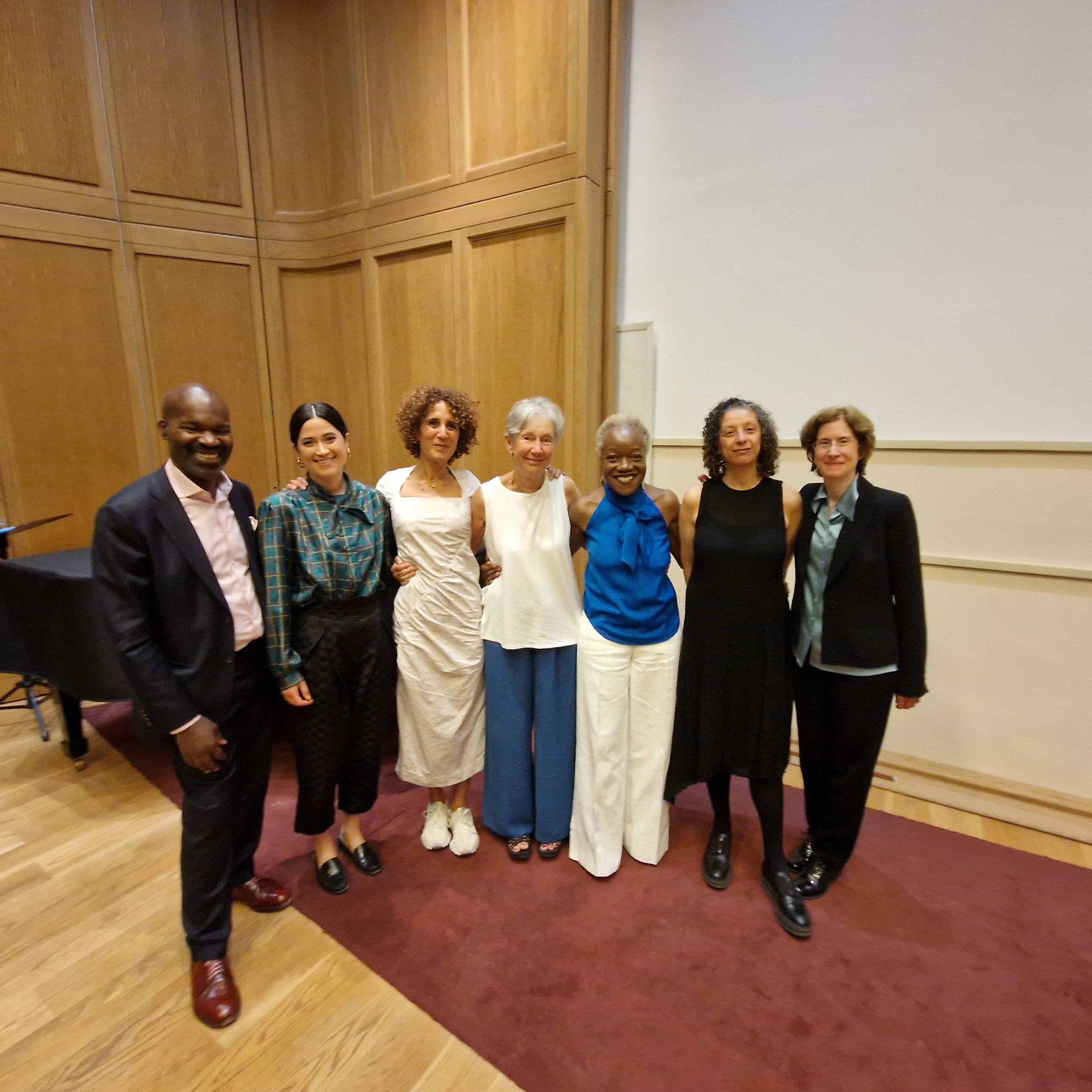
Image: (left to right): David Dibosa, Ruth Ramsden-Karelse, Becky Hall, Catherine Hall, Claudette Johnson, Gilane Tawadros, Julia Walworth.
Related
"Hall constituted his ideas by building tensions"
"Hall constituted his ideas by building tensions"
22nd February 2014 / Article
Stuart Hall: in favour of difference
By: Liv Sovik
Hall constituted his ideas by building tensions
"Hall constituted his ideas by building tensions"
Published in O Globo, “Prosa & Verso” supplement, p.4, Saturday, 22 February 2014 https://blogs.oglobo.globo.com/prosa/post/stuart-hall-favor-da-diferenca-525304.html
Perhaps Stuart Hall would have liked to know that to write about him after his death is to participate in a Bakhtinian polyphony of different voices that talk about him, what he did and said, the impact he had. My favourite homage, at the moment, is an excerpt from the obituary by David Morley and Bill Schwarz, his friends and former students. Published on The Guardian’s website, it was the most read article on the day the professor, theorist and activist, teacher and maître-à-penser died. The article ends by saying:
“When he appeared on Desert Island Discs, Hall talked about his lifelong passion for Miles Davis. He said that the music represented for him ‘the sound of what cannot be’. What was his own intellectual life but the striving, against all odds, to make ‘what cannot be’ alive in the imagination?”
In “What is this ‘black’ in black popular culture?” Hall wrote that “the people of the black diaspora have, in opposition to all that [the logocentric world centred on writing], found the deep form, the deep structure of their cultural life in music.” Hall was doubly diasporic, a descendent of people dislocated by the history of colonization and slavery, and a migrant from Jamaica to England. He pronounced himself in texts as if he were a Miles Davis: playing and collaborating with his partners, doing solos in tune and in contradiction with his context in a complex sound, difficult at first listening but with a freedom that could be admired at each new hearing.
In Brazil, in 2000, a keynote with impact
Hall constituted his ideas by building tensions – I described this process in the preface to a collection of his work, Da diáspora: Identidades e mediações culturais (UFMG, 2003). I said that in “What is this ‘black’…?”, “the question about black identity to which the title refers reverts to critical consideration of dominant ethnicity; black identity is crossed through by other identities, including gender and sexual orientation. Essentialist identity politics point to something worth fighting for, but do not result simply in greater freedom from domination. In this complex context, cultural politics and the struggle that they constitute are waged on many fronts and at every level of culture, including everyday life, popular culture and mass culture. Hall adds a further complicating factor at the end: the commodified and stereotyped medium of mass culture is made up of representations and figures of a great mythical drama with which audiences identify, it is much more an experience of fantasy than of self-recognition.”
It would be difficult to reduce this train of thought to dialectics. Instead, we can think of the way Hall elaborated his thinking as having a musical structure, in which theme and variation can be interrupted by improvisation, a solo can come forth out of a chorus of voices from the bibliography, understood as a source of strength to be mustered to understand different objects – different from the academic habit of negative criticism of predecessors under pain of seeming submissive to them. Maybe it was his way of feeling and elaborating ideas, based on a deep musical structure, that also has to do with Brazilian cultural life, that his work has resonated so strongly here.
The invitation to come Salvador in July 2000 for the conference of the Brazilian Comparative Literature Association was motivated by the organizing committee’s desire to highlight him as a black intellectual with an international impact in a black city, with its black culture, marked by racist oppression, at a time when there was a certain romanticisation of Bahia as the cradle of black Brazilian culture. Hall did not let the audience off the hook: in his lecture he conceived colonization not as an effect of the reach of European hegemony, but as a world historical event, involving “expansion, exploration, conquest, colonization, slavery, economic exploitation and imperial hegemony,” through which Europe “remade itself” starting in 1492. This concept has the effect of shifting the historical focus from modern Europe to global peripheries; instead of celebrating the periphery’s cultural diversity as a useful fruit of globalisation it understands it as the product of refusal and persistence of peoples distant from the metropolis; and identifying western modernity not as the “Universal Rule of Reason”, but the “suturing character of its power” and capacity, as a consequence, to generate differences. In the second place, Hall identified in racism (and in discourses on gender and sexuality) the exception to the rule by which diversity is understood as cultural creation: these discourses manage to naturalize difference more effectively. Thus, in this new dance of thesis and counter-thesis, variation and invention, Hall’s lecture returned to the theme of political responsibilities, which were primordial for him.
The collection of Hall’s work entitled Da diáspora was a consequence of his presence at the conference and came out in 2003, becoming an academic bestseller. I return to what I said before as a refrain: maybe it is because the themes on which he worked starting in the mid-1980s have to do with Brazilian cultural life that his work has resonated so strongly here, for from then on he was explicitly concerned with questions of black identity. For him, affirming the value of a diasporic “Africa”, a black diasporic identity summed up in the word “Africa”, was important in the “decolonization” of “minds in Brixton and Kingston,” of both black English and Jamaican youth. This “Africa” made it possible to talk about the “guilty secret of race […] the unspeakable trauma of the Caribbean” and marked all social movements and creative acts in the Caribbean in the twentieth century. At the same time, Hall was an implacable critic of the supposed biological foundation of differences in – he quoted W.E.B. Dubois – “colour, hair and bone.” For him, the body is read as a kind of text and its “race” can mean different things, depending different circumstances.
A utopian egalitarianism marked his relationships with his own others: people of other racial identities, women, homosexuals, students, young collaborators in the institutions he led, editors of collections of his work. He always remembered that the ideas that racial identity is based on genetic difference and that the subaltern roles of women are biologically determined are analogous in their naturalization of difference. He was always open to issues that did not affect him directly. I was once asked whether Hall was gay: in Brazil, where discrimination is criticised almost solely by its victims, it was impossible to imagine someone who was not gay, but appreciated the queer perspective without distancing himself from it, as he did in a number of articles, such as “The Spectacle of the ‘Other’”.
For Hall, who did not want disciples, intellectual life was lived in hand-to-hand combat with texts and authors, not by belonging to the cohort of one theoretician or another. Talking to him was to enter into a world in which reflections that could have political repercussions were the object, the problem, the game to be played. He welcomed people willing to enter this game and try to understand and project something new. Good humour and affection – and also the combative tone of a discourse within the oral tradition, in which its addressee is always implicitly present – come through in his writings and maybe this has to do with Brazilian cultural life, and constitutes one more reason that his work has resonated so strongly here.
Valuing the other
In the midst of so many, the best homage to Hall may be to avoid hurried agreement on what he thought – for example, understanding in a banal way, as sociability without conflict, the multiculturalism of which he is said to be the father. When someone asked him, at a symposium on culture, globalization and the world-system, held in upstate New York in 1989, if there was such a thing as “humanity”, he said no. When there is talk of humanity and of “everyone being human, in the end,” differences are erased in the name of a hierarchical inclusion, to the benefit of a few. The hope, he said, is that at the moment in which social hierarchy is naturalized in the name of universal humanity, something escapes.
Hall’s hope that the Other can escape reduction to the Same and to the name that the power system attributes to it, as well as the translation of this hope into respect for people in their variety: all of this was part of his charisma, his capacity to generate feelings of friendship and, no doubt, his contribution of images of “what can(not) be”. Herald of the openness of historical processes – he always insisted their results were not predetermined – his thinking was as complex as the sound of Miles Davis. This thought, motivated by the will for a less cruel, a more just future, has to do with Brazilian cultural life, and may be one more reason that Stuart Hall has resonated so strongly here.
""...an experiment in drawing out” the “connections between the ‘life’ and..."
24th September 2020 / Article
Review of Familiar Stranger: A Life Between Two Islands
By: Ruth Ramsden-Karelse
""...an experiment in drawing out” the “connections between the ‘life’ and..."
24th September 2020 / Article
Review of Familiar Stranger: A Life Between Two Islands
By: Ruth Ramsden-Karelse
"...an experiment in drawing out” the “connections between the ‘life’ and ‘ideas’
""...an experiment in drawing out” the “connections between the ‘life’ and..."
24th September 2020 / Article
Review of Familiar Stranger: A Life Between Two Islands
By: Ruth Ramsden-Karelse
Familiar Stranger: A Life Between Two Islands Stuart Hall, with Bill Schwarz (Penguin Books, 2017).
Familiar Stranger: A Life Between Two Islands is “not a memoir in any formal sense” (10), but rather “an experiment in drawing out” the “connections between the ‘life’ and ‘ideas’” of Stuart Hall (63), the enormously influential intellectual whose incisive commentary is sorely missed by many of us living in Britain’s uncertain present. I hope he would have forgiven me for describing him as such: for Hall, the term “intellectual” suggests “too much posturing,” and he explains that although it “doesn’t seem exalted enough for most people,” he prefers to think of himself “as a teacher” (13).
Across nine essays, this characteristically untraditional memoir gives an account of Hall’s existence between entangled colonial and post-colonial worlds, centring on his 1951 journey from colony to metropole: from Kingston, Jamaica to a post-war Britain rife with racism. It gives insight into his life prior to his Directorship of the Birmingham Centre for Contemporary Cultural Studies (and later Professorship of Sociology at Open University). And narrating these first thirty-two years, before he became known as the godfather of multiculturalism, Familiar Stranger maps the early development of Hall’s ground-breaking ideas on cultural theory, through various challenges including stints of generally rather inadequate formal education, and through key partnerships, alliances, and periods of feverish political engagement.
Born in 1932 to a socially-ambitious family with a “fantasy relationship to colonial dependency” (51), Hall was educated alongside future political and literary giants at elite
boys’ school Jamaica College. In the midst of challenges to Colonial rule, Hall details his alienation, from an early age, from the stifling respectability of the Jamaican middle class, the product of “a social system … inflected by the full force of white bias” (63). He arrived in England three years after the Empire Windrush, as a nineteen-year-old Rhodes scholar – a recipient of funding from the Jamaican Government to read English Literature at Merton, “a seductively beautiful place” of “medieval seriousness, solidity and gloom” (156, 155). Of his first meal in College, he remembers thinking that his “survival chances did not look good!” (156)
Upon completing his undergraduate degree, Hall embarked on and then abandoned a graduate thesis on Henry James, and left in a College basement the trunk in which he had brought all his belongings. “I sometimes wonder what became of it,” he writes. “For all I know it’s still there” (155). He did some work for BBC’s Caribbean Voices, crossed paths with V. S. Naipul, and forged friendships with American students, also outsiders at Merton, and others from the Caribbean including George Lamming and working migrants with whom he played jazz piano.
Describing his “rebirth” as “a diasporic subject” caught between “colonial formation” and “anti-colonial sentiments” (171), Hall names the University of Oxford as a key location in which those arriving from places where “colonization had done its divide-and-rule work … came to understand that they were seen by the British as all having the same racial/ethnic identity” (164-165). Ultimately, the “diasporic perspective” provided an “opportunity to change not the answers but the questions” (172). Becoming “seriously committed to critical
ideas” and more actively involved in British politics was, for Hall, “the start of a lifelong intellectual disengagement from Oxford and all it stood for” (223).
In a transforming social landscape, between 1956 and 1964, “‘normal life’ was suspended” by “political activity” (228). Hall gives brief and exciting sketches of early meetings and collaborations with key figures such as Raymond Williams and E. P. Thompson, his involvement in the founding of the New Left political movement, the Universities and Left Review and the New Left Review, and his work with the Campaign for Nuclear Disarmament. It was at a CND march in 1962 that he met Catherine Hall, then Catherine Barrett, before she embarked on her own ground-breaking academic career. He pays tribute to her influence on his own thinking, and explains that “even when we are not actually speaking, I am in perpetual conversation with her and have been for years” (267).
Familiar Stranger ends in 1964, with Stuart and Catherine Hall on the eve of their move to Birmingham, where each would take up university posts. Describing some of the racist abuse they would be targeted with there, as a newly-married couple, Hall draws a parallel with the experiences of his daughter some twenty years later. Reading his memoir, fifty-five years after he moved to Birmingham, Hall’s desire to “change British society, not adopt it” continues to be felt (271). And, happily, his enormous body of writing is still being collected and published, partly in the form of the eponymous series from Duke University Press that includes Familiar Stranger as well as Selected Political Writings, which covers a five-decade period beginning in the year the former ends.
It seems apt that Familiar Stranger, published three years after Hall’s passing, is the product of collaboration with long-term interlocutor and friend Bill Schwarz. Hall’s lifelong commitment to working and writing in partnership is just one aspect of the inspiring model he offers for doing important thinking generously. In that spirit, the text makes frequent direct and indirect reference to some of the scholars and writers who have informed Hall’s thinking, and a list of works cited (including some of Hall’s own) is helpfully included in the appendices. It seems characteristically generous, also, that Hall and Schwarz worked intermittently over a period of two decades to create the material Schwarz has carefully edited into this final volume, which is incredibly rich. Exemplifying Hall’s concern with the relationship between the individual and the collective, it discusses the formation of his ‘life’ and ‘ideas’ as part of broad patterns of historical change: “the social processes of history” (63). It is at once academic and personal; it is often funny and deeply moving.
At a time when his insistence that Britain had never come to terms with colonialism and its legacies is further evidenced daily, we might consider this self-described teacher’s memoir as a lesson of sorts. Our struggles to live in an increasingly-divided Britain should be guided by Familiar Stranger, a product of Hall’s longstanding dedication to carefully grappling with the nature of belonging – “the chaos of identifications which we assemble in order to navigate the social world” (63) – and with his own personal relation to the still-painful entanglement of race, ethnicity, gender and socioeconomic class.
Ruth Ramsden-Karelse Stuart Hall Doctoral Scholar (2017-2020)
28th April 2021
Out Now: Stuart Hall's Selected Writings
We are pleased to announce the release of two new Stuart Hall titles published by Duke University Press: 'Selected Writings on Marxism' edited...
26th July 2021 / Video
Stuart Hall: Selected Writings on Marxism, an online roundtable
26th July 2021 / Video
Stuart Hall: Selected Writings on Marxism, an online roundtable
To mark the publication of Stuart Hall, Selected Writings on Marxism, edited by Gregor McLennan, the Stuart Hall Foundation partnered with...
To mark the publication of Stuart Hall, Selected Writings on Marxism, edited by Gregor McLennan, the Stuart Hall Foundation partnered with publishers Duke University Press to host an online roundtable taking place on Wednesday 30th June. A panel of esteemed authors each presented their response to the book, followed by further exchange and discussion reflecting on Stuart Hall’s political and intellectual relationship to Marxism:
- Gregor McLennan, Professor of Sociology, University of Bristol
- Angela McRobbie Professor of Cultural Studies, Coventry University and Emeritus Professor, Goldsmiths, University of London
- Bruce Robbins, Old Dominion Foundation Professor of the Humanities, Columbia University, New York
- Brett St Louis, Senior Lecturer in sociology, Goldsmiths, University of London
- Chair: Catherine Hall, Emerita Professor of History and Chair of the Centre for the Study of the Legacies of British Slavery, University College London.
Stay connected
Sign up to our newsletter for the latest news, events and opportunities:
Share this