Related
23rd May 2025
Festival of Ideas: an unclassified syncretism
Join intermedia artist Bleue Liverpool, the University of Sussex Stuart Hall Fellow 2025, for a collaboration with musician/sound artist Ibukun...
"what transformative elements of this world exist for its users?"
"what transformative elements of this world exist for its users?"
8th April 2020 / Article
Offline Responses to an Online World
By: Priya Sharma
what transformative elements of this world exist for its users?
This paper focuses on the current theme of offline response that is the result of research conducted on digital identity work and labour amongst queer and female British South Asian Instagrammers. In this context, online space is defined as internet-based social media platforms and offline space refers to the local diaspora community or family in which the participant is embedded.
This quote from Christine Hine speaks to the complex ways in which we navigate our way through these online and offline spaces:
‘ The internet has brought us together in myriad new ways, but still much of the interpretive work that goes on to embed it into people’s lives is not apparent on the Internet itself, as its users weave together highly individualized and complex patterns of meaning out of these publicly observable threads of interaction.’
(Ethnography for the Internet: Embedded, Embodied and Everyday)
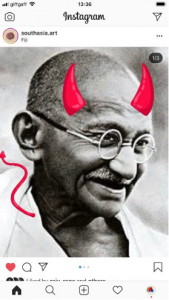
The image above is a screenshot taken from Instagram. It is a doctored image of Gandhi as the devil posted up to an account called SouthAsia Art. This image, along with others on this account are the result of an Indo-Fijian artist’s residency, where she has researched the plight of female South Asian indentured labourers in Fiji and Gandhi’s complicity with the British empire in deciding their fate. The offline conversations and activities that have resulted in this image go some way in highlighting these complex
patterns of meaning that Hine is talking about that aren’t obviously apparent on the internet alone. It would be interesting to gain an insight into the activity being done currently in Fiji around this forgotten history and the meetings and conversations that are taking place amongst the South Asian diaspora there. And it is the uncovering of a working-class female South Asian history, being done by female scholars from the diaspora that is at the heart of the activity behind this image. In this same vein, this research presents an opportunity for young British South Asians who exist outside of male, cis-gendered heteronormativity to reflect on and speak for themselves, about themselves and others who inhabit this online space. Just as the diaspora is recovering its histories, so too should it be allowed to articulate its present.
The decision to analyse participant responses was taken as opposed to analyses of digital content that users put up on their Instagram profiles as a different truth (and albeit one that is rarely researched) was found in participant’s reflections of this digital world. We know that we are beyond the point of the early days of tech utopia and simple empowerment online because the real-world systemic inequalities are perpetuated in the digital world. But what transformative elements of this world exist for its users? What are the limitations and barriers? How could participants explain, in their own words what this world represented to them? And in turn, what would these responses reveal about the wider South Asian diaspora in Britain today?
Thirty years after Stuart Hall’s discussion of ‘new ethnicities’, this paper is an attempt to try and think through the ways in which young female and queer British diaspora communities articulate themselves but also reflect on their digital selves and the issues that are confronted through their responses. Drawing on anonymised interviews conducted with 34 Instagrammers, this study attempts to make visible things that their digital content usually renders invisible.
Instagram is a photo and video sharing smartphone app launched in 2010 that enables an account holder to share content with followers who have chosen to subscribe to their account and vice versa. The particular sphere of Instagram the participants inhabit will be referred to as the South Asian Digital Diaspora space (the SADD space) throughout this paper. It is defined as a networked space that privileges articulations of gender, sexuality and culture through the lens of South Asian diaspora communities.
Many themes and issues were covered by participants in the interviews, but what stood out most were the anxieties and connections that lie behind the accounts within the SADD space. Here are some of the themes that really came to the fore and the ones that will be discussed in this paper:
- The private and public account
- Respectability politics
- Digital space invasion
- Racial neoliberalism
The private and public account
The private and public account theme was a prominent one amongst participants: this is where a user can choose to either make an Instagram account private so when someone clicks onto the account, they can’t see the content and have to put in a request to follow it. It is up to the account holder to grant them access to the content. A public account is open so anyone can view content when they click on the account. One participant talks about having a private account that ends up being infiltrated by what they term a ‘lurking profile’:
“So it’s typically a profile with not many posts at all, they follow more people than they are followed by and there’s often no profile picture and they just lurk and watch people’s stories. One of my friends alerted me coz people were making really homophobic comments about me in WhatsApp chats and I was like ‘oh damn’ I have to be careful. I blocked a lot of people after this and I thought it was a safe space because it was private but apparently it wasn’t. You don’t know whose watching, especially when you’re wanting to further your career and a lot of your art entails themes of queerness, there’s this sense of impending danger that you have lurking somewhere at the back of your mind. I think in one way, while Instagram is good in getting stuff out there, you also expose yourself which is difficult to navigate because you don’t know who’s watching.”
Another participant recently made her profile private after her comments on a photograph of a prominent Muslim Instagrammer sparked some outrage:
“There was an argument going on in somebody else’s comment section, as always! She [this famous instagrammer] wears her headscarf in quite a unique way so you can see a little bit of her hair. Then someone commented, a guy, who clearly didn’t know what he was on about saying ‘this is what fame does to you, you forget your morals, you forget your principles, you don’t wear the hijab correctly’ […] I said ‘that’s funny coming from you coz you’re a male and you don’t know the struggles of covering your hair’ […] he got angry at me and said ‘you don’t wear your hijab properly either’ and at that moment I realised for him to say that he’s seen my pictures on my Instagram […] it made me feel something, unsafe I think […] he’s looking at my photos and using that against me.”
Through these responses, we begin to understand how the public and private functions of the SADD space operate. Trying to articulate the intersections of your identity or defending another person’s can put you at risk. For the first participant, it was an ex-school friend who had created the ‘lurking profile’ – this friend had connections to the participant’s family and so there was risk of the offline world becoming an unsafe space for them. For the second participant, before this negative interaction, her profile had been public for a very long time meaning that the SADD space was where she felt safe. After this interaction, this space became unsafe.
To counter the public profile, private ones are made so there is a secret online life being lived alongside the offline life. This doubling of life isn’t new to those that have grown up in strict, conservative South Asian families, the difference is the detail that goes into this digital life and the constancy of it (you’re always carrying it around with you on your phone), which can create real anxiety for participants. The societal risks that exist within the offline and online South Asian community at large creates a barrier to self-representation for the participants, especially when it comes to issues around gender and sexuality.
Respectability politics
This barrier to self-representation, even when challenged, can remain a barrier, the result being the self-censoring of content. Participants are held up to the politics of respectability in the SAAD space. This participant says:
“I know there’s been cases where my mum’s been like ‘take that down now’ because I’m too exposed, and my mum is very liberal. She’s like ‘your projecting the wrong image out there’ and basically compared me to being a sex worker”
The images we would see on this participant’s profile isn’t how she truly wants to be seen, but how her family will allow her to be seen. What this remark makes visible are these private conversations between parents and offspring that happen behind closed doors and influence the images in the SADD space. Even though this participant describes her mum as very liberal, she tells her daughter that she is projecting the ‘wrong’ image by posting up pictures of herself in what she considers provocative clothing, equating the showing of flesh to sex work, which is very problematic for reasons we don’t have time for today . This participant’s notion of parental liberalism, or her mother’s liberalism, permits her to do things, like wear a short skirt and drink as long as it is done away from the community, that it remains invisible. And that no trace of it exists in the SADD space.
This idea of the ‘wrong image’ is echoed in this participant’s answer:
“I’m not going to say I censor it, but I can very easily choose certain issues that I know spark some kind of outrage within my parents’ communities – I would avoid those deliberately. I’m not gonna talk about my personal life so there’s nothing essentially on my profile that would make people think ‘oh my god, look what your daughter’s doing’. What am I doing? I’m just posting photos, so there’s not really anything wrong that I’m doing.”
This participant subconsciously conflates her personal life with doing something wrong – the personal: i.e: the emotional, the intimate is made to feel wrong in the SADD space, so is best kept invisible.
The SADD space is a space of self-representation that can end up being externally policed by those outside of it, especially when it comes down to articulations of sexuality, gender and lifestyle. One way of making the SADD space safe is to make it private, but even then, as demonstrated earlier, it can be infiltrated. So how can participants navigate these complex online/offline relations with some ease?
Digital space invasion
One participant said that the SADD space gave her the confidence to be more vocal about who is she within her local community:
“I think for the confidence levels and the confidence to be outspoken and political and to kind of take that change and put it back into the community as well. I’ve been able to, rather than living that entirely online, I have been able to take that back out and because I’ve shown that side of myself publicly on the internet, now it’s allowed me to show that person to the people I see in the community who’ve seen it on Instagram.”
There is an awareness that this approach comes with risk of confrontation or worse, but it demonstrates one way that these anxieties can be relieved. This approach comes down to how safe somebody already feels within their offline community.
The popularity of the SADD space goes beyond articulations of self to demonstrate the ways in which participants circumvent the traditional cultural industries, making them space invaders of industries that have historically rejected or compromised the work of British South Asian creatives, as Nirmal Puwar writes:
“As we witness a number of policy initiatives under the banner of ‘diversity’, the ‘guarded’ tolerance in the desire for difference carries in the unspoken small print of assimilation a ‘drive for sameness’. Through these processes the kind of questions that are asked as well as the voices that are amenable to being heard within the regular channels of the art world, academia, or other fields of work, can become seriously stunted.” (Space Invaders: Race, Gender and Bodies Out of Place, 2004)
This digital invasion of the cultural industries has forcibly opened up a space of difference without compromise and industry gatekeeping. One participant runs her business entirely through the SADD space and has relied on it heavily to gain recognition and get work, promoting herself specifically as a South Asian tattoo artist:
“I used my Instagram as my portfolio when I was looking for tattooing apprenticeships, and I was lucky enough to have found the apprenticeships I had because of Instagram. I used to be an apprentice at the studio I now own and they had offered me a job there because they saw and liked my work on Instagram.”
Participants have stated that they have gotten art and writing commissions, exhibitions, collaborations and job opportunities off the back of the SADD space and they also make a point of supporting each other through it:
“I’ve been able to connect with some really lovely people locally because of it and have been able to show up to events that were exclusively advertised on IG and learn about a lot of underrated hyperlocal culture that I felt needed visibility as well.”
Staying culturally true to yourself, connecting with others like you, not giving in to dominant whiteness and still financially succeeding by way of bypassing traditional gatekeepers is undeniably empowering for members of the SADD space.
Racial neoliberalism
However, it could be argued that this space, as a social media platform could be described as a cultural industry, whereby the processes of cultural production of British South
Asian identity are not without their problems. Under the racial neoliberal address, there is a call for a shift from the politics of representation to a politics of production (Anamik Saha, Race and the Cultural Industries, 2018), the constraints of which appear largely invisible within the SADD space. On a platform like Instagram, you can feel like you are in control of the processes of production behind your self-representation without having to question it further. This is a platform that has approached participants to sell products, that exists on an economy of likes and sponsorship deals and I think to not interrogate these processes of capitalist production further is to do a disservice to Stuart Hall’s conception of a politics of representation – we mustn’t forget the political. When we do, we begin to see the essentialising effects of the neoliberal processes of production, churning out what we believe to be our own truths, as one participant puts it:
“There’s this South Asian monolithic nation project happening out there which I think is something that I’m quite cautious about because I think that growing up in this country, a lot of South Asians, you’re growing up with loads of people from diasporas and to self – exoticise yourself sometimes because it does go to that at points, there is a real risk because with this collective consciousness which is coming about on Instagram, there is a convergence of more niche people into this bigger aesthetic in order to get recognition to be a part of that project.”
The convergence of South Asian religious and ethnic identities within the SADD space (usually Hindu/Punjabi and middle-class), removes the potential for a radical politics of representation, but this essentialism is not lost on some participants who inhabit the SADD space, which is promising.
Conversely, these processes of production are significant to users because the aforementioned religious and patriarchal barriers present much more of an oppression compared to that of capitalist neoliberal processes of production, which offer a type of safety and freedom to allow participants to be honest without major consequence. As recognised by some participants, these neoliberal forms of self-representation do not offer a long-term solution to systemic oppressions, but it also cannot be denied that the SADD space can be an affirming space for many of its users; this positive response from one participant is a reminder that ultimately we are all searching for ways to belong:
“It makes so much difference to know there are also other south Asians living alternative lifestyles, helping and supporting one another. Giving visibility to and sharing content from these accounts is important to me because I’m trying to be the person I needed when I was younger.”
Let Our Statues Speak
Let Our Statues Speak is a multi-part, collaborative project, which began in September 2018. Instigated to spark a wide-ranging investigation...
Share this