9th September 2026 / Article
Reflections: Ruth Ramsden-Karelse on the SHF Peer Network Forums
By: Ruth Ramsden-Karelse
The Stuart Hall Foundation Peer Network online monthly forums provide a regular opportunity for members to connect, exchange ideas and support one another. SHF Associate and Peer Network member Ruth Ramsden-Karelse details her experience facilitating these forums below.
Since January 2023, I’ve facilitated virtual monthly forums for researchers and artists whose work has, like mine, been made possible by scholarships and fellowships that the Stuart Hall Foundation offers in partnership with institutions across the UK and beyond.
When I started my DPhil in 2017, I was honoured to receive a Stuart Hall scholarship. Four years later, on the eventual other side of that doctoral research, I was delighted to become one of the Foundation’s Associates: new roles designed to support the work of the Trustees and ensure input and representation across career stages. As an Associate, I’ve sat on the Foundation’s Academic Committee and worked with my colleagues to support our growing network of Stuart Hall scholars, fellows, and artists-in-residence.
As a member of that network myself, I formed connections that continue to shape and enrich my work in meaningful ways. Higher education is typically atomising, and for minoritised scholars and those invested in social justice, finding community is particularly important. Opportunities to gather and speak with other network members and Trustees always highlighted the Foundation’s biggest strength: a community of scholars, cultural workers, and organisers, spanning Master’s students to Professors, and ranging from child psychoanalysts and sociologists to poets and musicians, whose interests, investments, and political engagements reflect the rich diversity of Stuart Hall’s own.
Our monthly forums aim to harness precisely that strength. In addition to three annual in-person events, these virtual meetings offer network members a more regular space to gather, meet, and catch up with each other, with myself, and with our Director, Orsod. Attendees air challenges, share resources, and offer support and encouragement. Topics of discussion build on each other, and often relate to current events, ranging from abolition, to the connections between arts and academia, to what it might mean to be an organic intellectual. A few forums have taken the form of workshops facilitated by network members—by Lola Olufemi on writing as a response to political violence and by Subira Joy on killing the cop inside our heads, for example.
With these forums, we try to put into practice in some small way the model offered by Stuart Hall: by centring collaboration, knowledge sharing, and thinking and learning together; by committing to the necessary, continual practice of having the difficult conversations and acting on them; and by taking seriously our political commitments, while trying not to take ourselves too seriously.
– Ruth Ramsden-Karelse, July 2026
Related
"On Friday 22nd March 2024, we invited members of the SHF Peer Network and..."
6th June 2024 / Article
Reflections: CJ Simon on the Anti-Racist Scholar Activism Workshop
By: CJ Simon
"On Friday 22nd March 2024, we invited members of the SHF Peer Network and..."
6th June 2024 / Article
Reflections: CJ Simon on the Anti-Racist Scholar Activism Workshop
By: CJ Simon
On Friday 22nd March 2024, we invited members of the SHF Peer Network and the CoDE ECR (Centre on the Dynamics of Ethnicity Early Career...
"Ahead of the 8th Annual Stuart Hall Public Conversation in May 2025, our..."
7th November 2025 / Article
Reflections: Eleanor Beaton on the SHF Peer Network Spring Workshop with Françoise Vergès
By: Eleanor Beaton
"Ahead of the 8th Annual Stuart Hall Public Conversation in May 2025, our..."
7th November 2025 / Article
Reflections: Eleanor Beaton on the SHF Peer Network Spring Workshop with Françoise Vergès
By: Eleanor Beaton
Ahead of the 8th Annual Stuart Hall Public Conversation in May 2025, our network of creative and intellectual practitioners gathered at Conway...
17th December 2025 / Images
Reflections: Bleue Liverpool on an unclassified syncretism
By: Bleue Liverpool
17th December 2025 / Images
Reflections: Bleue Liverpool on an unclassified syncretism
By: Bleue Liverpool
On Friday 23rd May, 2025 University of Sussex Stuart Hall Fellow Bleue Liverpool presented new work at the Brighton Festival as part of her...
17th December 2025 / Image
Reflections: Bleue Liverpool on an unclassified syncretism
By: Bleue Liverpool
On Friday 23rd May, 2025 University of Sussex Stuart Hall Fellow Bleue Liverpool presented new work at the Brighton Festival as part of her Fellowship. Bleue collaborated with musician and sound artist Ibukun Sunday to create ‘an unclassified syncretism’, an audio-visual intervention within the Meeting House Chapel at the University of Sussex. Through this event, the duo sought to composite metaphysical abstractions of Paul Gilroy with research into migration narratives and landscapes of south-east English Channel coastline port culture. The event was part of the Festival of Ideas, a collaboration between the Faculty of Media, Arts and Humanities at the University of Sussex and Brighton Festival.
Bleue Liverpool shares reflections on her experience of the collaboration below, alongside production photographs of the audio-visual work plus a new text building upon the themes of project.
– So what do we know ?
– You mean, what are we willing to tell ?
Well, we know that the practice of syncretism in the 18th century Afro-Caribbean, enabled the subjugated to insurgently gather, speak, & remember – right under the gaze of the colonial eye. We’re aware that our ancestors, ambitious as they were, on the night of the 14th of August 1791, came together in ritual that embedded West African Vodou resistance – a legacy of the Fon Kingdom – into appropriated Christian systems and iconography. Allegedly the appropriation of the Catholic Church’s appliances deeply disturbed colonial administrators, whom were utilizing the system to “civilize”, “assimilate”, “commodify” our ancestors’ dignity. Subsequently, this ritual and a carefully calculated eclipse brought on a rebellion – sugar everywhere – a rupture, in the politics, that made a case of Identity.
– But Ibukun, you’re from that port Lagos, in Nigeria… South North Atlantic?
– Yes
– Me too, from a port, in the North North Atlantic…
– Yes
– A Pan-African conversation when we gather, no? when we commune?
– Yep… it’s old & ongoing
– What is?
– The conversation
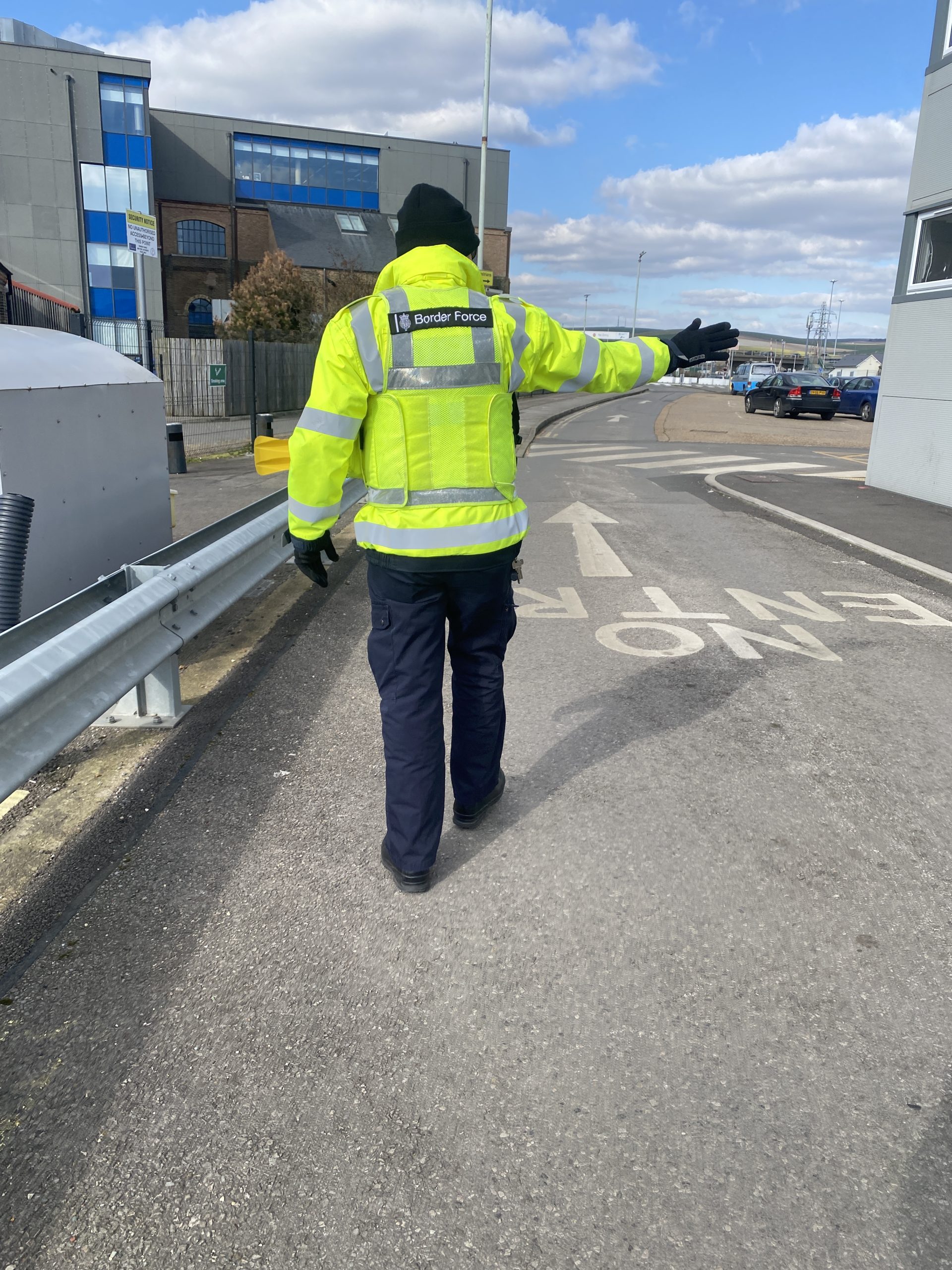
The ports of Calais, Dover, Newhaven Port and Dieppe have had a great deal of increased activity in the 21st century. They are coming, the Others, moving from east to west, using container lorries in any attempt to flee civil rights atrocities, seeking employment, a better life than history. The border-industrial complex is having a field day, acquiring oxygen detectors, attempting to catch whomever before land. Asylum claims are easily accumulated, strategically neglected, and ultimately unclassified – leaving the politics to place the Others in Hotels. They stay in these hotels sometimes for years, a room for a family, unable to seek employment, without access to fundamental natural law actions e.g. cooking for oneself. These hotels, conduits, elongated liminal spaces forge new identities, the nature oscillates in spite of fixity.
– a form of syncretism?
– Yep
In a cafe around Waterloo, down a spiral staircase to a basement that could easily recreate London’s Great Fire of 1666, he comes to my table slowly but densely. “The word “race” was utilized in the same way that in our contemporary the word “culture” is used. That the project of cultural studies is a more or less attractive candidate for institutionalization. The national character ascribed to the concept of modes of production is a fundamental question, ethnohistorical specificity of dominant approaches of cultural politics. That what was initially felt to be a curse – the curse of homelessness or the curse of enforced exile gets repossessed. It becomes affirmed and is reconstructed as the basis of a privileged standpoint.”[1] I ask him if slavery was integral to the economic fruition of western civilization, how is the western world economically dependent on asylum seekers despite nationalism?
– Our inflections transfigure West to East, North to South.
– Yea… Of course.
– We need to find axis points.
– hmm
– Where do we gather to speak?
– They have Churches.
– Yes Ibukun, they have Churches.
As an Intermedia artist, collaboration has become an integral improvisational utility in circumventing a collective memory. By facilitating Pan-African conversations that take on unorthodox and unconventional mediums – such as sound and video artistic experimentation – new sonic-visual methodology is spontaneously generated that perhaps gives insight on not only acts of resistance but on cultural preservation. What was most appreciated on my side was that the Stuart Hall Foundation gave Ibukun and I the opportunity to come together finally for what will be a ongoing collaboration. In addition, the opportunity to wander, with naïveté, around the coast of South-East Sussex with nothing more than a handi-cam, generously provided by the media department of the University of Sussex, was pivotal. The camera gave me permission to wander, and that in itself from the position of my specific identity: revolutionary.
– Bleue Liverpool, November 2025
[1] Paul Gilroy, The Black Atlantic, The Black Atlantic: Modernity and Double Consciousness (Harvard University Press 1993)
View a video excerpt of ‘an unclassified syncretism’ below.
"Ahead of the 9th Annual Stuart Hall Public Conversation in May 2026, our..."
9th September 2026 / Article
Reflections: Konstantin Helm on the SHF Peer Network Spring Workshop with Fred Moten
By: Konstantin Helm
"Ahead of the 9th Annual Stuart Hall Public Conversation in May 2026, our..."
9th September 2026 / Article
Reflections: Konstantin Helm on the SHF Peer Network Spring Workshop with Fred Moten
By: Konstantin Helm
Ahead of the 9th Annual Stuart Hall Public Conversation in May 2026, our network of creative and intellectual practitioners gathered at Conway...
Share this